I’m experimenting in democracy by running for Mayor for Honolulu. I don’t collect donations from Lobbyists or PACs.
The incumbent Mayor Rick Blangiardi has a war-chest of about $1.7 Million. Not only does he have the vast resources of his Office to campaign from, he has the money to buy TV ads and mass mail out to throughout the island of Oahu.
I don’t have that resources because I’m campaigning on the premise that money must not control our political campaigns. I tell people they don’t need to donate but to consider voting for me and to tell their friends.
FACEBOOK is my FREE social media to share with my friends. Here is a post (recollected) I shared this morning.
#honolulumayor2024: How is Status Quo benefitting us? The Oligarchy makes it a big deal that you have to be Macho Man to be a Mayor. That’s so patronizing.
The Truth is it’s the 10,000 hardworking employees at City Hall who do the work daily. The Mayor can go on a long vacation and he will not be missed except for a few needed signatures :=))
The Mayor sets the tone and culture at City Hall. I want to be the Mayor who puts Residents First!I do not collect donations from Lobbyists or PACs.
I understand that there is pressure. Some of you have pending contracts or grants. Those will not change. You don’t have to reveal who you vote for. #ResidentsFirst. “
But several hours later, I received this message from FACEBOOK META.
Message #1
Message #2 I requested a review.
Message #3 Of course, we’re talking to the Meta Universe out there.
Message #4
In the meanwhile, the post is gone. Whether this same post will be restored is a guess.
And you can see why people can suspicious of censorship and dirty tricks. Generally Facebook posts can be reported. If enough people report, Facebook Meta will automatically shut you down. Facebook warnings or “Jail Time” can last for a while. Sometimes, it’s 24 hours or 6 days or a month. I’ve known of others who last long
This 2024 Presidential Elections offers a rare opportunity for the American public, students, and concerned citizens to be inspired and educated by Robert F. Kennedy, Jr. – – a walking encyclopedia of the US Constitution and American/World History and Affairs.
“The Constitution is more than a legal document. It’s meant to inspire us. It’s a recital of the most fundamental moral truths that govern human conduct. It reminds us of the central proposition that only under a system that maximizes the personal freedoms that God intended for us when He gives us Free Will can we achieve our potential for creativity, the prosperity the ultimate elevation for the Human Spirit.The Constitution embodies the very soul of our nation as first invoked in the Declaration of the Independence. I get goose bumps when I read the words.” Robert F. Kennedy, Jr.
This is worth the time to listen to his speech shared on May 24, 2024 at the Libertarian Convention. We would be so lucky to have Kennedy at the White House with his brilliance and skills and mindset.
Despite overwhelming public testimony against this rushed and disjointed Land-Use sea-change from the most affected residents in Hawaii, the legislators quickly adopted this zoning to increase density for ALL Hawaii counties.
This was a last-minute attempt to disclose to the public about this Bill.
SOCIAL MEDIA’S FAST & EASY FALLACIES APPROACH TO PUBLIC POLICIES:
On the other hand, there was social media by interest groups circulated to those who hope for “affordable housing.” Share whatever is in your mind. No vetting needed. Ah! Creating a seismic land-use change is so simple; you do not consider all the multiplier impacts on Hawaii residents. Who cares about inviting more real estate speculators and investors to compete with local residents?
Interesting, I was warned by a California land-use planner about the trend to decimate single family and it was coming to Hawaii soon. That was about five years ago.
California pushed it and here is the recent court answer to rouge legislators who squashed single-family zoning.
April 29, 2024 3 AM PT
” A Los Angeles County Superior Court judge has ruled that a landmark law ending single-family-home-only zoning in California is unconstitutional, a decision that could lead to the law being invalidated in the state’s largest cities.
Judge Curtis Kin determined that Senate Bill 9 does not provide housing restricted for low-income residents and therefore cannot override state constitutional protections afforded to local zoning practices.”
CHATTER CIRCULATING AROUND
There was chatter circulating that increasing the density will pass. Rumors were circulating around that Senator Brian Schatz has met with local politicians and every one should fall in line for this “progressive” idea.
Senator Stanley Change and House Representative Luke Evlslin championed this process.
BACK TO TODAY AT THE STATE CAPITOL:
Scroll to 5:03 video of today’s hearing at the House of Representatives. (By the way, these hearings do not appear on the Olelo Public Access Television anymore. It’s on the Capitol’s own channel that requires ONLINE capabilities. Many residents, especially the kupuna sector, are not connected.)
April 26, 2024, the Committee Report said it has a FULL & FREE discussion. But it doesn’t say that the merits and the demerits were fully and freely discussed and analyzed.
Hawaii Residents should not have to spend time trying to explain and convince the decision makers that SB3202 is problematic and deficient.
Lawmakers must disclose such seismic land-use hijacking to their most-affected constituents first. So far, it’s been a well-kept secret. But the rush is on to adopt this bill.
This STATE bill subverts COUNTY HOME RULE. It’s the Counties which manage and enforce the Land-Use Comprehensive Plans or Community Plans and so on. These plans requires public hearings and public participation. These processes take months and years.
Senator Stanley Chang from Oahu and Representative Luke Evslin sponsored SB3202 and HB1630. They expect to adopt this within four short months with hardly any public participation or disclosures. They’re both on the ballot this year.
Long-story short, the bills upends Hawaii’s residential landed properties zoned Residential 3.5, Residential 5, Residential 7.5, Residential 10, Country in the name of “affordable housing” :
To allow a dwelling on every 2,000 square feet of land.
To allow subdivision of these 2,000 square feet of land.
It’s that “simple”. If they are allowed to subdivide and build, they can “keep families together” and fill the “missingMiddle” gap, so the supporters say.
Read the written testimonies submitted by the usual development lobbyists, non-profits, building industries and related commerce. The supporters this time around included Real Estate Escrow Company, a Aloha Shirt Company and so on. It’s a view into who’s connected to who in Hawaii.
When a small segment of the public caught wind of it, there are more opinions from the frontline and the most affected. It’s interesting to scroll down. There are some very thoughtful insights and warnings. But they do not appear to cause some legislators to pause and think deeper.
This is the video of the April 1, 2024 hearing on SB3202. It’s understandable to expect special interests lobby for their own industry or personal interests.
But it’s alarming to see those in public offices not thoughtfully and dutifully represent the public interests i.e. Hawaii’s residents.
One example: Scroll to 1:49 to listen for a few minutes to this Hawaii County Planner. He obviously disses the elected Hawaii County Council but claims “I’m very much a Home Rule guy.” Who hired this guy?
There is whole lot more to discuss. But here’s an extremely brief poster about SB3202. It’s alarming that taxpayers will always be responsible for crappy malfeasance if the legislators push this Bill through on May 1, 2024.
I urge you to speak up. You have to protect yourself and your own future in Hawaii.
EMAIL and tell them your opinions. Or simply say “OPPOSE HAMMAJANG SB3202”.
The evacuation of 379 JAL 516 flight passengers in such an orderly and calm fashion reflects the same social culture that stayed behind to clean up after in the 2022 World Cup in Qatar.
TOKYO — A Japan Airlines plane collided with a Japan Coast Guard aircraft while landing at Tokyo’s Haneda Airport on Tuesday evening, forcing hundreds of passengers to escape before the jetliner was engulfed in flames.
Television footage showed the plane burning on the runway. The aircraft was an Airbus A350 operating as flight 516 from New Chitose Airport, which serves Sapporo on the country’s northern island of Hokkaido.
According to JAL, all of the nearly 400 passengers and crew made it out of the aircraft. Japanese public broadcaster NHK reported that at least 17 people on the flight were injured.
Police said five of the six crew members on the Coast Guard aircraft were killed, while the captain is in serious condition.
More videos:
Imagine there is no stampede in this situation. You can see the passengers seated still while the flames can be seen outside the windows.
This video is worth watching for those interested in more information. The cabin crew, pilots and passengers were nothing but remarkable.
Some news media described it as “obedience”. A better word would be “cooperation”. There was no stampede or chaos. They followed the cabin crew. This domestic Airbus plane passengers cooperated and helped by not panicking, not taking baggages and cooperating.
Here’s another perspective from a foreign passenger.
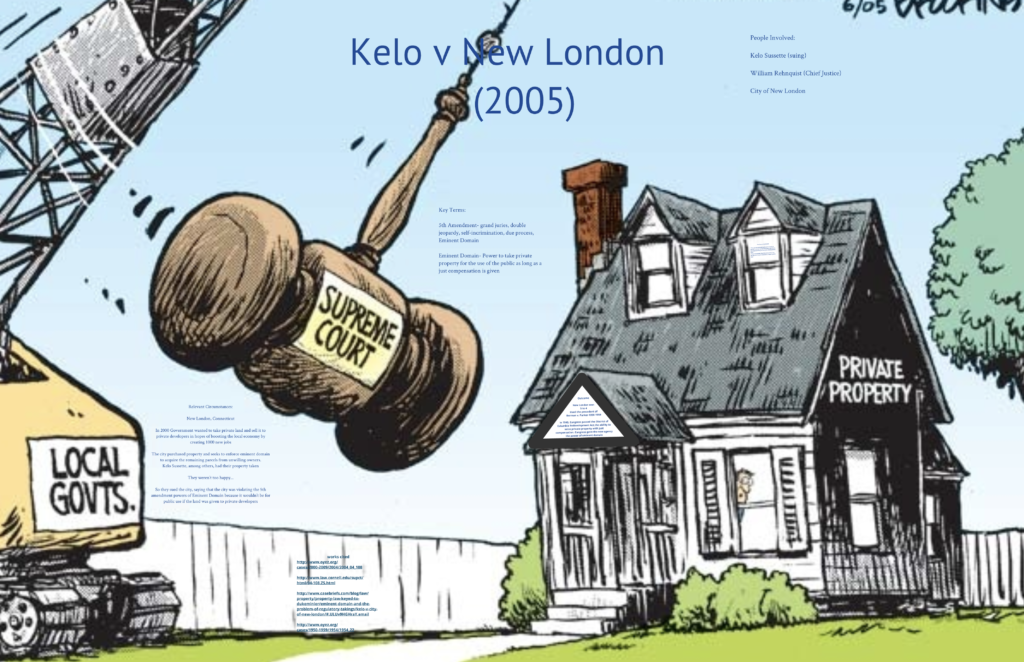
Here is the landmark case about private property rights. Sandra Day O’Connor was right all along.
On June 23, 2005, the Supreme Court ruled in a 5–4 decision in favor of the City of New London. Justice John Paul Stevens wrote the majority opinion, joined by Justices Anthony Kennedy, David Souter, Ruth Bader Ginsburg, and Stephen Breyer.
Dissenting: Sandra Day O’Connor, Anthony Scalia, William Rehnquist, and Clarence Thomas
Up to today, the Sandra Day O’Connor was right. Corporate Pfizer did not even build after pushing the entire neighborhood out with the weight of its powerful allies and cronies.
Kelo v. City of New London, 545 U.S. 469 (2005)
Docket No.04-108
Granted:September 28, 2004
Argued:February 22, 2005
Decided:June 23, 2005
Annotation
PRIMARY HOLDING
Economic benefits are a permissible form of public use that justifies the government in seizing property from private citizens.
FACTS
Susette Kelo and other private property owners in the city of New London, Connecticut sued the city for an alleged abuse of its eminent domain power. The city government had condemned privately owned real estate within its boundaries and transferred it to the New London Development Corporation, a private entity, for a comprehensive redevelopment plan.
The plaintiffs grounded their claim on an argument that the city’s stated purpose of economic development was not a public use, as required to exercise the eminent domain power under the Fifth Amendment. However, a state law provided that economic development was a public use.OPINIONS
Majority
John Paul Stevens (Author)
Anthony M. Kennedy
David H. Souter
Ruth Bader Ginsburg
Stephen G. Breyer
Stevens continued the Court’s ongoing trend of finding that a public purpose constituted a public use, and he did not find any requirement that the city rather than a private entity pursue that public purpose. Even though the urban area was not blighted, and no social harm was threatened, the city was justified in trying to improve its tax base by attracting wealthier property owners.
Concurrence
Anthony M. Kennedy (Author)
It is important to note that this concurrence is not binding, since Kennedy joined the majority opinion. However, he felt it appropriate to provide clearer guidance on how to review challenges to the eminent domain power under the Fifth Amendment. Rational basis is the proper level of scrutiny to apply here, which requires a rational relationship to a legitimate government purpose. Kennedy suggested that it should be interpreted in a highly fact-specific manner and that defining the government purpose should be left to a trier of fact. Among factors for courts to consider, according to this view, are whether the private developer would benefit more than the city, whether the city had committed public funds before identifying the private beneficiaries, whether the government had engaged in a good-faith review of development alternatives, whether the government could supply evidence regarding the depressed economic conditions, and whether the government was unaware of private beneficiaries beyond the developer at the time that it decided on the plan.
Dissent
Sandra Day O’Connor (Author)
William Hubbs Rehnquist
Antonin Scalia
Taking a pragmatic view of the decision’s impact, O’Connor argued that it would encourage cities to take away property from impoverished residents and distribute it among wealthy developers and prospective residents. This is because they have greater influence over the political process and can subvert it to create inequalities.
Dissent
Clarence Thomas (Author)
Thomas was not persuaded by the majority’s identification of a public purpose with a public use, which he found was not supported by the Fifth Amendment from a textualist perspective.CASE COMMENTARY
This decision was widely controversial and unpopular among the public, but it was not as startling as people may have believed. The Court’s conflation of public use with public purpose had appeared in earlier decisions on eminent domain as well. Many observers found this outcome more unpalatable, however, since the city was essentially using its power to remove lower middle class property owners and seek wealthier residents, rather than trying to remedy social ills as in the older cases.
As it turned out, the corporation never managed to get the funding for the redevelopment plan and left the property abandoned as an empty lot. None of the jobs or the other economic benefits materialized as Pfizer, the principal beneficiary of the project, changed its plans.
O’CONNOR, J., DISSENTING KELO V. NEW LONDON 545 U. S. ____ (2005) SUPREME COURT OF THE UNITED STATES NO. 04-108
SUSETTE KELO, et al., PETITIONERS v. CITY OF NEW LONDON, CONNECTICUT, et al. on writ of certiorari to the supreme court of connecticut [June 23, 2005] Justice O’Connor, with whom The Chief Justice, Justice Scalia, and Justice Thomas join, dissenting. Over two centuries ago, just after the Bill of Rights was ratified, Justice Chase wrote: “An act of the Legislature (for I cannot call it a law) contrary to the great first principles of the social compact, cannot be considered a rightful exercise of legislative authority … . A few instances will suffice to explain what I mean… . [A] law that takes property from A. and gives it to B: It is against all reason and justice, for a people to entrust a Legislature with such powers; and, therefore, it cannot be presumed that they have done it.” Calder v. Bull, 3 Dall. 386, 388 (1798) (emphasis deleted). Today the Court abandons this long-held, basic limitation on government power. Under the banner of economic development, all private property is now vulnerable to being taken and transferred to another private owner, so long as it might be upgraded—i.e., given to an owner who will use it in a way that the legislature deems more beneficial to the public—in the process. To reason, as the Court does, that the incidental public benefits resulting from the subsequent ordinary use of private property render economic development takings “for public use” is to wash out any distinction between private and public use of property—and thereby effectively to delete the words “for public use” from the Takings Clause of the Fifth Amendment. Accordingly I respectfully dissent. I Petitioners are nine resident or investment owners of 15 homes in the Fort Trumbull neighborhood of New London, Connecticut. Petitioner Wilhelmina Dery, for example, lives in a house on Walbach Street that has been in her family for over 100 years. She was born in the house in 1918; her husband, petitioner Charles Dery, moved into the house when they married in 1946. Their son lives next door with his family in the house he received as a wedding gift, and joins his parents in this suit. Two petitioners keep rental properties in the neighborhood. In February 1998, Pfizer Inc., the pharmaceuticals manufacturer, announced that it would build a global research facility near the Fort Trumbull neighborhood. Two months later, New London’s city council gave initial approval for the New London Development Corporation (NLDC) to prepare the development plan at issue here. The NLDC is a private, nonprofit corporation whose mission is to assist the city council in economic development planning. It is not elected by popular vote, and its directors and employees are privately appointed. Consistent with its mandate, the NLDC generated an ambitious plan for redeveloping 90 acres of Fort Trumbull in order to “complement the facility that Pfizer was planning to build, create jobs, increase tax and other revenues, encourage public access to and use of the city’s waterfront, and eventually ‘build momentum’ for the revitalization of the rest of the city.” App. to Pet. for Cert. 5. Petitioners own properties in two of the plan’s seven parcels—Parcel 3 and Parcel 4A. Under the plan, Parcel 3 is slated for the construction of research and office space as a market develops for such space. It will also retain the existing Italian Dramatic Club (a private cultural organization) though the homes of three plaintiffs in that parcel are to be demolished. Parcel 4A is slated, mysteriously, for “ ‘park support.’ ” Id., at 345–346. At oral argument, counsel for respondents conceded the vagueness of this proposed use, and offered that the parcel might eventually be used for parking. Tr. of Oral Arg. 36. To save their homes, petitioners sued New London and the NLDC, to whom New London has delegated eminent domain power. Petitioners maintain that the Fifth Amendment prohibits the NLDC from condemning their properties for the sake of an economic development plan. Petitioners are not hold-outs; they do not seek increased compensation, and none is opposed to new development in the area. Theirs is an objection in principle: They claim that the NLDC’s proposed use for their confiscated property is not a “public” one for purposes of the Fifth Amendment. While the government may take their homes to build a road or a railroad or to eliminate a property use that harms the public, say petitioners, it cannot take their property for the private use of other owners simply because the new owners may make more productive use of the property. II The Fifth Amendment to the Constitution, made applicable to the States by the Fourteenth Amendment, provides that “private property [shall not] be taken for public use, without just compensation.” When interpreting the Constitution, we begin with the unremarkable presumption that every word in the document has independent meaning, “that no word was unnecessarily used, or needlessly added.” Wright v. United States, 302 U. S. 583, 588 (1938). In keeping with that presumption, we have read the Fifth Amendment’s language to impose two distinct conditions on the exercise of eminent domain: “the taking must be for a ‘public use’ and ‘just compensation’ must be paid to the owner.” Brown v. Legal Foundation of Wash., 538 U. S. 216, 231–232 (2003). These two limitations serve to protect “the security of Property,” which Alexander Hamilton described to the Philadelphia Convention as one of the “great obj[ects] of Gov[ernment].” 1 Records of the Federal Convention of 1787, p. 302 (M. Farrand ed. 1934). Together they ensure stable property ownership by providing safeguards against excessive, unpredictable, or unfair use of the government’s eminent domain power—particularly against those owners who, for whatever reasons, may be unable to protect themselves in the political process against the majority’s will. While the Takings Clause presupposes that government can take private property without the owner’s consent, the just compensation requirement spreads the cost of condemnations and thus “prevents the public from loading upon one individual more than his just share of the burdens of government.” Monongahela Nav. Co. v. United States, 148 U. S. 312, 325 (1893); see also Armstrong v. United States, 364 U. S. 40, 49 (1960). The public use requirement, in turn, imposes a more basic limitation, circumscribing the very scope of the eminent domain power: Government may compel an individual to forfeit her property for the public’s use, but not for the benefit of another private person. This requirement promotes fairness as well as security. Cf. Tahoe-Sierra Preservation Council, Inc. v. Tahoe Regional Planning Agency, 535 U. S. 302, 336 (2002) (“The concepts of ‘fairness and justice’ … underlie the Takings Clause”). Where is the line between “public” and “private” property use? We give considerable deference to legislatures’ determinations about what governmental activities will advantage the public. But were the political branches the sole arbiters of the public-private distinction, the Public Use Clause would amount to little more than hortatory fluff. An external, judicial check on how the public use requirement is interpreted, however limited, is necessary if this constraint on government power is to retain any meaning. See Cincinnati v. Vester, 281 U. S. 439, 446 (1930) (“It is well established that … the question [of] what is a public use is a judicial one”). Our cases have generally identified three categories of takings that comply with the public use requirement, though it is in the nature of things that the boundaries between these categories are not always firm. Two are relatively straightforward and uncontroversial. First, the sovereign may transfer private property to public ownership—such as for a road, a hospital, or a military base. See, e.g., Old Dominion Land Co. v. United States, 269 U. S. 55 (1925); Rindge Co. v. County of Los Angeles, 262 U. S. 700 (1923). Second, the sovereign may transfer private property to private parties, often common carriers, who make the property available for the public’s use—such as with a railroad, a public utility, or a stadium. See, e.g., National Railroad Passenger Corporation v. Boston & Maine Corp., 503 U. S. 407 (1992); Mt. Vernon-Woodberry Cotton Duck Co. v. Alabama Interstate Power Co., 240 U. S. 30 (1916). But “public ownership” and “use-by-the-public” are sometimes too constricting and impractical ways to define the scope of the Public Use Clause. Thus we have allowed that, in certain circumstances and to meet certain exigencies, takings that serve a public purpose also satisfy the Constitution even if the property is destined for subsequent private use. See, e.g., Berman v. Parker, 348 U. S. 26 (1954); Hawaii Housing Authority v. Midkiff, 467 U. S. 229 (1984). This case returns us for the first time in over 20 years to the hard question of when a purportedly “public purpose” taking meets the public use requirement. It presents an issue of first impression: Are economic development takings constitutional? I would hold that they are not. We are guided by two precedents about the taking of real property by eminent domain. In Berman, we upheld takings within a blighted neighborhood of Washington, D. C. The neighborhood had so deteriorated that, for example, 64.3% of its dwellings were beyond repair. 348 U. S., at 30. It had become burdened with “overcrowding of dwellings,” “lack of adequate streets and alleys,” and “lack of light and air.” Id., at 34. Congress had determined that the neighborhood had become “injurious to the public health, safety, morals, and welfare” and that it was necessary to “eliminat[e] all such injurious conditions by employing all means necessary and appropriate for the purpose,” including eminent domain. Id., at 28. Mr. Berman’s department store was not itself blighted. Having approved of Congress’ decision to eliminate the harm to the public emanating from the blighted neighborhood, however, we did not second-guess its decision to treat the neighborhood as a whole rather than lot-by-lot. Id., at 34–35; see also Midkiff, 467 U. S., at 244 (“it is only the taking’s purpose, and not its mechanics, that must pass scrutiny”). In Midkiff, we upheld a land condemnation scheme in Hawaii whereby title in real property was taken from lessors and transferred to lessees. At that time, the State and Federal Governments owned nearly 49% of the State’s land, and another 47% was in the hands of only 72 private landowners. Concentration of land ownership was so dramatic that on the State’s most urbanized island, Oahu, 22 landowners owned 72.5% of the fee simple titles. Id., at 232. The Hawaii Legislature had concluded that the oligopoly in land ownership was “skewing the State’s residential fee simple market, inflating land prices, and injuring the public tranquility and welfare,” and therefore enacted a condemnation scheme for redistributing title. Ibid. In those decisions, we emphasized the importance of deferring to legislative judgments about public purpose. Because courts are ill-equipped to evaluate the efficacy of proposed legislative initiatives, we rejected as unworkable the idea of courts’ “ ‘deciding on what is and is not a governmental function and … invalidating legislation on the basis of their view on that question at the moment of decision, a practice which has proved impracticable in other fields.’ ” Id., at 240–241 (quoting United States ex rel. TVA v. Welch, 327 U. S. 546, 552 (1946)); see Berman, supra, at 32 (“[T]he legislature, not the judiciary, is the main guardian of the public needs to be served by social legislation”); see also Lingle v. Chevron U. S. A., Inc., 544 U. S. __ (2005). Likewise, we recognized our inability to evaluate whether, in a given case, eminent domain is a necessary means by which to pursue the legislature’s ends. Midkiff, supra, at 242; Berman, supra, at 103. Yet for all the emphasis on deference, Berman and Midkiff hewed to a bedrock principle without which our public use jurisprudence would collapse: “A purely private taking could not withstand the scrutiny of the public use requirement; it would serve no legitimate purpose of government and would thus be void.” Midkiff, 467 U. S., at 245; id., at 241 (“[T]he Court’s cases have repeatedly stated that ‘one person’s property may not be taken for the benefit of another private person without a justifying public purpose, even though compensation be paid’ ” (quoting Thompson v. Consolidated Gas Util. Corp., 300 U. S. 55, 80 (1937))); see also Missouri Pacific R. Co. v. Nebraska, 164 U. S. 403, 417 (1896). To protect that principle, those decisions reserved “a role for courts to play in reviewing a legislature’s judgment of what constitutes a public use … [though] the Court in Berman made clear that it is ‘an extremely narrow’ one.” Midkiff, supra, at 240 (quoting Berman, supra, at 32). The Court’s holdings in Berman and Midkiff were true to the principle underlying the Public Use Clause. In both those cases, the extraordinary, precondemnation use of the targeted property inflicted affirmative harm on society—in Berman through blight resulting from extreme poverty and in Midkiff through oligopoly resulting from extreme wealth. And in both cases, the relevant legislative body had found that eliminating the existing property use was necessary to remedy the harm. Berman, supra, at 28–29; Midkiff, supra, at 232. Thus a public purpose was realized when the harmful use was eliminated. Because each taking directly achieved a public benefit, it did not matter that the property was turned over to private use. Here, in contrast, New London does not claim that Susette Kelo’s and Wilhelmina Dery’s well-maintained homes are the source of any social harm. Indeed, it could not so claim without adopting the absurd argument that any single-family home that might be razed to make way for an apartment building, or any church that might be replaced with a retail store, or any small business that might be more lucrative if it were instead part of a national franchise, is inherently harmful to society and thus within the government’s power to condemn. In moving away from our decisions sanctioning the condemnation of harmful property use, the Court today significantly expands the meaning of public use. It holds that the sovereign may take private property currently put to ordinary private use, and give it over for new, ordinary private use, so long as the new use is predicted to generate some secondary benefit for the public—such as increased tax revenue, more jobs, maybe even aesthetic pleasure. But nearly any lawful use of real private property can be said to generate some incidental benefit to the public. Thus, if predicted (or even guaranteed) positive side-effects are enough to render transfer from one private party to another constitutional, then the words “for public use” do not realistically exclude any takings, and thus do not exert any constraint on the eminent domain power. There is a sense in which this troubling result follows from errant language in Berman and Midkiff. In discussing whether takings within a blighted neighborhood were for a public use, Berman began by observing: “We deal, in other words, with what traditionally has been known as the police power.” 348 U. S., at 32. From there it declared that “[o]nce the object is within the authority of Congress, the right to realize it through the exercise of eminent domain is clear.” Id., at 33. Following up, we said in Midkiff that “[t]he ‘public use’ requirement is coterminous with the scope of a sovereign’s police powers.” 467 U. S., at 240. This language was unnecessary to the specific holdings of those decisions. Berman and Midkiff simply did not put such language to the constitutional test, because the takings in those cases were within the police power but also for “public use” for the reasons I have described. The case before us now demonstrates why, when deciding if a taking’s purpose is constitutional, the police power and “public use” cannot always be equated. The Court protests that it does not sanction the bare transfer from A to B for B’s benefit. It suggests two limitations on what can be taken after today’s decision. First, it maintains a role for courts in ferreting out takings whose sole purpose is to bestow a benefit on the private transferee—without detailing how courts are to conduct that complicated inquiry. Ante, at 7. For his part, Justice Kennedy suggests that courts may divine illicit purpose by a careful review of the record and the process by which a legislature arrived at the decision to take—without specifying what courts should look for in a case with different facts, how they will know if they have found it, and what to do if they do not. Ante, at 2–3 (concurring opinion). Whatever the details of Justice Kennedy’s as-yet-undisclosed test, it is difficult to envision anyone but the “stupid staff[er]” failing it. See Lucas v. South Carolina Coastal Council, 505 U. S. 1003, 1025–1026, n. 12 (1992). The trouble with economic development takings is that private benefit and incidental public benefit are, by definition, merged and mutually reinforcing. In this case, for example, any boon for Pfizer or the plan’s developer is difficult to disaggregate from the promised public gains in taxes and jobs. See App. to Pet. for Cert. 275–277. Even if there were a practical way to isolate the motives behind a given taking, the gesture toward a purpose test is theoretically flawed. If it is true that incidental public benefits from new private use are enough to ensure the “public purpose” in a taking, why should it matter, as far as the Fifth Amendment is concerned, what inspired the taking in the first place? How much the government does or does not desire to benefit a favored private party has no bearing on whether an economic development taking will or will not generate secondary benefit for the public. And whatever the reason for a given condemnation, the effect is the same from the constitutional perspective—private property is forcibly relinquished to new private ownership. A second proposed limitation is implicit in the Court’s opinion. The logic of today’s decision is that eminent domain may only be used to upgrade—not downgrade—property. At best this makes the Public Use Clause redundant with the Due Process Clause, which already prohibits irrational government action. See Lingle, 544 U. S. __. The Court rightfully admits, however, that the judiciary cannot get bogged down in predictive judgments about whether the public will actually be better off after a property transfer. In any event, this constraint has no realistic import. For who among us can say she already makes the most productive or attractive possible use of her property? The specter of condemnation hangs over all property. Nothing is to prevent the State from replacing any Motel 6 with a Ritz-Carlton, any home with a shopping mall, or any farm with a factory. Cf. Bugryn v. Bristol, 63 Conn. App. 98, 774 A. 2d 1042 (2001) (taking the homes and farm of four owners in their 70’s and 80’s and giving it to an “industrial park”); 99 Cents Only Stores v. Lancaster Redevelopment Authority, 237 F. Supp. 2d 1123 (CD Cal. 2001) (attempted taking of 99 Cents store to replace with a Costco); Poletown Neighborhood Council v. Detroit, 410 Mich. 616, 304 N. W. 2d 455 (1981) (taking a working-class, immigrant community in Detroit and giving it to a General Motors assembly plant), overruled by County of Wayne v. Hathcock, 471 Mich. 415, 684 N. W. 2d 765 (2004); Brief for the Becket Fund for Religious Liberty as Amicus Curiae 4–11 (describing takings of religious institutions’ properties); Institute for Justice, D. Berliner, Public Power, Private Gain: A Five-Year, State-by-State Report Examining the Abuse of Eminent Domain (2003) (collecting accounts of economic development takings). The Court also puts special emphasis on facts peculiar to this case: The NLDC’s plan is the product of a relatively careful deliberative process; it proposes to use eminent domain for a multipart, integrated plan rather than for isolated property transfer; it promises an array of incidental benefits (even aesthetic ones), not just increased tax revenue; it comes on the heels of a legislative determination that New London is a depressed municipality. See, e.g., ante, at 16 (“[A] one-to-one transfer of property, executed outside the confines of an integrated development plan, is not presented in this case”). Justice Kennedy, too, takes great comfort in these facts. Ante, at 4 (concurring opinion). But none has legal significance to blunt the force of today’s holding. If legislative prognostications about the secondary public benefits of a new use can legitimate a taking, there is nothing in the Court’s rule or in Justice Kennedy’s gloss on that rule to prohibit property transfers generated with less care, that are less comprehensive, that happen to result from less elaborate process, whose only projected advantage is the incidence of higher taxes, or that hope to transform an already prosperous city into an even more prosperous one. Finally, in a coda, the Court suggests that property owners should turn to the States, who may or may not choose to impose appropriate limits on economic development takings. Ante, at 19. This is an abdication of our responsibility. States play many important functions in our system of dual sovereignty, but compensating for our refusal to enforce properly the Federal Constitution (and a provision meant to curtail state action, no less) is not among them. *** It was possible after Berman and Midkiff to imagine unconstitutional transfers from A to B. Those decisions endorsed government intervention when private property use had veered to such an extreme that the public was suffering as a consequence. Today nearly all real property is susceptible to condemnation on the Court’s theory. In the prescient words of a dissenter from the infamous decision in Poletown, “[n]ow that we have authorized local legislative bodies to decide that a different commercial or industrial use of property will produce greater public benefits than its present use, no homeowner’s, merchant’s or manufacturer’s property, however productive or valuable to its owner, is immune from condemnation for the benefit of other private interests that will put it to a ‘higher’ use.” 410 Mich., at 644–645, 304 N. W. 2d, at 464 (opinion of Fitzgerald, J.). This is why economic development takings “seriously jeopardiz[e] the security of all private property ownership.” Id., at 645, 304 N. W. 2d, at 465 (Ryan, J., dissenting). Any property may now be taken for the benefit of another private party, but the fallout from this decision will not be random. The beneficiaries are likely to be those citizens with disproportionate influence and power in the political process, including large corporations and development firms. As for the victims, the government now has license to transfer property from those with fewer resources to those with more. The Founders cannot have intended this perverse result. “[T]hat alone is a just government,” wrote James Madison, “which impartially secures to every man, whatever is his own.” For the National Gazette, Property, (Mar. 29, 1792), reprinted in 14 Papers of James Madison 266 (R. Rutland et al. eds. 1983). I would hold that the takings in both Parcel 3 and Parcel 4A are unconstitutional, reverse the judgment of the Supreme Court of Connecticut, and remand for further proceedings.
I had a meeting in Honolulu and was hungry. I found myself in one of those Chinatown little shops.
I ordered a “chicken-rice” plate.
Out came a plate with white rice and half of a chicken that literally looked like a rubber chicken. The skin was an old yellow color that those who are familiar with chicken will understand what I’m talking about.
I took a bite and could not take a second. Those who know me know that I’m not a fussy eater at all. I pretty much eat anything. I love cafeteria food during my college years because I was happy I didn’t have to cook or wash dishes. So, this dish was really bad.
So, I quickly ordered another dish. This time, it was a noodle bowl.
I took the chicken dish home and threw it away.
Sometimes I think there is no need to make a fuss about everything. Everyone is trying to make a living. Food is not so important that it has to become a tit for tat.
When a waitress brings me a wrong dish. I’m ok with it too. Why create a fuss? There are more important things in life.
We should all watch more Mister Rogers’ Neighborhood regularly. He will remind us to be consistent – – to hold basic respect for others and recognize the free-agency of each individual. Nobody has to think exactly like us. The world would be a more peaceful and reasonable place on all levels, if we’re fair and consistent to ourselves and to others.
Let’s be that helper. Let’s be good neighbors.
Personally, I recall a sage advice very early on in my youthful civic engagement from a community activist. She noticed me and took me under her wings to share her decades of experience in protecting the environment, open space, and community empowerment.
“Be careful. Avoid fanatics on all sides. They’ll support and love you when you don’t cross them. But when you don’t fit their mold of thinking or their causes, they’ll not hesitate to eat you, chew you good, and spit you out! “
Facebook posts don’t have to be about just about food and events. I thought this was a very helpful share from a friend.
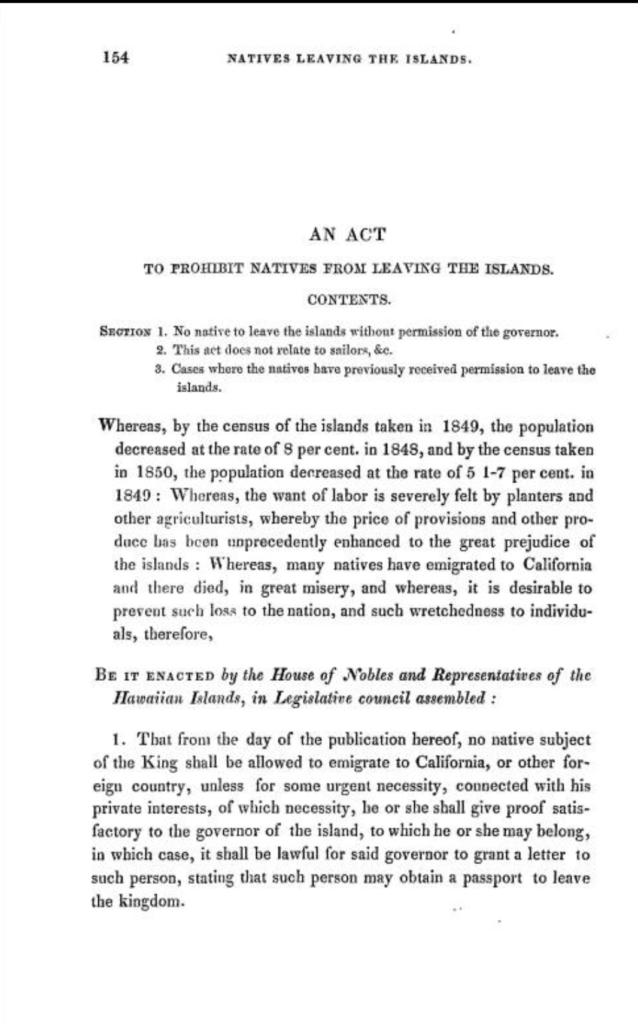
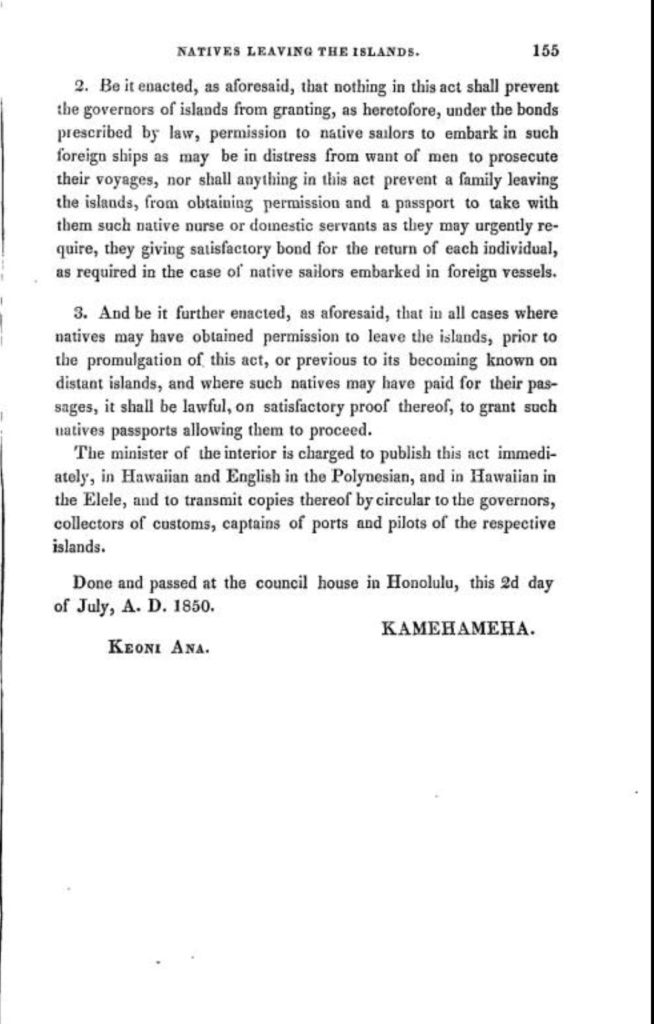
Hawaii has morphed into a very expensive place to live with the average price of a single family at $1M. There are more Hawaiians living out of Hawaii than here. There are a lot of frustrations and angst, and rightly so.
Perhaps the saddest thing I’ve heard from my years of community advocacy is this phrase from a Hawaiian: ” You can go home to your homeland but we have no place to return to. This is our homeland.”
” While looking for something else, I came across this law from 1850, prohibiting natives from leaving Hawai’i due to a concern of population loss. It puts into perspective the recent discussions on the exact same issue.” Jonathan Scheuer