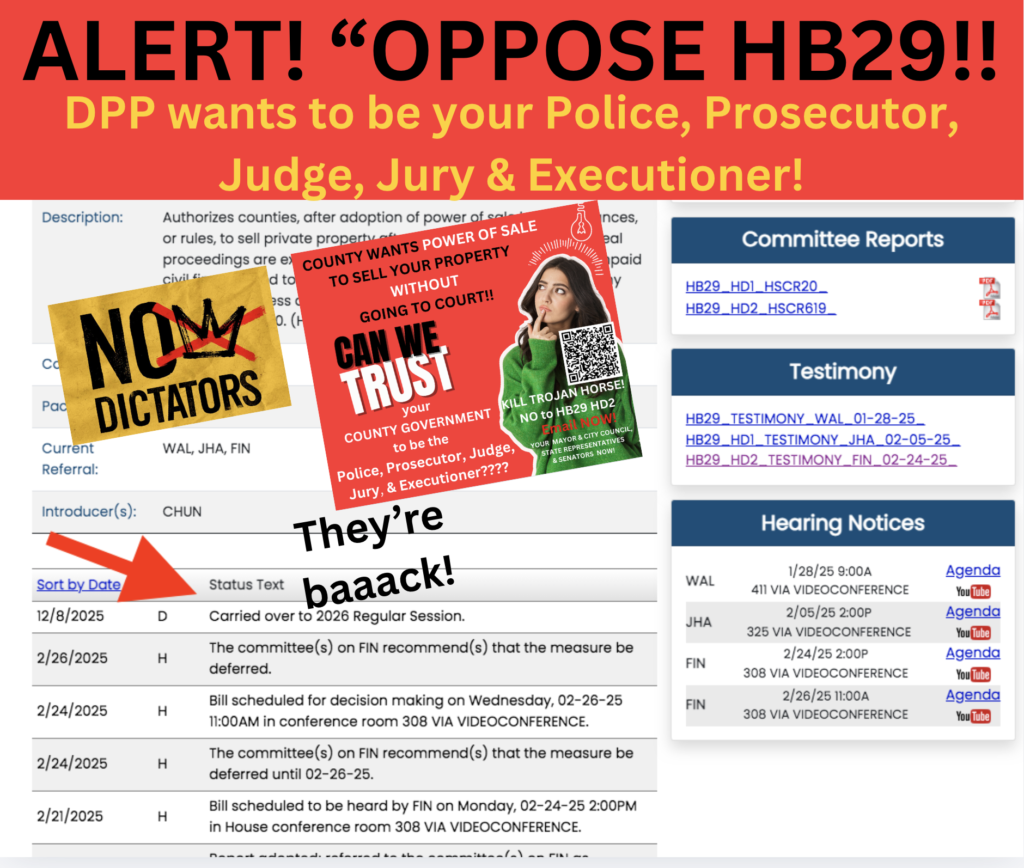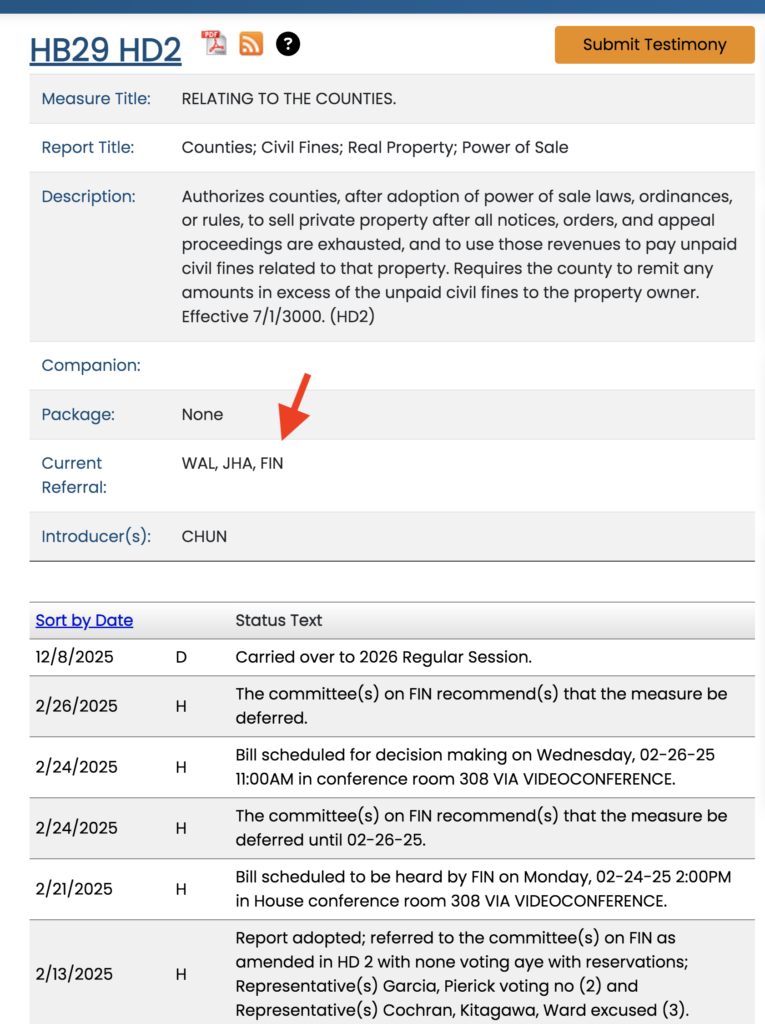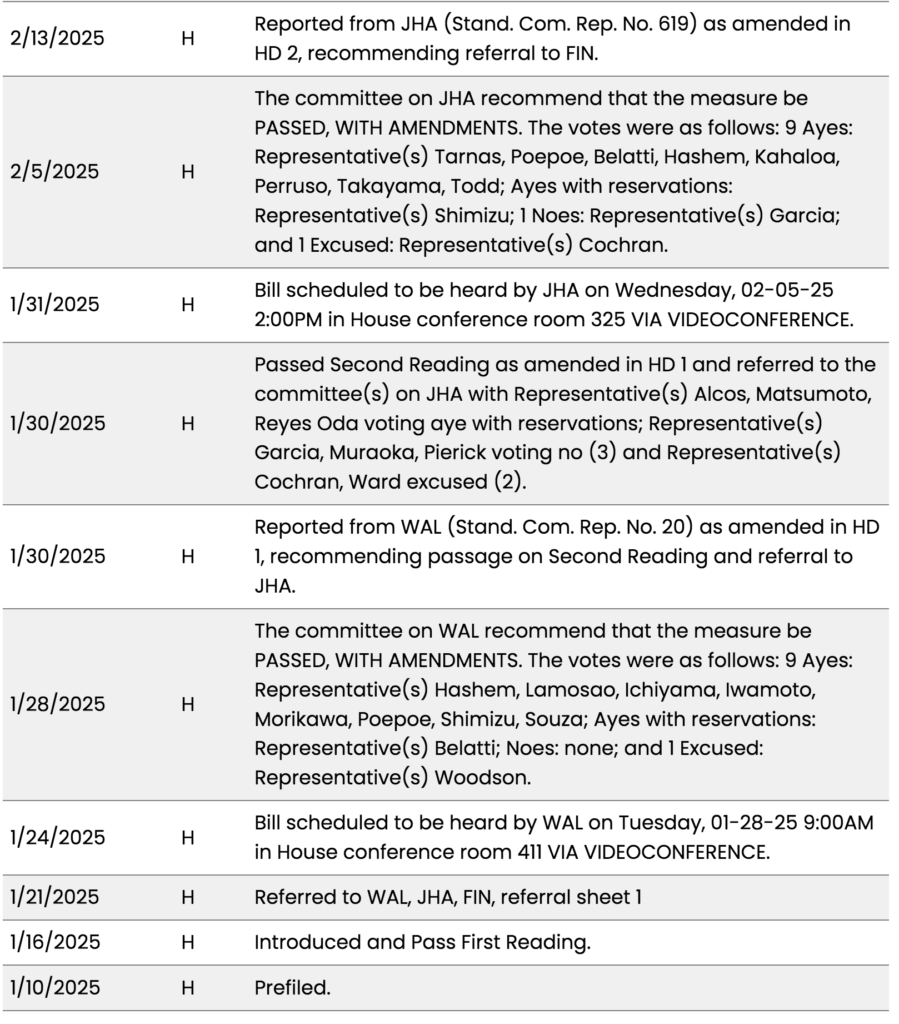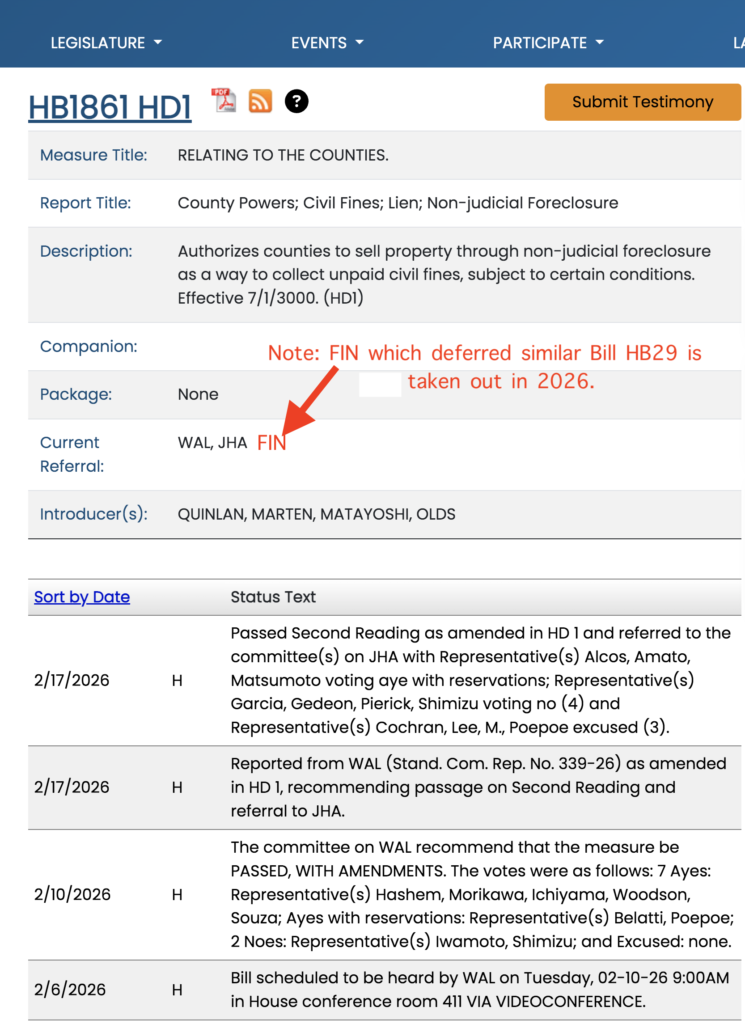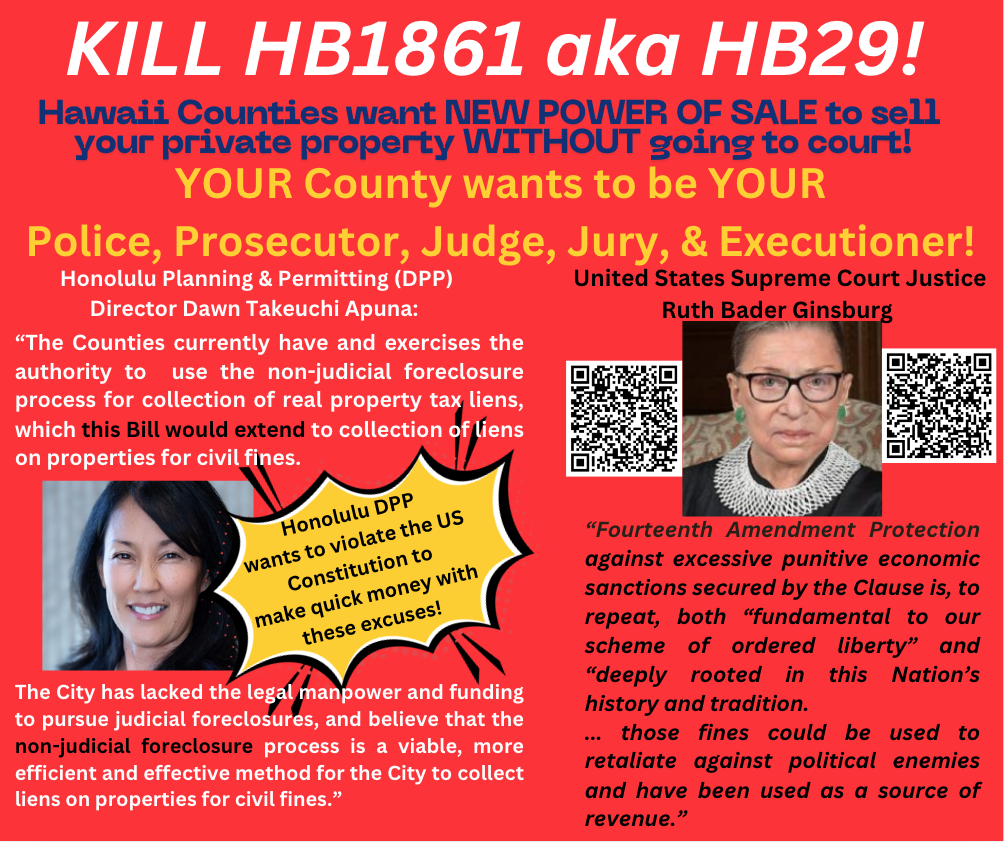
Hawaii Legislators want to remove DUE PROCESS from Private Property Rights through HB1861 aka HB29. New NON-Judicial Power of Sale to seize private properties based on county fines. No court. Just Non-Judicial Foreclosure.
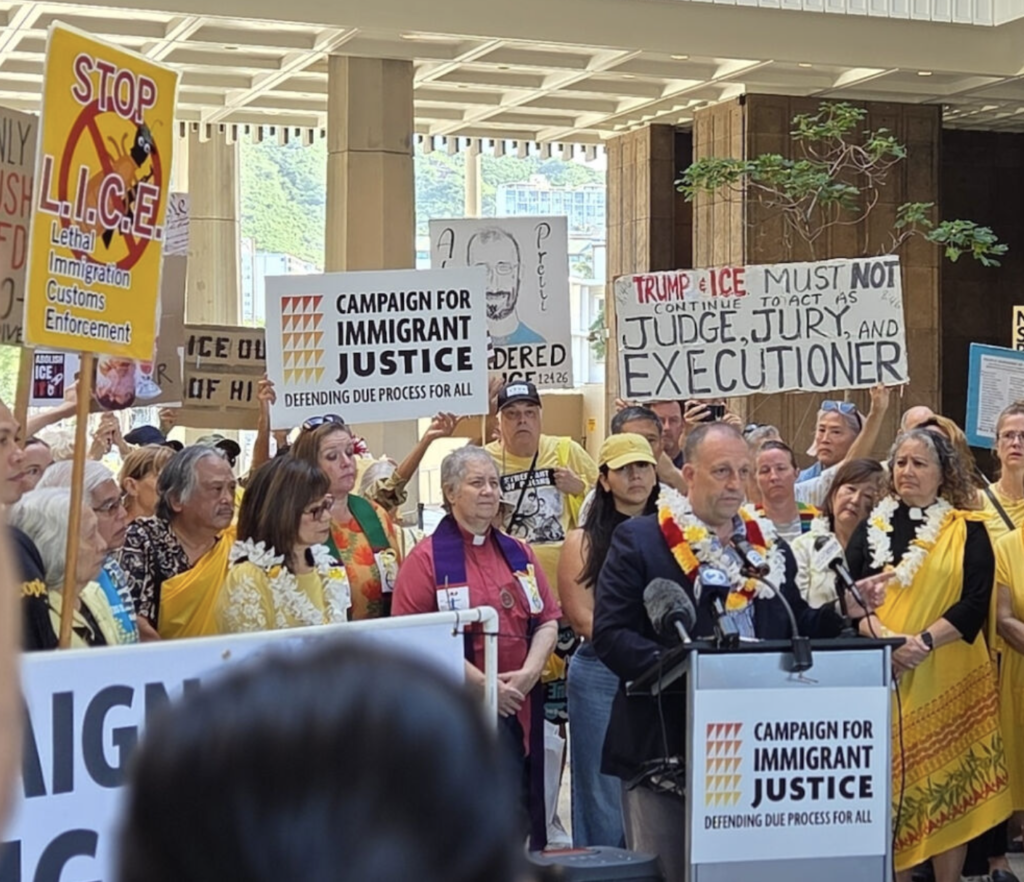
On the other hand, Democratic Party affiliated protesters organized nation-wide civic resistance – “No Dictators” protests against the Trump administration’s policies relating to civil rights, Due Process and democracy in October, 2025.
Such rallies were held the Hawaii State Capitol and neighbor islands including Hilo, Waimea, Kona, and Kahului.
I
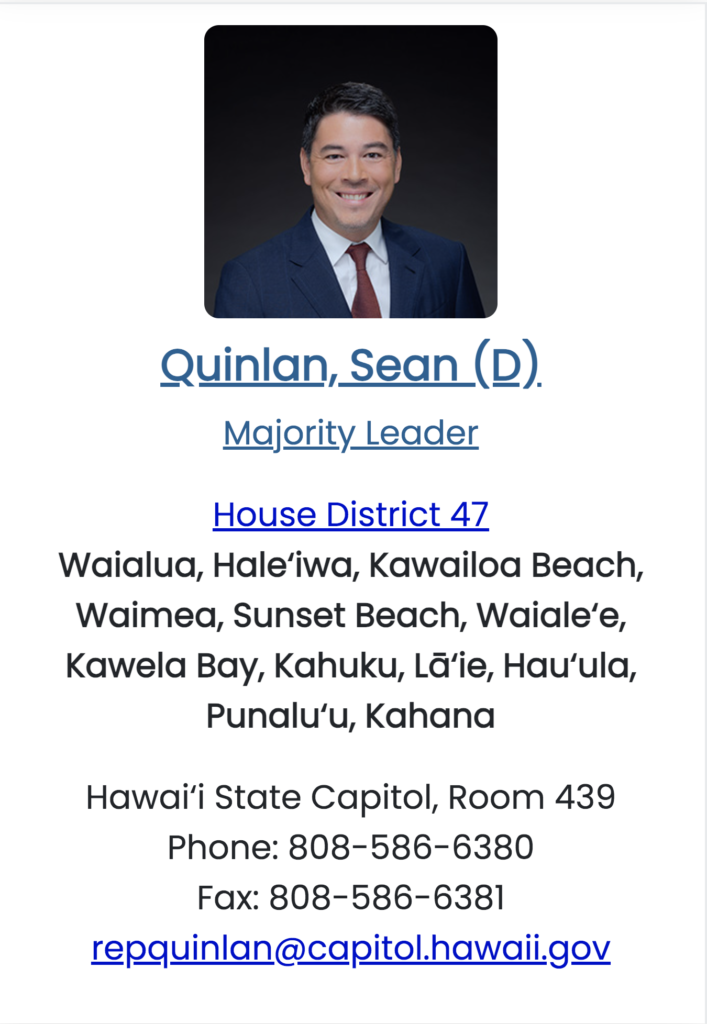
n January 2026, these four Hawaii Legislators (below) want to remove DUE PROCESS from private property owners through HB1861 aka HB29.
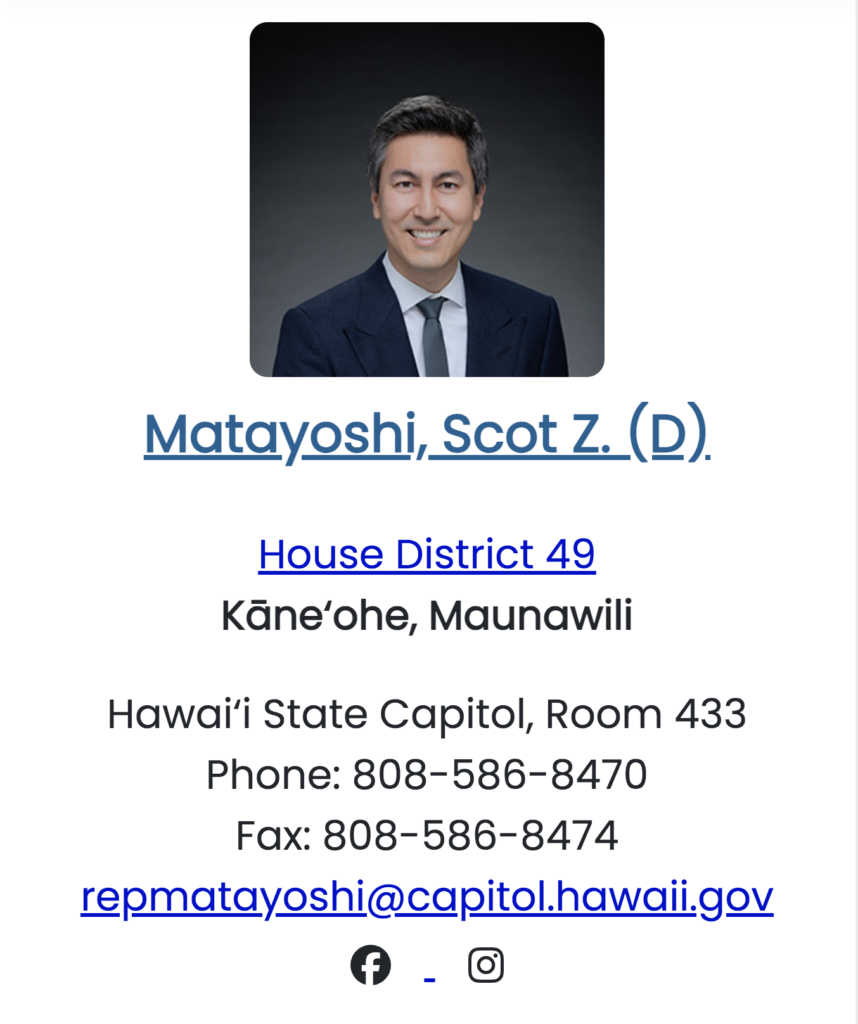
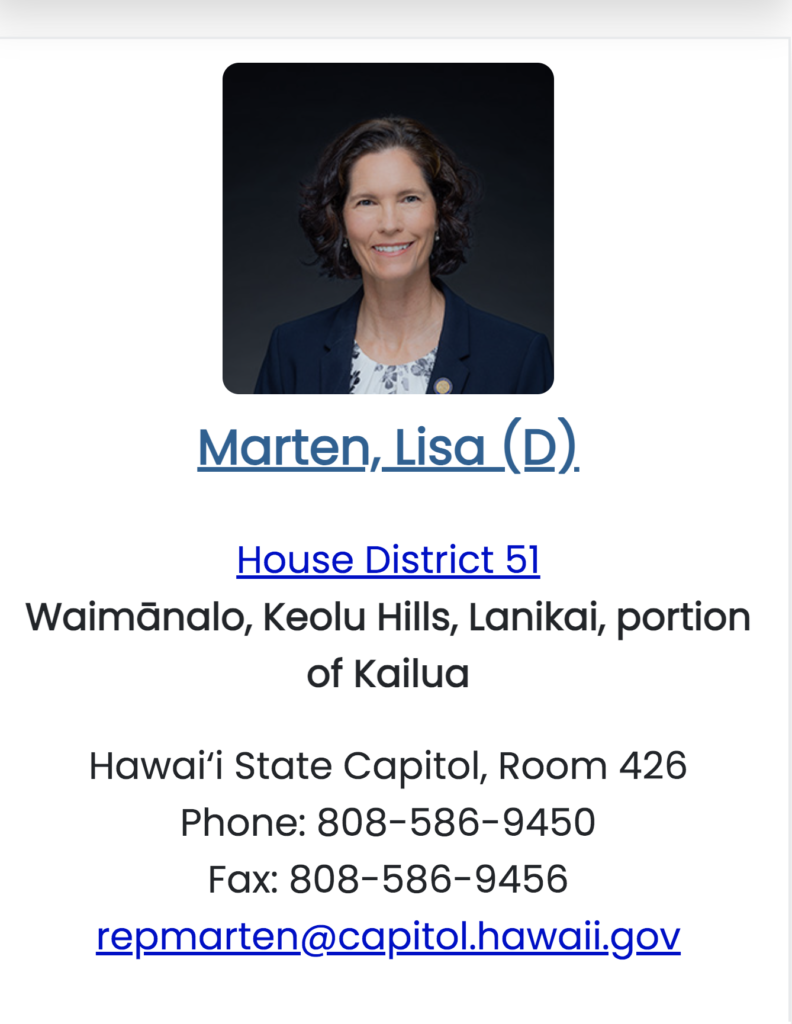
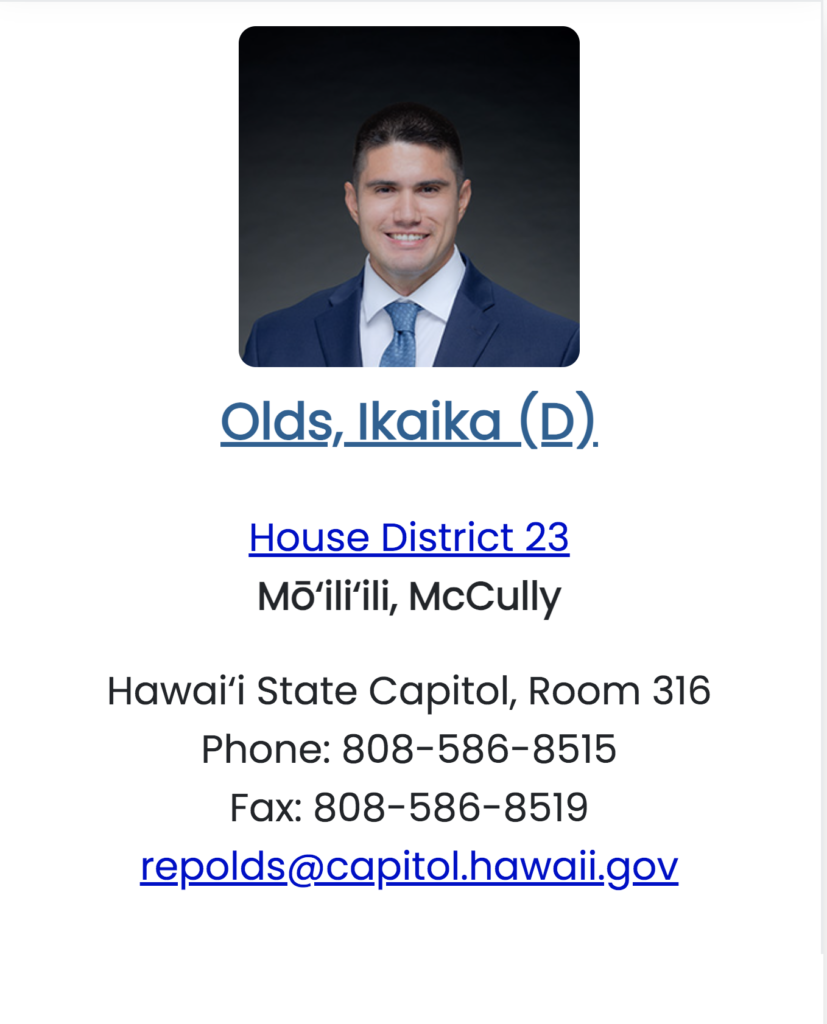
This unconstitutional Tyranny agenda began with Honolulu City County in 2021. The Blangiardi Administration introduced NON-Judicial Power of Sale as a County Legislative Package in 2021. The Department of Planning and Permitting (DPP) gets to issue violations, to place fines and to seize property without no Due Process of going to court.
Who wants to give more powers to the long arm of the government? Who wants DPP to be the Police, Prosecutor, Judge, Jury, and Executioner?

Private Property owners will be stripped of Due Process if these non-judicial Power of Sale Bills are adopted by the Hawaii State Legislature this year.
It’s ironic that the Unhoused now has more rights than ordinary private property owners and renters if non-judicial Power of Sale based on county civil fines is adopted through HB1861 aka HB29.

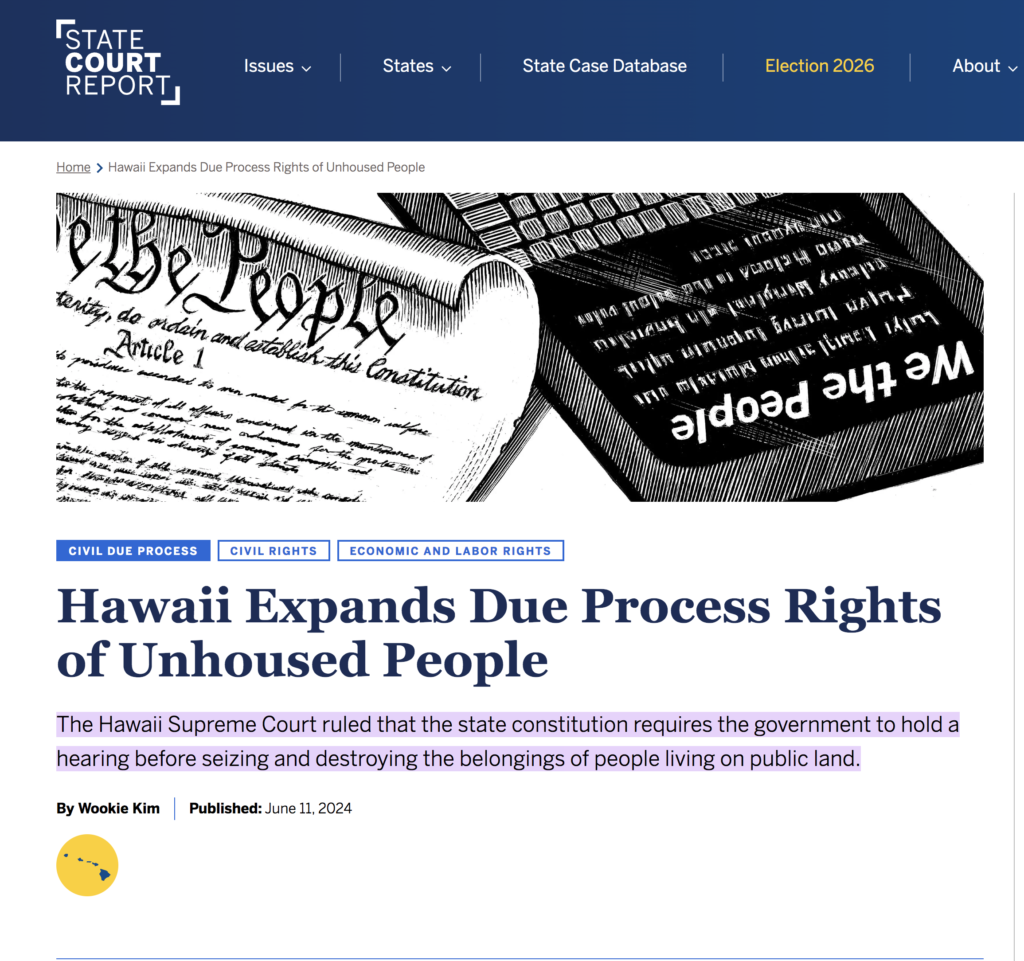
Below excerpt is for educational purposes.
The Unhoused is guaranteed an expanded Due Process Rights while private property owners will be denied Due Process in court.
Due Process in Hawaii is fundamentally guaranteed by Article I, Section 5 of the Hawaii Constitution, protecting life, liberty, and property from arbitrary government action. It ensures fair legal proceedings, including the right to counsel in specific cases, and has been recently applied to protect the property rights of unhoused individuals and the rights of parents in child protective proceedings.
Wookie Kim is the legal director of the ACLU of Hawaiʻi, which represented the plaintiffs in Davis v. Bissen.
On September 20, 2021, a group of unhoused people living near Kanahā Beach Park in central Maui were awakened by police officers and other Maui County workers armed with forklifts, dump trucks, and other heavy machinery. Wielding the threat of arrest and prosecution for criminal trespass, they forced everyone living in the park to leave immediately — with or without their personal belongings.
The county seized everything that was left behind. All told, the county impounded dozens of vehicles and immediately destroyed tons of property, including tents, clothes, pots and pans, child car seats, strollers, and water tanks.
Earlier this year, the Hawaii Supreme Court unanimously ruled in Davis v. Bissen that the county’s actions violated the due process rights of the people whose property was seized.
In an opinion authored by Justice Sabrina McKenna, the court held that “unabandoned possessions of houseless persons” were a “classic form” of property protected by Article I, Section 5, of the state constitution, even if such property was in a public space. The private interest at stake was “significant,” the court said, and the county’s “unchecked decision to seize and destroy the plaintiffs’ personal property posed a high risk of erroneous deprivation of property.”
Moreover, the court held, because “the county’s plan was to destroy (instead of store) seized property,” it could not carry out the sweep without first conducting a “contested case” hearing under the Hawaii Administrative Procedure Act. A contested case hearing is a proceeding before the relevant agency (here, Maui County) in which the agency considers evidence, hears testimony, allows for cross-examination of witnesses, holds oral arguments, and renders a decision about the legality of a planned action, much like a court proceeding.
Here, the plaintiffs had formally requested such a hearing before the sweep occurred, but Maui County ignored those requests. As later court filings would reveal, the county’s stance was that it did not need to hold any hearings. Why? Because, it maintained, unhoused people’s property was “on government property without permission and in violation of trespassing laws” and, therefore, was not protected by due process in the first instance. But, as the court’s decision confirms, one does not forfeit due process protections simply by leaving property in a public space.
The ruling paves the way for a potential first: the holding of a contested case hearing before a local government conducts a sweep of a houseless encampment. While such a hearing would be routine for, say, a landowner challenging the state’s decision to bulldoze a home erected on her property, to my knowledge no municipality in the country has ever held or been required to hold such a robust hearing before destroying the property of unhoused people. While the plaintiffs in this case may only get a post-deprivation hearing on remand, going forward unhoused people in Hawaii may be entitled to a full-blown contested case hearing before a planned sweep.
This could have significant practical effect on the lives of an immense number of people in Hawaii: As of 2023, there were 6,223 houseless people in in the state. Native Hawaiian women, including two of the four plaintiffs, are disproportionally impacted by Hawaii’s housing crisis. Maui County uses sweeps to force — or, as Honolulu officials euphemistically describe it, “gently coerce” — unhoused people into pulling themselves up by their bootstraps. (Never mind that many unhoused people in Hawaii are employed, including all but one of the plaintiffs in this case, who work in service jobs tailored to Maui’s tourism industry.) Rather than helping people get off the streets, sweeps only perpetuate the homeless crisis.
Beyond its practical impact, a state supreme court win squarely vindicating the due process rights of unhoused people also carries symbolic weight. Our legal system structurally disfavors unhoused people: as scholar Wayne Wagner has written, “homeless persons possess fewer and lesser legal rights” than those who live in houses or apartments. Many of our constitutional rights — including those relating to privacy and autonomy — are predicated on owning or having possession of real property, a place to which one can retreat from governmental interference. Further, in lacking access to conventional housing, unhoused people are more likely to be politically disempowered because of difficulties in proving identity or residence when registering to vote. The Hawaii Supreme Court’s declaration that government actors are bound to respect due process for everyone, unhoused or not, at all times, is a victory for the principle of equality under the law.
Finally, the court’s decision is notable not only for its holding but for the way it got there. The court applied what it calls the “state-constitution-first approach” to constitutional interpretation. Under that approach, the court “interpret[s] the Hawaii constitutional provision before its federal analogue.” The court adopted this approach less than a month earlier in State v. Wilson — a case construing the Hawaii Constitution’s analogue to the Second Amendment — to govern how it would resolve cases in which a party “invokes both the Hawaii and United States Constitutions.”
In choosing to interpret and rely exclusively on the state constitution in its Davis decision, the Hawaii Supreme Court has highlighted the “distinct role [of state constitutions] under our nation’s system of federalism” and reminded us, once again, that state constitutions can be as important a source of rights as the U.S. Constitution.
Suggested Citation: Wookie Kim, Hawaii Expands Due Process Rights of Unhoused People, Sᴛᴀᴛᴇ Cᴏᴜʀᴛ Rᴇᴘᴏʀᴛ (Jun. 11, 2024), https://statecourtreport.org/our-work/analysis-opinion/hawaii-expands-due-process-rights-unhoused-people.
More information about HB1861 aka HB28