Tag Archives: Department of Planning and Permitting

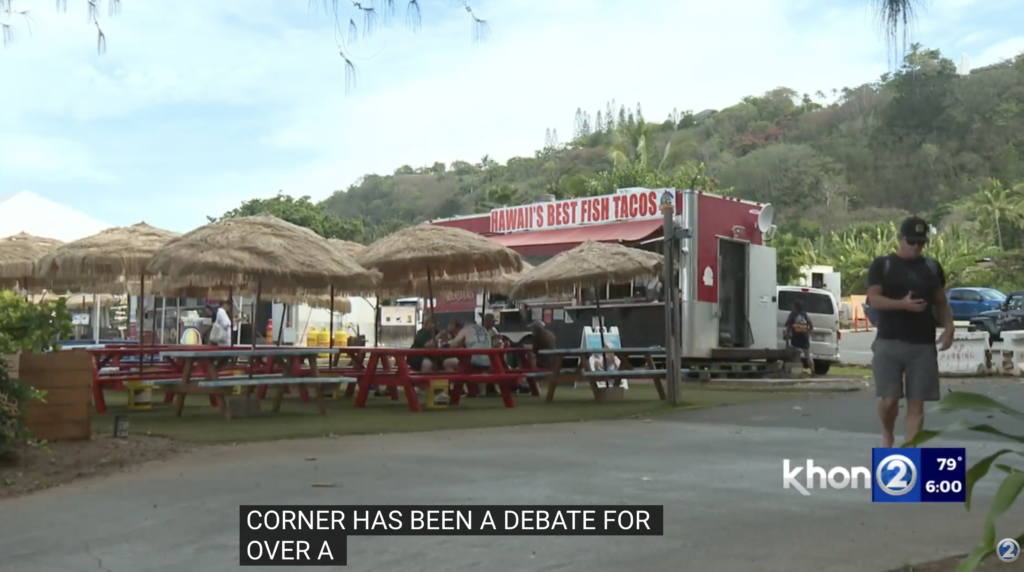
Shark’s Cove Controversy at North Shore, Oahu began with poor decision-making at the Honolulu City Department of Planning and Permitting (DPP) and City Council

In a nutshell, the County of Honolulu, Department of Planning and Permitting and City Council, failed to adhere to its own county ordinances. A B-1 Zoning is for rural communities commerce for its own neighborhood needs, not for tourism. This lack of adherence to its own Ordinances, Rules and Regulations created a lot of friction amongst residents. The livelihood of small businesses, the surrounding environment as well as the taxpayers of Honolulu have been needlessly disrupted.

Hanapohaku LLC, owned by Andrew Yani, purchased the three-acre property near Shark’s Cove in Pupukea on Oahu’s North Shore for $5.5 million in 2014. (Years later, in March 2026, the City and County of Honolulu bought this same property from Hanapohaku LLC for $24.6 million.

County of Honolulu’s Failure to recognize it’s own Planning Ordinances:

AI Overview: The North Shore | Sustainable Communities Plan is a long-range guide by the City and County of Honolulu’s Department of Planning and Permitting. It manages land use, rural character, and infrastructure from Kaʻena Point to Kawela Bay through 2045, keeping 97% of the region zoned for agriculture or preservationThe North Shore Sustainable Communities Plan Ordinance mandates the B-1 Zoning.

Under the City and County of Honolulu Land Use Ordinance (LUO) Chapter 21, B-1 zoning designates the Neighborhood Business District.

Its primary purpose is to provide small-scale commercial areas that serve the daily retail and business needs of the immediately surrounding residential population.

Common Permitted Uses for B-1 Zoning

  • Retail & Convenience: Small grocery stores, drug stores, and local retail shops.
  • Services: Dry cleaners, salons, medical clinics, and branch banks.
  • Food & Beverage: Neighborhood cafes and restaurants.
  • Mixed-Use Residential: Multi-family dwellings are permitted under specific rules, provided they are built above or alongside a commercial use on the lower level.
EXCERPT FROM CIVIL BEAT – A petition seeks to force the city to enforce land use and coastal zone management laws designed to protect marine areas from overuse. By Stewart Yerton  October 3, 2017

“In a petition filed earlier this month with the Honolulu Department of Planning and Permitting, the nonprofit organization Malama Pupukea-Waimea says the department erroneously granted a permit to allow the dining encampment and has let the landowner behind the project get away without paying fines.

Malama Pupukea-Waimea wants the planning department to require developer Hanapohaku to correct land use violations, pay outstanding fines and apply for the type of permit the owner needs to lawfully operate its food truck village in a specially protected area near the ocean.

The petition requests a contested case hearing, a sort of administrative judicial hearing before the agency, which is a necessary prelude to a court challenge.

“This poorly planned development and the irresponsible approach of the owners has imposed hardship on community,” said Denise Antolini, Malama Pupukea-Waimea’s president and the attorney who filed the petition. “For the past three years, weʻve seen a big spike in traffic, pedestrian hazards, runoff, and spillover litter and other impacts on the Pupukea beach park and the Sharks Cove marine protected area.”

Antolini said the property owners allowed things to get out of control on the site and racked up nearly $150,000 in unpaid fines for violating city planning and permitting laws, letting as many as 10 food trucks operate without the type of permit needed for coastline development.

Although the property owner has scaled back to five food trucks from eight, Antolini said the city needs to take a harder look at the project.

“Only after community vigilance, monitoring, and complaints to regulatory agencies and elected officials did Developer make any effort to reduce the impact of its activities,” Malama Pupukea-Waimea’s petition says. “However, these significant problems persist.”

Andrew Yani, a partner in Hanapohaku, declined to comment.

Curtis Lum, a spokesman for the Honolulu Department of Planning and Permitting, declined to comment, citing the litigation.”

Consequently, City and County of Honolulu exposes itself to Environmental Lawsuits and Friction

The multi-million dollar public buyout serves as the climax to nearly a decade of legal battles over commercialization:

  • The Food Truck Violations: In the late 2010s, groups like Mālama Pūpūkea-Waimea filed petitions against the developer for racking up roughly $150,000 in city fines. The site operated up to ten food trucks simultaneously without the proper coastal zone development permits, causing toxic runoff, traffic hazards, and litter spillover into the marine life conservation district.
  • The 2019 Mega-Development Lawsuit: In February 2019, Hawaii’s Thousand Friends, the Save Sharks Cove Alliance, and local residents filed a massive lawsuit against Hanapohaku LLC. They successfully blocked a proposed mauka commercial center featuring multi-story retail buildings and a 126-space parking lot.
  • The Resolution: Faced with permanent community resistance, litigation, and zoning restrictions, the developer ultimately pivoted to sell the property directly to the city, transforming a bitter zoning war into a public safety project. The city paid $24.6 Million for this property that was privately acquired in 2014 for $5.5 Million.

The City Acquisition Timeline

  • March 2026: Honolulu Mayor Rick Blangiardi announced that all primary parties signed a purchase and sale agreement to buy the 2.7-acre property from Hanapohaku LLC for $24.6 million.
  • August 2026: The land deal is undergoing its final closing stages, cementing the property for the future Honolulu Ocean Safety and EMS first responder hub.
  • August–Late 2026: Upon final closing, the city is legally mandated to issue a strict 90-day notice to vacate to the eight onsite commercial tenants.
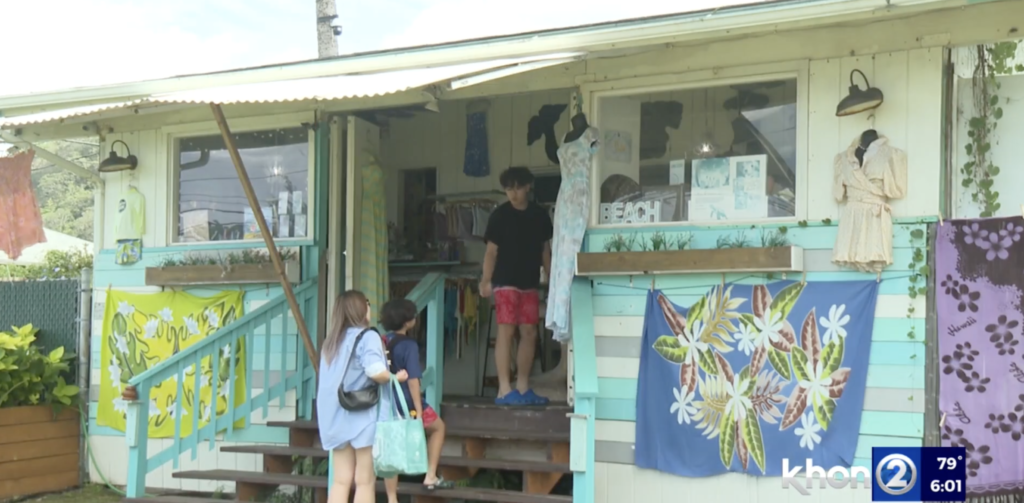
  • The Long-term Outlook: Affected businesses (including North Shore Surf Shop and Sunrise Shack) are actively petitioning for a compromise, but city officials stated they lack the legal framework to mix private commercial storefronts with public safety facilities on the site. The city plans to offer off-site relocation assistance.


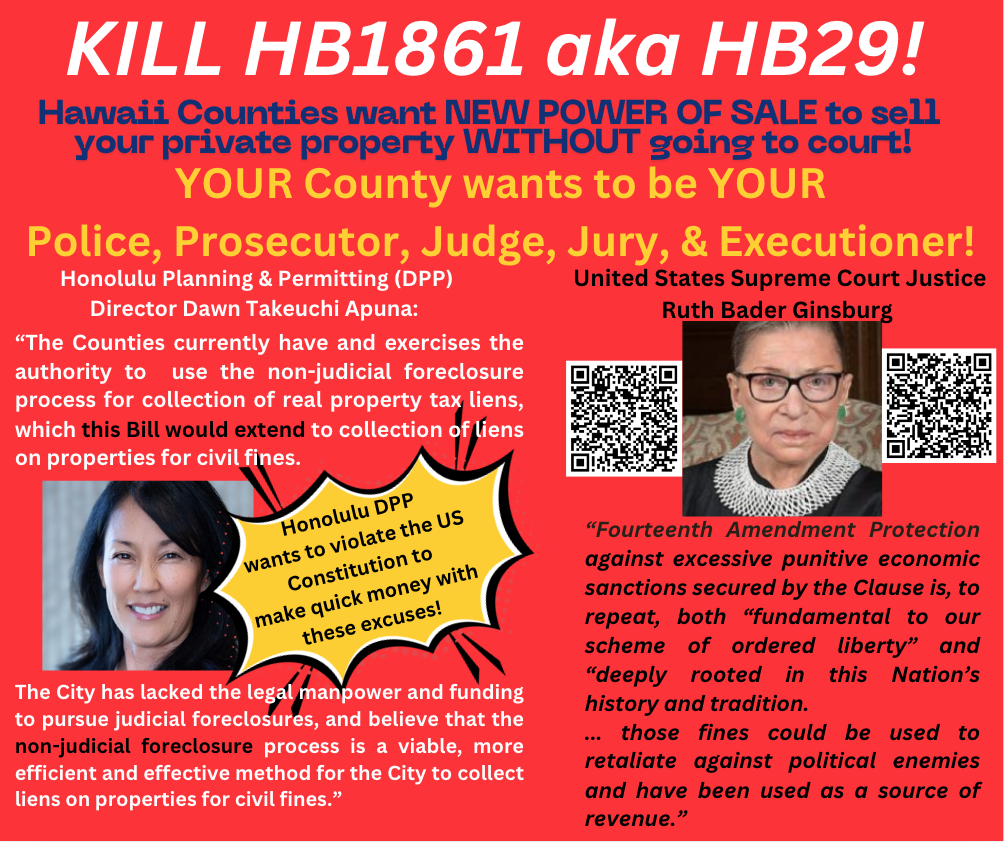
KILL House Bill 1861 aka HB29 –  Best-Kept Secret Hamajang to Deny DUE PROCESS to HAWAII 

Hawaii is vigorously protesting “NO KING – NO TYRANT – NO ICE ” to demand constitutional Due Process for all.

Yet, four (4) Hawaii State House Representatives – Sean Quinlan, Scott Matayoshi, Lisa Marten, and Ikaika Olds – have introduced House Bill 1861 aka HB29 to deny DUE Process to all Hawaii counties. 

HB1861 (2026) authorizes counties to sell property through non-judicial foreclosure as a way to collect unpaid civil fines. Owners cannot go to court to explain or protect themselves. Period. Judicial Due Process is denied.

Yet, four (4) Hawaii State House Representatives – Sean Quinlan, Scott Matayoshi, Lisa Marten, and Ikaika Olds – have introduced House Bill 1861 aka HB29 to deny DUE Process to all Hawaii counties. 

HB1861 (2026) authorizes counties to sell property through non-judicial foreclosure as a way to collect unpaid civil fines. Owners cannot go to court to explain or protect themselves. Period. Judicial Due Process is denied.

This stealth anti Due Process agenda has been happening for five years!    

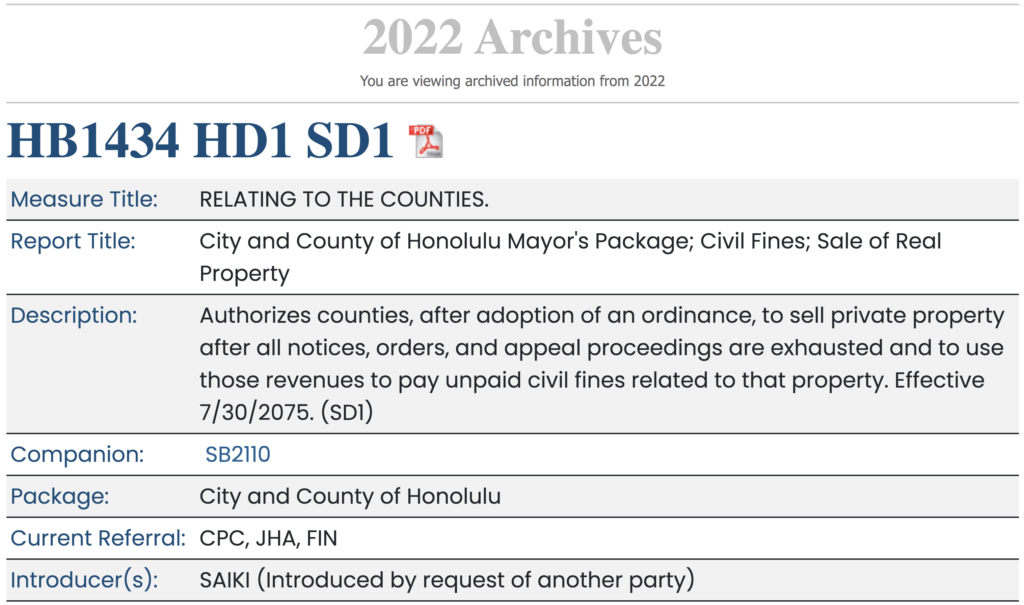
The Honolulu County Blangiardi Administration spear-headed this hamajang in 2021 through House Bill 1434 /Senate Bill 2110  – requesting a new NON-JUDICIAL Power of Sale based on the Department of Planning and Permitting (DPP) civil fines. The Mayor’s DPP Director testified that existing “Eminent Domain” was too slow, took manpower, and resources.

Can you trust the troubled DPP to be your Police, Prosecutor, Judge, Jury, and Executioner?

Look at Kalihi, Kamuki, Kailua, Kaneohe, Kahuku. Look at Waimanalo, Waianae, Wahiawa and Whitmore.  What about Palolo, Mo’ili’ili, Sunset Beach, and Haleiwa? How many residents have turned their garages into extra living space or other additions to accommodate generational living or a little extra income to help pay for their mortgage? Is housing a huge problem in Hawaii?

This ill-thought unconstitutional bill will turn Hawaii’s private property owners and renters into perennial sitting ducks. The long arm of the government will be allowed to create a new source of revenue, bully, do political mischief, or issue violations at will that can morph into significant fines, ripe for non-judicial foreclosure.

Which legislator in 2026 would deny basic Constitutional Due Process Rights (through HB1861) as a  “quick solution” to various issues some Counties have no will to manage.

No amount of contorted promises of “Due Process” through county appeals can justify this sweeping unconstitutional invasion and violation of Civil Rights to all Hawaii. 

HB1861 aka HB29 is burning down a Cathedral to fry an egg.

Give Voice Now. Don’t complain AFTER-THE-FACT. Contact your legislators, Mayors, and City Councils. Elected legislators must stay inside the Constitutional Path for the Public Good.

Kill HB1861 hamajang!

Nothing good can come out by giving the long arm of government MORE new powers to control its people.

STATUS OF HB1861 ONLY Representatives Garcia, Gedeon, Pierick, Shimizu voting no. “Reservations is a YES vote.”

2/17/2026HPassed Second Reading as amended in HD 1 and referred to the committee(s) on JHA with Representative(s) Alcos, Amato, Matsumoto voting aye with reservations; Representative(s) Garcia, Gedeon, Pierick, Shimizu voting no (4) and Representative(s) Cochran, Lee, M., Poepoe excused (3).
2/17/2026HReported from WAL (Stand. Com. Rep. No. 339-26) as amended in HD 1, recommending passage on Second Reading and referral to JHA.
2/10/2026HThe committee on WAL recommend that the measure be PASSED, WITH AMENDMENTS. The votes were as follows: 7 Ayes: Representative(s) Hashem, Morikawa, Ichiyama, Woodson, Souza; Ayes with reservations: Representative(s) Belatti, Poepoe; 2 Noes: Representative(s) Iwamoto, Shimizu; and Excused: none.
2/6/2026HBill scheduled to be heard by WAL on Tuesday, 02-10-26 9:00AM in House conference room 411 VIA VIDEOCONFERENCE.
1/26/2026HReferred to WAL, JHA, referral sheet 2 (FINANCE COMMITTEE IS DELETED in 2026. FINANCE COMMITTEE DEFERRED SIMILAR BILL HB29 in 2025.)
1/26/2026HIntroduced and Pass First Reading.
1/23/2026HPending introduction.

Bill 106 threatens private property owners

This is a reprint from the Star Advertiser published February 15, 2023. The limit for Star Advertiser was 600 words. For educational purposes, we’re adding more info through links and photos.

EDITORIAL | ISLAND VOICES

Column: Bill threatens private property owners

  • By Choon James and Natalie Iwasa
  • Today 
  • Updated 7:19 pm

As part of the 2022 county package to state legislators, Honolulu Mayor Rick Blangiardi requested “nonjudicial foreclosure” powers, i.e., the power to seize private property without going to court. Fortunately, House Bill 1434 did not pass last year.

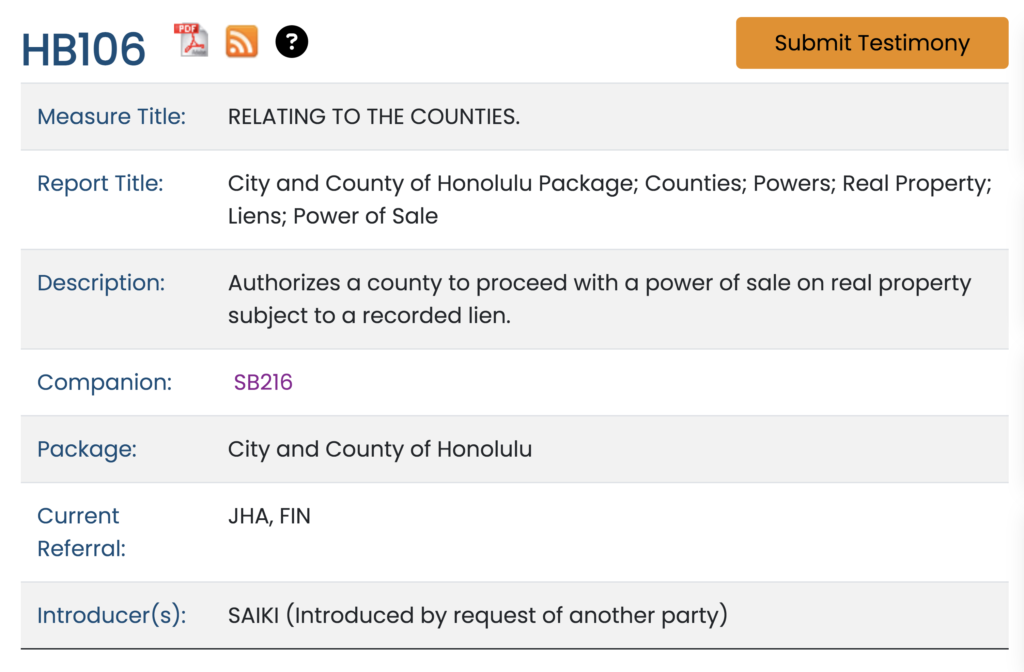
This year’s package includes another request for “nonjudicial foreclosure,” aka “power of sale.” 2023 HB 106 BELOW represents an alarming threat to property owners and is prevalent in totalitarian regimes.

This year’s HB 106 offers weak assurance that “a county may, after all notices, orders, and appeal proceedings are exhausted, satisfy all unpaid civil fines through the power of sale on the real property subject to a recorded lien.”

Unfortunately, our years of civic participation at Honolulu Hale show that due process has not always been fair and equitable to ordinary residents.

Furthermore, recent federal indictments and guilty pleas continue to show the troubled Honolulu Department of Planning and Permitting (DPP) has no consistent record of fair play or efficient management. Written testimonies reveal alarming threats toward private property rights.

Dawn Takeuchi Apana, DPP director designate, stated: “Specifically, this bill would authorize the city to bring closure to pending civil fines imposed on landowners who are in violation of the city’s land use ordinances and building codes, through a nonjudicial or administrative process.”

Honolulu City Councilman Calvin Say also submitted testimony for a quicker seizure: “Our city corporation counsel is currently able to initiate a Judicial Foreclosure process, which has been successful in similar instances, however this is a long process that takes valuable resources away from other pressing legal matters.”

In other words, give us the authorization to hurry it up by bypassing the regular court method of foreclosure.

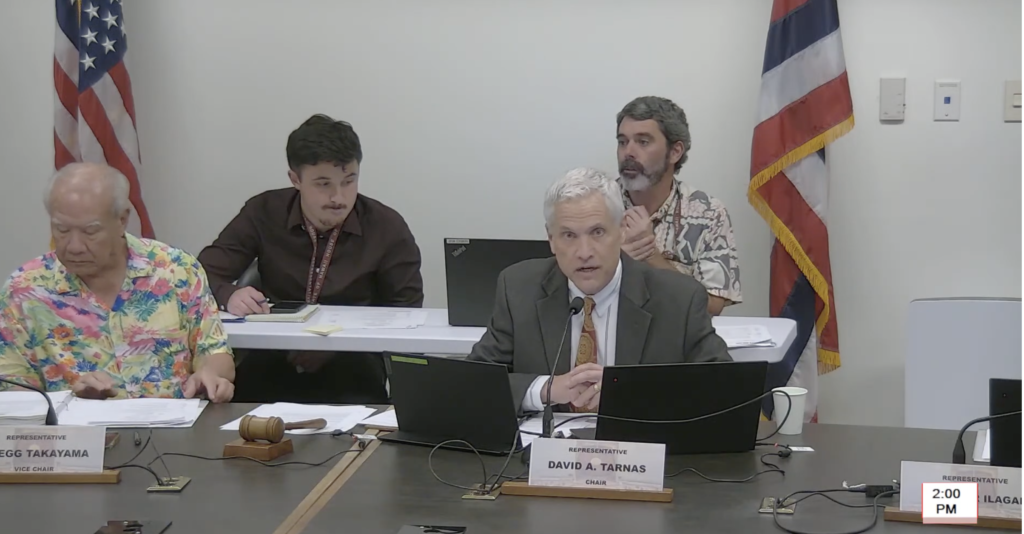
The House Committee on Judiciary & Hawaiian Affairs, whose members include Chairman David Tarnas and Vice Chair Gregg Takayama, approved HB 106 on Jan. 31. Its report states in part:

“Your committee finds that authorizing the counties to collect on liens filed on properties through a nonjudicial foreclosure process provides some leverage over property owners to comply or lose their property. If a property owner fails to comply and the property is foreclosed upon, this measure would enable the property to be put to productive use, allow liens attached to the property to be satisfied, and stop the accrual of additional debt or taxes on the property.”

Chairman David Tarnas and Vice Chair Gregg Takayama, approved HB 106 on Jan. 31. 2023

Hawaii’s state legislators should recognize that most ordinary residents sacrifice and work their tails off to achieve real property ownership. Each county’s goal should be to help property owners comply with the law and correct their violations, not summarily seize their properties.

HB 106 invites corruption and exposes residents, especially those who have fewer financial resources available to them, as easy casualties of this potential power of sale. All Hawaii counties would be affected.

It should be noted the U.S. Supreme Court ruled unanimously on Feb. 20, 2019 (Timbs vs Indiana), that the Constitution’s ban on excessive fines — civil asset forfeitures are a type of fine — applies to state and local governments, thus limiting their ability to use fines to raise revenue.

The late Justice Ruth Bader Ginsburg also astutely argued fines could be used to retaliate against political enemies and had been used as a source to raise revenue.

RBG was a tireless and resolute champion of justice.

Hawaii has a few egregious property owners, but this tyrannical bill is not the solution. We urge our legislators to vote “no” on HB 106.

###


AUTHORS: Natalie Iwasa is a CPA and certified fraud examiner; Choon James is a residential Realtor and farmer. They have spent combined decades of civic participation at Honolulu Hale as community advocates for good governance.

Resolution 22-11: STRONGLY OPPOSE -Selective Targeting With Hostile Taking of Private Property

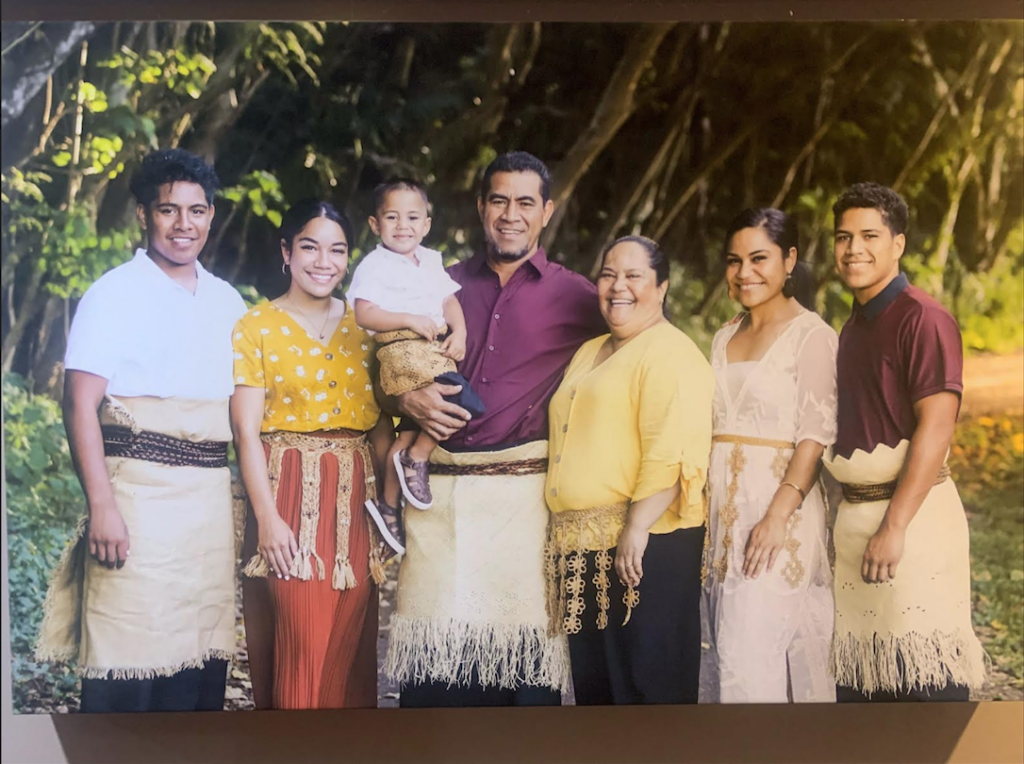
There is no question that the subject property owner Taufa needs to correct his violations. But these violations take time to cure.

A city council member should especially make the efforts to reach out to those in trouble and try to help them. Immigrant families especially need more education and understanding in addressing Hawaii’s land use issues.

I’ve known many immigrants here for over forty years. Some may be here for a while but still need understanding due to inherent cultural perceptions or lack of knowledge or carelessness. For example: I continue to help educate our Southeast Asian farmers that “Round-Up” must be used very carefully, if at all. Many think that “Round-up” and other chemical fertilizers are simply “Good medicine”.

Even some from the Continental Mainland have misunderstandings of Oahu’s land-use ordinances. In places like Idaho, Tennessee, or Upstate New York, there are still counties with no land-use designations. A property can do as they wish. They can drill a well, build an air-strip, do a quarry business or build a residential home side by side of each other. Hawaii fortunately has a wonderful land-use designations on paper.

It’s a known fact that many contractors store their equipments and do their businesses out of their ag-zoned parcels whether it be roofing, trucking, and so on. I’m not saying that these owners are correct. But parts of the islands do not have “industrial” zone area for such business activities. But I’m saying that it is a very common occurrence in Oahu to mix ag-land with construction businesses.

Thus, if such a quick severe punishment is imposed on one particular owner and not the others, there should be at least a fair and objective outreach by the city council member first.

A few neighbors near this property have complained about this property. They have the right to do so. The Hau’ula Community Association President has weighed in although many in Hau’ula does not feel she represents the community at large. This activism began to snow-ball to include a few north shore environmentalists, who in turn has solicited for testimonies from around the island for DPP to “do its job” in enforcement.

I understand the frustrations with DPP. But we cannot allow this anger against DPP’s chronic lack of enforcement by turning this small property owner into a whipping boy. This is grossly unfair. There is no question that the property owner has violations to cure. Enforcement by DPP is important. But social justice is important too, especially when dealing with minorities and immigrant families.

Unfortunately, instead of granting some outreach to the property owner, City Council Member Tsuneyoshi initiated her first step with this Resolution 22-006.

RES22-006

Measure Title: STRONGLY URGING THE DEPARTMENT OF PLANNING AND PERMITTING TO IMMEDIATELY ADDRESS OUTSTANDING VIOLATIONS RELATED TO THE PROPERTY AT 54-406 KAMEHAMEHA HIGHWAY IN HAU’ULA (TAX MAP KEY 5-4-004:021).

Date Introduced: Jan 7, 2022 Introduced By:HEIDI TSUNEYOSHI

Committee: ZONING AND PLANNING (ZP)

Resolution Status

Voting Legend: * = Aye w/Reservations

DateTypeDescription
01/07/2022INTROIntroduced.
01/13/2022ZPReported out for adoption.CR-007 (22)4 AYES: CORDERO, ELEFANTE, KIAʻĀINA, SAY
01/26/2022CCLCommittee report and Resolution were adopted.9 AYES: CORDERO, ELEFANTE, FUKUNAGA, KIAʻĀINA, SAY, TSUNEYOSHI, TULBA, TUPOLA, WATERS

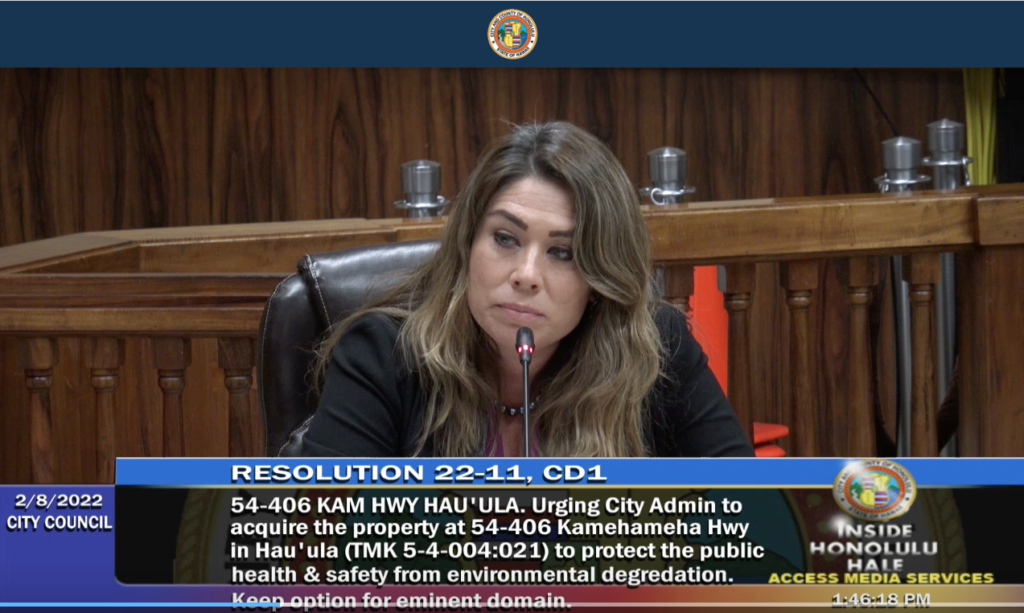
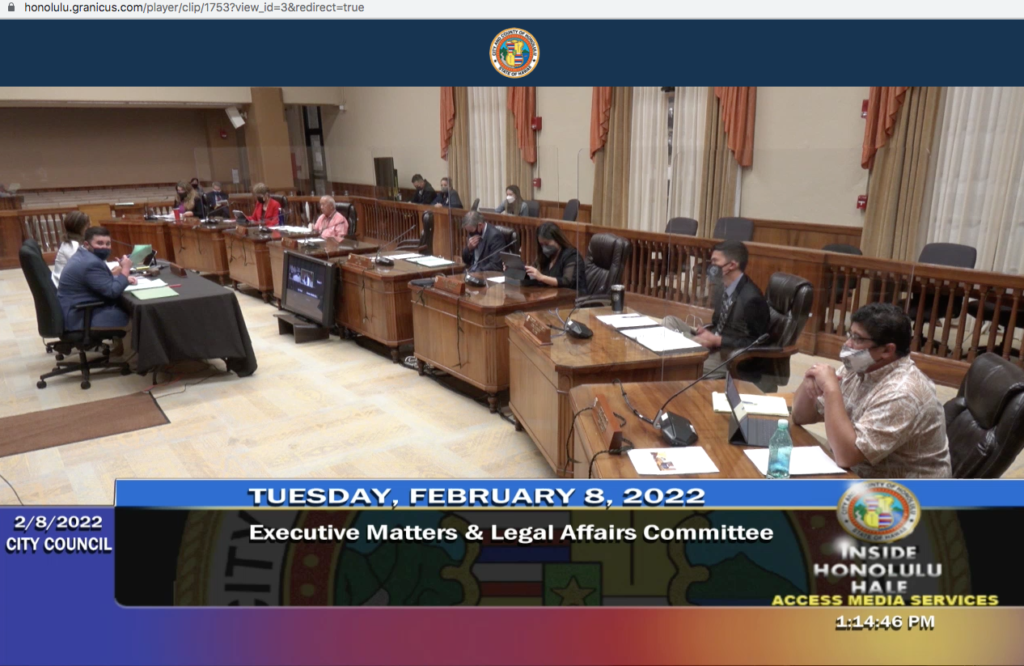
After persuading the entire City Council to adopt her Resolution 22-06 on January 26, 2022, despite flawed information, City Council Member Heidi Tsuneyoshi quickly introduced another Resolution 22-11 to use eminent domain on the Taufa’s property at the Executive Matters and Legal Affairs Committee on February 8, 2022.  

Resolution 22-11

Measure Title: URGING THE CITY ADMINISTRATION TO ACQUIRE THE PROPERTY AT 54-406 KAMEHAMEHA HIGHWAY IN HAUULA (TAX MAP KEY 5-4-004:021) IN ORDER TO PROTECT THE PUBLIC HEALTH AND SAFETY FROM ENVIRONMENTAL DEGREDATION, INCLUDING, IF NECESSARY, TAKING STEPS TO ACQUIRE THE PROPERTY BY EMINENT DOMAIN.

Date Introduced:Jan 20, 2022 Introduced By:HEIDI TSUNEYOSHI

Committee: EXECUTIVE MATTERS AND LEGAL AFFAIRS (EMLA)

Resolution Status

Voting Legend: * = Aye w/Reservations

DateTypeDescription
01/20/2022INTROIntroduced.
02/08/2022EMLAReported out for adoption as amended in CD1 form.CR-168 AYES: CORDERO, ELEFANTE, FUKUNAGA, SAY, TSUNEYOSHI, TULBA, TUPOLA, WATERS1 EXCUSED: KIAʻĀINA      

The Star Advertiser prepared and published an article on the proposed takings in the morning of February 8, 2022 EMLA ( Executive Matters Legal Affairs) Committee.

District 2 Council member Tsuneyoshi as quoted to Star Advertiser’s Ashley Mizuo:  

Hopefully, it isn’t seen as coming after a property owner. … It was hopeful that we could have come to a resolution where he would have complied with all that’s been told to him to do, but unfortunately, after five years that wasn’t the case.” ( Note that the owners acquired the property in November 2019 which is about two years ago.)

TSUNEYOSHI’S WORDS TO THE STAR ADVERTISER CONTRADICT HER ACTIONS

A close look at the timeline shows that Tsuneyoshi was already lining all the ducks in a row despite her words to the Star Advertiser that it ” shouldn’t be seen as after a property owner “.

February 26, 2020. Note Resolution 22-006 was adopted by the Honolulu City Council.

January 20, 2022. However, note that her new eminent domain Resolution 22-011 was prepared and introduced six days BEFORE Reso 22-006 was adopted.

It’s hard to buy her public statements that “Hopefully, it isn’t seen as coming after a property owner …”.

MORE TARGETING BY TSUNEYOSHI

The discrimination and targeting mounted when Tsuneyoshi persuaded the EMLA Committee to amend her Eminent Domain to Judicial Foreclosure. This action was completed in about an half hour period.

There were other little changes like a spelling error in her Resolution 22-11 with the word correcting “degredation” to “degradation” in the title of her resolution and miscellaneous technical and non substantive amendments.

But other far more substantial errors in the Resolution’s contents were untouched. Contrary Information and concerns submitted by the public did not appear to be considered by her.

EVEN MORE TARGETING of PROPERTY OWNER THROUGH INCONSISTENT TREATMENTS

At the Executive Matters & Legal Affairs Committee, there was more targeting of the property owner through inconsistent treatments.

There were three (3) Resolutions relating to Eminent Domain takings. It’s important to note that the 1.Taufa Resolution 22-11 is the only hostile taking of property. Tsuneyoshi stated his compounded DPP fines was about $400,000.00 (However, statement to the news media on February 21, she changed the news media that his fines were about $300,000.00 ). During the EMLA meeting, the Taufa’s eminent domain action was the only Resolution that was changed to Judicial Foreclosure in a very short period.

2. Resolution 21- 280 for eminent domain relates to an abandoned property in Pensacola with Fines of about $900,000.00

3. Resolution 22-22 involves a property owners in Waianae who told the City Council members that she would be so happy if the city would acquire her property.

NO CONSISTENCY

These actions should be alarming to any private property owner. There is no consistency in the application of Due Process. There appeared to be no clear understanding of the differences of Eminent Domain versus Judicial Foreclosure but it was quickly decided upon anyways.

So, what is the threshold to take someone’s property by Eminent Domain or Judicial Foreclosure?

Is it $900K as in the the Pensacola Street property?

Or is it $300K or $400k as in the subject Hau’ula Property?

Since the Hau’ula property is now solely targeted for Judicial Foreclosure takings, how is this process going to play out?

Judicial Foreclosures is generally a mortgage delinquency issue. We know that the county has powers to auction off a private property owner who has trouble paying their real property taxes. We also know that the City County of Honolulu has practiced forbearance in helping private properties solve their financial problems by allowing them TIME.

In this case here, we’re talking about county land-use violation fines. Some of violations were incorrect but the owners were fined.

There are still many OTHER unanswered questions relating to this issue.

Why is City Council member Heidi Tsuneyoshi rushing this hostile taking of this property?