Why? Why does the public not know about this?
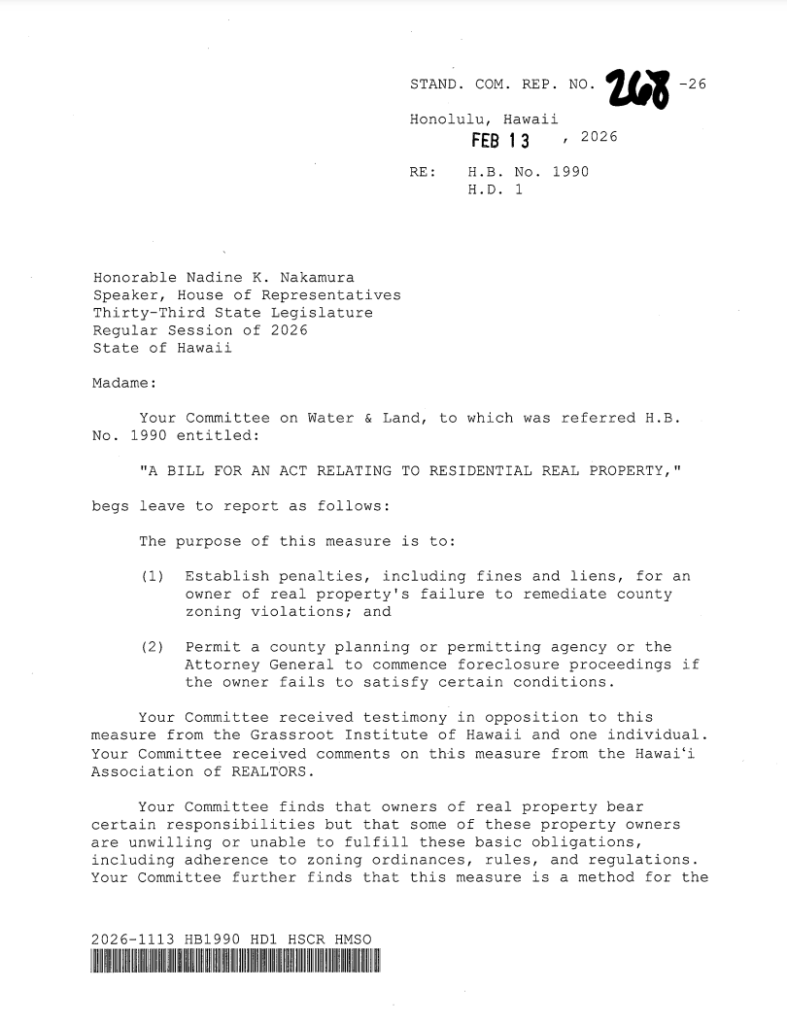
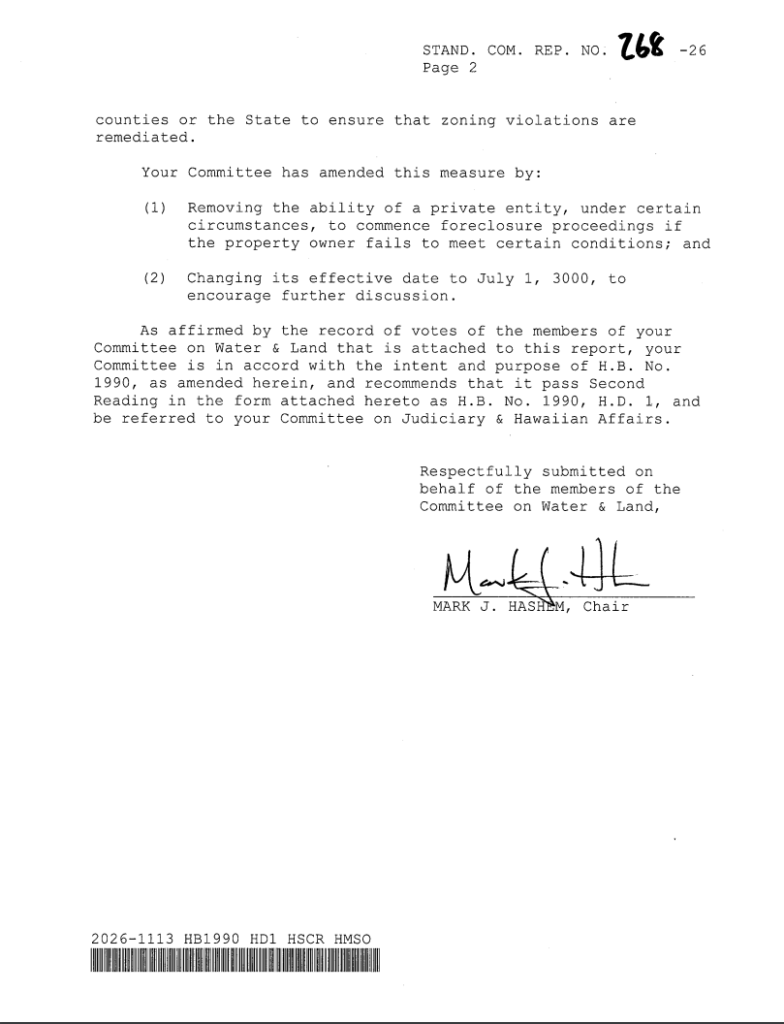
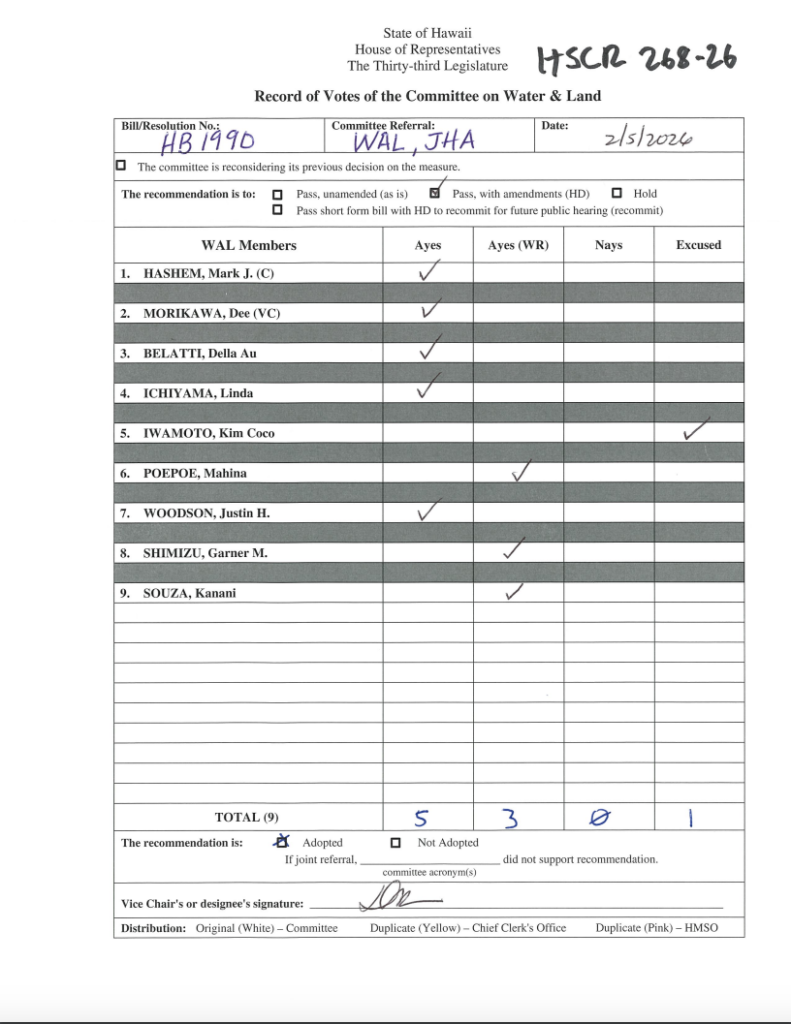
AYES (WR) With Reservations is still a “YES” vote.


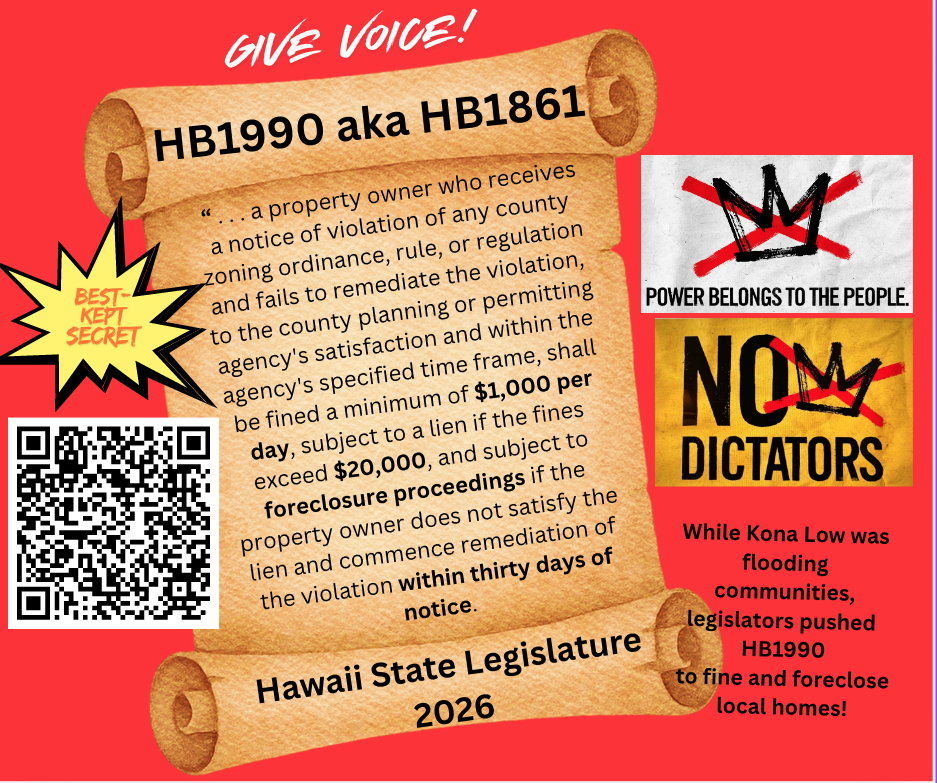
Why? Why does the public not know about this?
AYES (WR) With Reservations is still a “YES” vote.
This is a reprint from The Honolulu Advertiser for educational purposes. ( We added extra links from other publications for more information.)
By Dan Nakaso and Andrew Gomes
March 6, 2026

STAR-ADVERTISER / JAN. 8, 2018
U.S. Rep. Colleen Hanabusa formally announces she is running for governor during a gathering on the east lawn of the State Capitol building with dozens of her supporters in 2018.
Colleen Hanabusa, a formidable Hawaii politician and prominent labor lawyer from Waianae who served in Congress but failed to become Hawaii’s governor and Honolulu’s mayor, died early Friday morning at the age of 74.
Hanabusa had been hospitalized for five months with cancer, her family said.
Gov. Josh Green ordered the U.S. and Hawaiian flags be flown at half-staff at the state Capitol, all state offices and agencies, and all Hawaii National Guard facilities in honor of Hanabusa, a former U.S. representative and president of the state Senate who more recently chaired the board of the Honolulu Authority for Rapid Transportation.
“Colleen Opens in a new tab Hanabusa dedicated her life to serving the people of Hawaii Opens in a new tab — from the Waianae Coast she proudly called home, to the halls of the Hawaii State Capitol and the United States Congress,” Green said in a news release. “She broke barriers as the first woman to serve as President of the Hawaii State Senate and spent decades advocating for her community with strength, determination and heart. Her legacy of leadership and public service will continue to inspire generations to come.”
Honolulu Mayor Rick Blangiardi, who appointed Hanabusa to the HART chair, said in a statement, “Hawaii has lost a remarkable leader, and we all have lost a friend. Managing Director Mike Formby and I had a close relationship with Colleen, and she dedicated her life to serving the people of Hawaii with intelligence, determination, and an unwavering sense of purpose.”
City & County of Honolulu flags also will be lowered today through Sunday to honor her.
Hanabusa ended her political career at HART after she, Blangiardi and Lori Kahikina — HART’s executive director and CEO — proposed truncating the route to regain the confidence of the Federal Transit Authority, got long-awaited federal dollars flowing back to the project and opened the first leg of the Skyline system in June 2023.
Asked why Hanabusa would agree to serve as an unpaid volunteer while the rail project faced intense criticism at home and in Washington, D.C., Blangiardi told the Honolulu Star-Advertiser on Friday that “It speaks volumes about her. What it says is that she put Hawaii first.”
Kahikina said, “On behalf of myself and the entire HART Ohana, we are deeply saddened by the news of Colleen Hanabusa’s passing. My deepest sympathy goes out to the Hanabusa ohana. I greatly appreciate her contributions to the Honolulu rail project, and respect and admire her work as a tireless advocate and public servant. HART extends its sincere condolences to all who had the privilege of knowing Colleen.”
Hanabusa was born May 4, 1951, and raised in Waianae where her great-grandparents worked on a sugar plantation and her family later established a service station, Hanabusa Service, in 1948.
Because her parents, June and Isao, devoted so much time to the family business, Hanabusa was raised largely by her maternal grandmother.
After graduating from St. Andrew’s Priory in 1969, Hanabusa earned a bachelor’s degree in sociology and economics from the University of Hawaii in 1973, and followed it with a master’s degree in sociology in 1975 and then a law degree in 1977 also from UH.
As a labor lawyer during the 1980s and early 1990s under her married name at the time, Colleen Sakurai, Hanabusa represented some high-profile clients who were politically powerful and others who were politicians or intersected with politics.
Clients from that time included the Hawaii Teamsters Union in a legal fight to represent state corrections officers, and the Hotel Employees and Restaurant Employees Local 5 union in a dispute over picketing during a statewide hotel strike.
Hanabusa also represented Honolulu City Council members in a 1993 legal skirmish with then-Mayor Frank Fasi to stop him from using Oahu Neighborhood Board elections as an “advisory referendum” on tax funding for a $2 billion Fasi rail transit plan.
One of those Council members, Arnold Morgado, ran for mayor in 1994cq special election and 1996 with Hanabusa as a campaign strategist and attorney. Morgado lost both times to Jeremy Harris.
In 1998, Hanabusa sought political office herself. She ran for a state Senate seat against Sen. James Aki, the Democratic incumbent who a year earlier had been granted deferred acceptance of a no-contest plea to two felony gambling charges. Hanabusa won the primary and went on to win the general election to represent Nanakuli, Waianae and Makaha.
As a first-term lawmaker, Hanabusa quickly made a name for herself by helping organize the rejection of Margery Bronster as then-Gov. Ben Cayetano’s nominee for attorney general.
Then in 2001, she spearheaded efforts to reform state civil service laws, an action that stirred up politically powerful public worker unions.
“While the effort won quick public praise, it immediately drew the opposition of public employee unions, and Hanabusa, although being a labor lawyer, was never a favorite daughter of the public unions,” Honolulu Star-Bulletin reporter and political columnist Richard Borreca wrote in a column a few years later.
Hanabusa caught some heat and tangled with Cayetano again a few years later over legislation she introduced to provide Jeff Stone, developer of Ko Olina Resort & Marina, with $75 million in state tax credits to build a “world class” aquarium to enhance the resort.
The Legislature passed the bill in 2002, but Cayetano vetoed it. In response, Hanabusa sued Cayetano and reintroduced the bill in 2003 after Republican Linda Lingle beat then-Lt. Gov. Mazie Hirono to succeed Cayetano. The bill passed again and was signed by Lingle.
A year later, Hanabusa drew flack after it became publicly known that the home she shared at Ko Olina with her fiancee at the time, state Sheriff John F. Souza III, was sold to Souza by Stone, and that Souza also rented an office from Stone that Hanabusa rented from Souza for her law practice. Souza, a friend of Stone’s, had a trucking company that helped build homes at the resort.
Hanabusa, Souza and Stone said at the time that the real estate deals were at market prices and unrelated to the tax-credit legislation. Hanabusa shortly thereafter married Souza. Later, the aquarium project fizzled.
Higher power
While serving in the Legislature, Hanabusa pursued ambitions for higher office that resulted in two unsuccessful runs for Congress that didn’t put at risk her position in the state Senate.
Hanabusa’s first attempt in 2003 was to fill a vacancy representing urban Honolulu created by the death of U.S. Rep. Patsy Mink. Ed Case won the special election featuring 43 candidates. Hanabusa placed third.
Three years later, Hanabusa challenged Hirono to replace Case, who gave up his U.S. House seat representing rural parts of the state in an unsuccessful bid to unseat U.S. Sen. Daniel Akaka.
Touting her deep westside roots, Hanabusa announced her campaign in front of her family’s service station. “I believe I’ve been a loud voice for the people of the Waianae Coast,” she said. “I hope that the rest of the 2nd Congressional (District) will want to see a Waianae girl there.”
The primary election drew nine Democratic competitors. Hanabusa placed second to Hirono, who was born in Japan and moved to Hawaii when she was 8.
As an unrelated sort of consolation prize, Hanabusa was named Senate president in 2007 and became the first woman to lead the Senate or House of Representatives in Hawaii’s Legislature.
Hanabusa had angled for the Senate’s top position for several years, and succeeded despite early negative feedback.
Local historian Bob Dye wrote in a 2001 Honolulu Advertiser column that Hanabusa was told her goal was unattainable in part because she was a freshman at the time but also because she was a woman and had a “take no prisoners” political style.
Hanabusa’s time in the Legislature and as Senate president lasted until 2010 when then-U.S. Rep. Neil Abercrombie resigned to take office as Hawaii’s governor.
Abercrombie’s vacancy in Congress resulted in a special election that was won by Republican Charles Djou due to Hanabusa and Case splitting many Democratic votes, but Hanabusa defeated Djou with 53% of the vote in a regular election five months later to represent urban Honolulu.
Spurn and return
When Hawaii’s revered U.S. Sen. Daniel Inouye died in late 2012 at age 88, Hanabusa as his political protege saw a good opportunity to fill the seat, especially because Inouye before death conveyed his “last wish” for her to succeed him.
Abercrombie, however, as governor would pick Inouye’s interim successor, and named his lieutenant governor at the time, Brian Schatz, to fill out the last two years of Inouye’s term.
Two years later, Hanabusa did not seek reelection to her House seat and instead challenged Schatz for his Senate seat, in what became an intense and bruising showdown.
Some Schatz supporters and Hanabusa critics made a case that Schatz, then 41, was positioned to establish longer-term seniority in Congress compared with Hanabusa, then 63.
Hanabusa discounted the notion, telling the Washington Post, “It’s almost like saying that somebody would be anointed for 40 years.”
Schatz won the 2014 primary election by a narrow margin, and Hanabusa returned to Honolulu to practice law.
Honolulu’s mayor at the time, Kirk Caldwell, quickly appointed Hanabusa to the board of directors of the Honolulu Authority for Rapid Transportation overseeing the city’s overdue and over-budget rail project.
UH also selected Hanabusa to teach a course on civil liberties in times of crisis in 2016 as a visiting scholar funded by the Daniel K. Inouye Institute.
Hanabusa was HART’s board chair until 2016 when she returned to Capitol Hill after easily winning an election to succeed then-U.S. Rep. Mark Takai, who decided not to seek reelection due to cancer that led to his death soon after.
Back to HART
Just a year later, in 2017, Hanabusa declared that she wouldn’t seek reelection to the U.S. House so that she could to run for governor in a bid to prevent then-Gov. David Ige from being elected in 2018 to a second four-year term.
During a televised debate, Hanabusa criticized Ige for his handling of a January 2018 false missile alert from the Hawaii Emergency Management Agency, calling the incident that generated widespread public panic “a systemic failure of leadership” by Ige’s administration.
“You had no plan to begin with, and you didn’t know when something went wrong,” Hanabusa said. “Will you finally take personal responsibility for the missile fiasco?”
Ige won the primary contest, and Hanabusa finished out her congressional term in January 2019.
Out of office once again, Hanabusa mounted a campaign in 2020 to succeed term-limited Caldwell as mayor amid a crowded nonpartisan field of 15 candidates who included former Honolulu Mayor Mufi Hannemann, then-City Council member Kym Pine, former state high school athletics chief Keith Amemiya and former local television station general manager Rick Blangiardi.
Hanabusa finished third in the primary behind Amemiya and Blangiardi, who won the general election. Blangiardi in 2021 reappointed Hanabusa to HART’s board.
On Sept. 23, Hanabusa offered her letter of resignation to Blangiardi, effective Sept. 30, following her absence from the August HART board meeting. In the letter she said she could no longer effectively serve on the board where her term was to have run through June 30, 2026.
“Colleen and I once stood on opposite sides of a mayoral race, but what grew from that experience was a relationship built on mutual respect and friendship,” the mayor said Friday. “I came to appreciate her insight, her honesty, and her deep commitment to this community. I was grateful when she agreed to serve as Chair of the Honolulu Authority for Rapid Transportation Board. Her leadership and steady guidance were instrumental during an important time for the Skyline project.”
Hanabusa is survived by her husband John Souza.
Star-Advertiser reporter Peter Boylan contributed to this report.

I’m originally from Singapore and I appreciate efficient multi-modal transportation.
My trusted friend Natalie Iwasa, CPA and Certified Fraud Examiner, and I have been participating and observing City Hall for the last two decades. We know the good, the bad and the ugly.

We must stop the social media games and be honest with the Public.
Status Quo will not cut it.
The Rail Skyline is out of control.
If we do not control and reset these project costs, our children will pay for today’s mistakes.
As Mayor, I will do the following:
Every one is coming from a good place. I will gather all stakeholders, including City Council and HART back to the round table to analyze this project. INDEPENDENT experts in contracts, legal, costs-analysis, engineering, budget, environment, cultural, and others will be invited.
The public will have its say in this much needed reassessment.
Should HART be dissolved?
Should Rail Skyline be under the Transportation Department?
There will be no sacred cows; no tail wagging the dogs. There will be no hiding behind or blaming the FTA. FTA is not the monster or the Wizard of Oz behind the curtains. FTA is here to help and respect State Rights.
There should be no managing Rail Skyline through Public Relations handlers and insulting the Public Intelligence from the Mayor’s Office.
I have zero donations from lobbyists or PACs. I can be 100% independent to question the project with independent industry experts.
Together with all stakeholders and Oahu residents, we can decide the most pragmatic solutions for Oahu.

This project started in 2006 at the price tag of $2.7 BILLION. It’s filled with gross mishaps and mismanagement. The price tag is now around $12 BILLION and incomplete.

We must stop social media games and be honest with the Public. Status Quo will not cut it. The Rail Skyline is out of control. The Maintenance & Operations costs are unclear. If we do not control and reset these project costs, our children will pay for today’s mistakes.
My trusted friend Natalie Iwasa, CPA and Certified Fraud Examiner, and I have been participating and observing City Hall for the last two decades. We know the good, the bad and the ugly.
The 2012 Porter Report warned the city that it could not support both the Rail and its core services. The city ignores these warnings but continue to engage a “sunk-costs” Status Quo.

Mayor Blangiardi does not tell you that over $712 million was approved for Rail for 2025 city budget. Every year, big chunks of money are eaten up by rail but the Mayor has not told you about it, has he?
Portions of the Rail from Middle Street to Ala Moana Center is in the Honolulu Sea Level Rise Inundation Zone.
Why are we ignoring the City’s own data?
Why is the city throwing hundreds of millions ( and billions) of dollars into this without further consideration?

UPDATE: SB 875 & HB 15 are speeding on. ( HB 538 is quite similar.)
Keep in mind the counties already have “Judicial Foreclosure” and “Eminent Domain” powers in place. But the justification is that these processes take too long.
In other words, these bills will allow the counties to be the Police, Prosecutor, Jury, Judge, and Executioner. The Judicial Due Process will be cut off.
We’re asked who started these non-judicial foreclosure bills to forced sale of a private property, based on the Honolulu Department of Planning and Permitting (DPP) fines, without going to court.
Here are some quick answers:
It originated in 2022 as HB 1434 with Honolulu Mayor Rick Blangiardi. Keep it mind that this Power of Sale requests applied to ALL Counties in Hawaii. Based on my observations of him, it’s unlikely that this non-judicial Power of Sale idea originated from Blangiardi unless he’s hoping for a new stream of revenues from fines and sale of properties.
If I have to take a guess, it would be his Managing Director Mike Formby, formerly with the Pacific Resource Partnership (PRP) or former Department of Planning and Permitting (DPP) Director Dean Uchida.
Five (5) City Council members, known as the Gang of 5, also submitted testimony – Chair Tommy Waters, Esther Kia’iana, Brandon Elefante, Calvin Say, and Radiant Cordera.
What were the underlying motives?
Fortunately, Bill 1434 failed to pass last year.
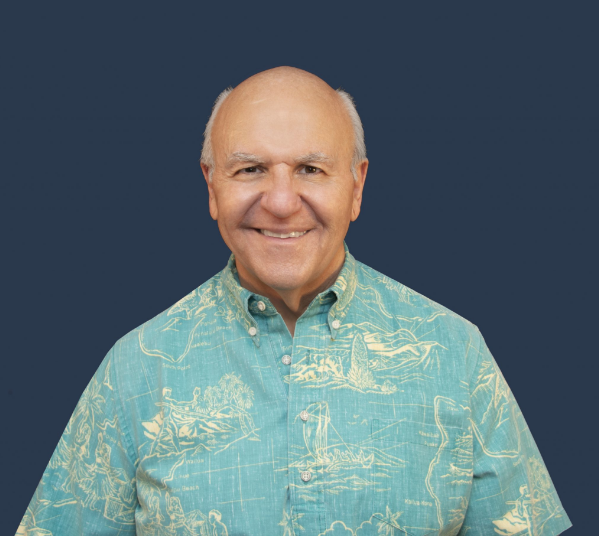
This year 2023, Mayor Blangiardi is back with HB 106 and SB 216 by request to Senate President Ron Kouchi and House Speaker Scott Saiki.
However, presto! The tactics have changed a bit this year. There are five (5) clone bills with the same agenda speeding through.
Google Searches show no county mayors, state legislators or city council members appear to have warned Hawaii about this draconian assault on private properties.
Here are the rest of the three (3) bills.
SB875 is introduced by Senators Stanley Chang, Donovan Dela Cruz and Sharon Moriwaki. This bill is alive and has crossed over on March 7, 2023.
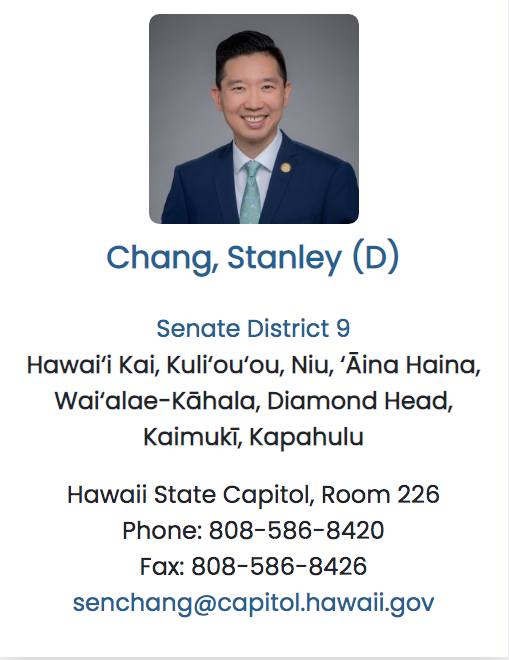
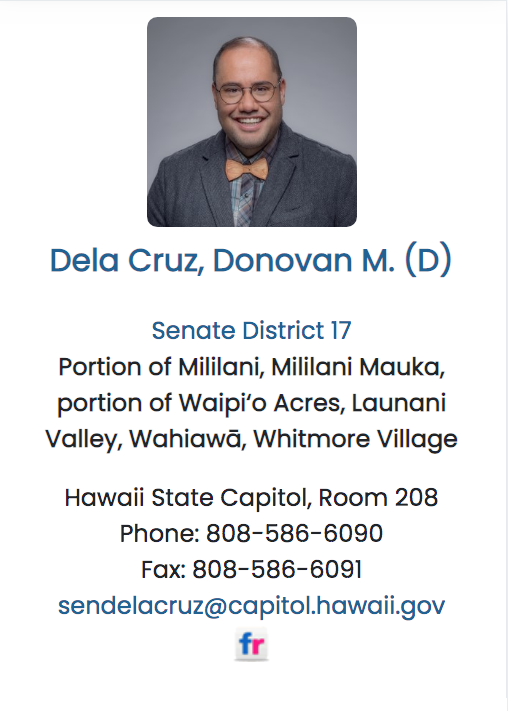
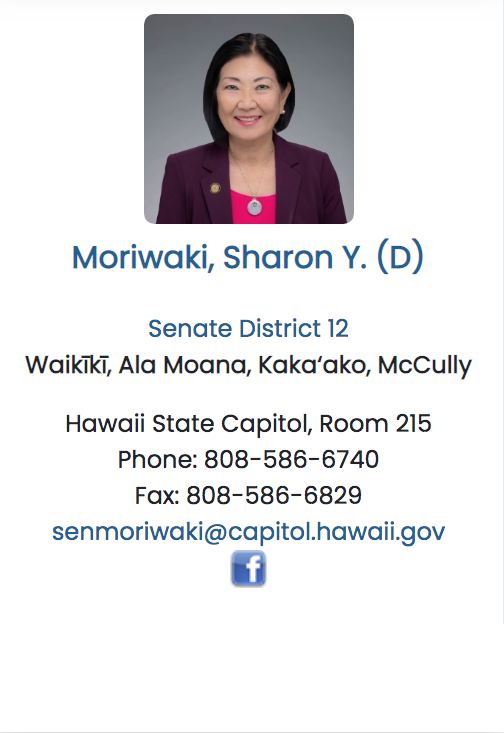
This time around, written testimonies come from only Honolulu City Council former Budget Chair Calvin Say and DPP Director Dawn Takeuchi Apuna.
Companion Bill HB498 is introduced by Representative Jackson Sayama.

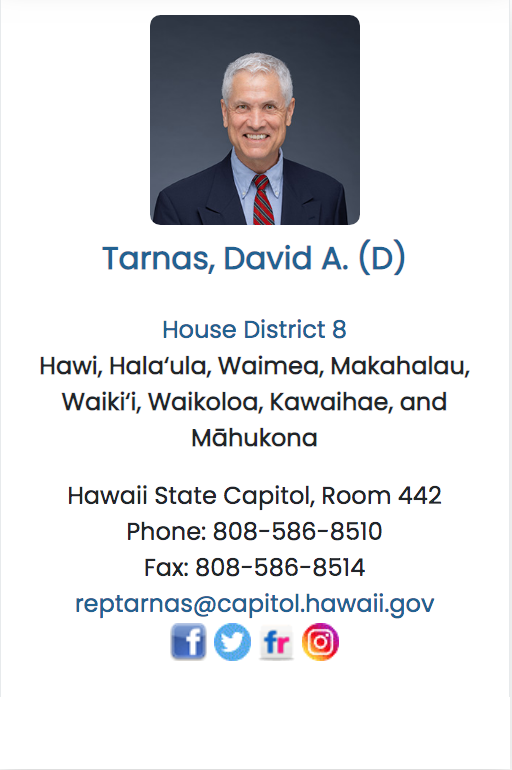
HB 15 is introduced by Representative David Tarnas (D) It has no senate companion bill but it has crossed over on March 7, 2023.
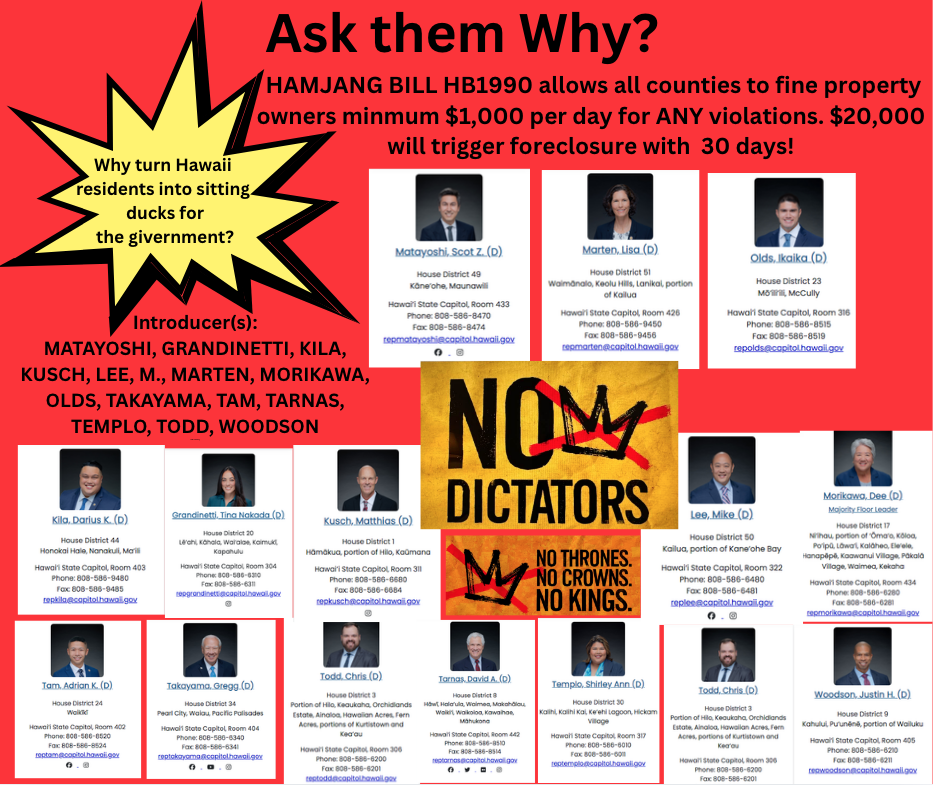
HB538 is another similar one that includes judicial or non-judicial foreclosure. It is introduced by MATAYOSHI, BELATTI, HASHIMOTO, HOLT, KILA, KITAGAWA, LAMOSAO, MARTEN, NISHIMOTO, TAKENOUCHI, TARNAS, Chun.
The time line provided in this bill is too unrealistic. It assumes that DPP is 100% efficient. In actual fact, it takes a very long time to get a permit. Some permits take a much longer time because it may need a shoreline certified shoreline. This could easily take six months to complete.
This is a reprint from the Star Advertiser published February 15, 2023. The limit for Star Advertiser was 600 words. For educational purposes, we’re adding more info through links and photos.
As part of the 2022 county package to state legislators, Honolulu Mayor Rick Blangiardi requested “nonjudicial foreclosure” powers, i.e., the power to seize private property without going to court. Fortunately, House Bill 1434 did not pass last year.
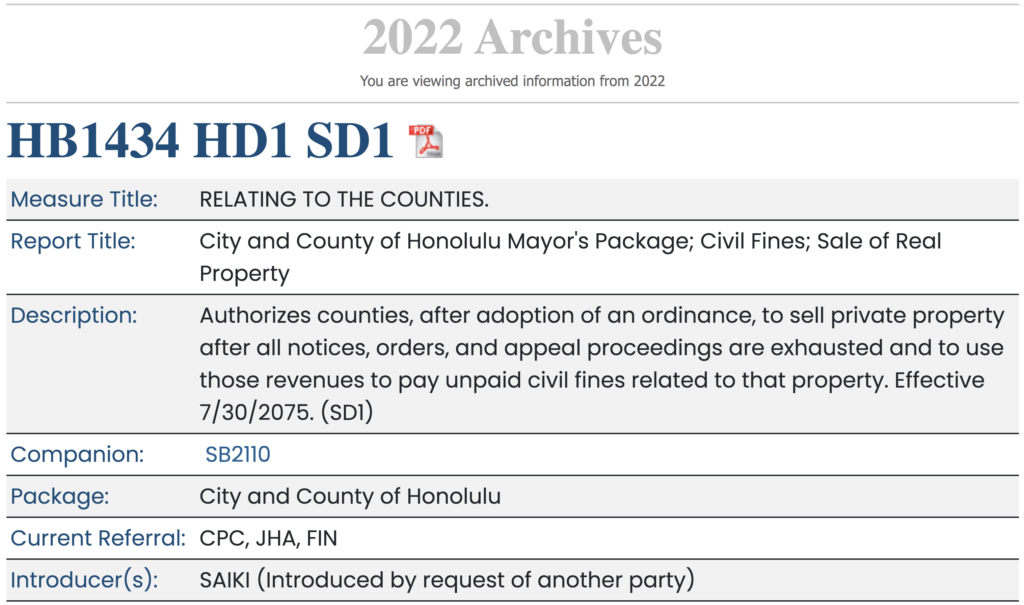
This year’s package includes another request for “nonjudicial foreclosure,” aka “power of sale.” 2023 HB 106 BELOW represents an alarming threat to property owners and is prevalent in totalitarian regimes.
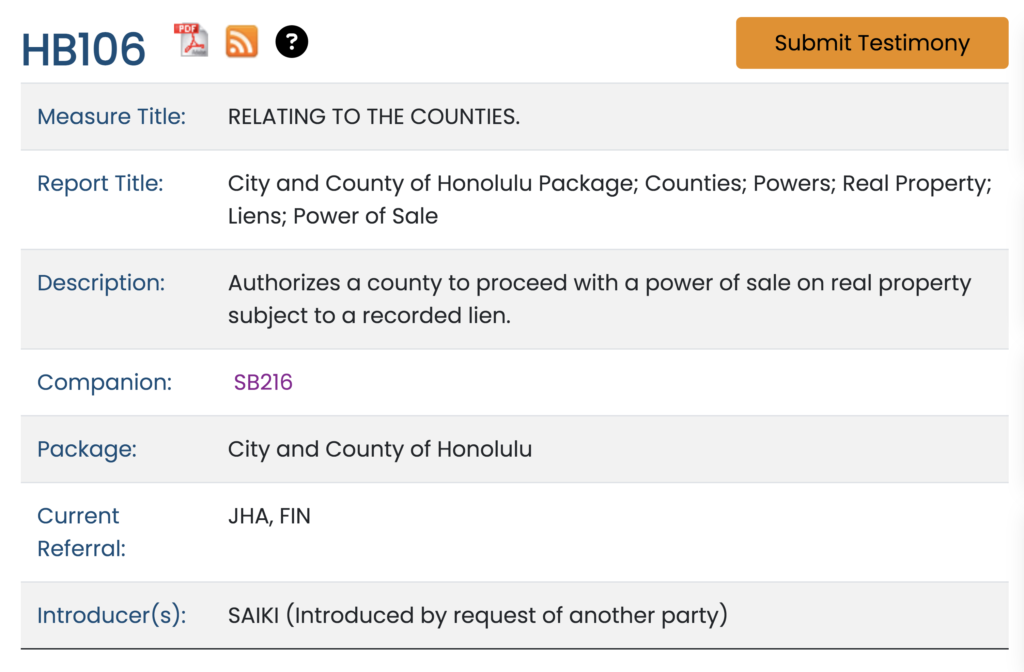
This year’s HB 106 offers weak assurance that “a county may, after all notices, orders, and appeal proceedings are exhausted, satisfy all unpaid civil fines through the power of sale on the real property subject to a recorded lien.”
Unfortunately, our years of civic participation at Honolulu Hale show that due process has not always been fair and equitable to ordinary residents.
Furthermore, recent federal indictments and guilty pleas continue to show the troubled Honolulu Department of Planning and Permitting (DPP) has no consistent record of fair play or efficient management. Written testimonies reveal alarming threats toward private property rights.
Dawn Takeuchi Apana, DPP director designate, stated: “Specifically, this bill would authorize the city to bring closure to pending civil fines imposed on landowners who are in violation of the city’s land use ordinances and building codes, through a nonjudicial or administrative process.”
Honolulu City Councilman Calvin Say also submitted testimony for a quicker seizure: “Our city corporation counsel is currently able to initiate a Judicial Foreclosure process, which has been successful in similar instances, however this is a long process that takes valuable resources away from other pressing legal matters.”
In other words, give us the authorization to hurry it up by bypassing the regular court method of foreclosure.
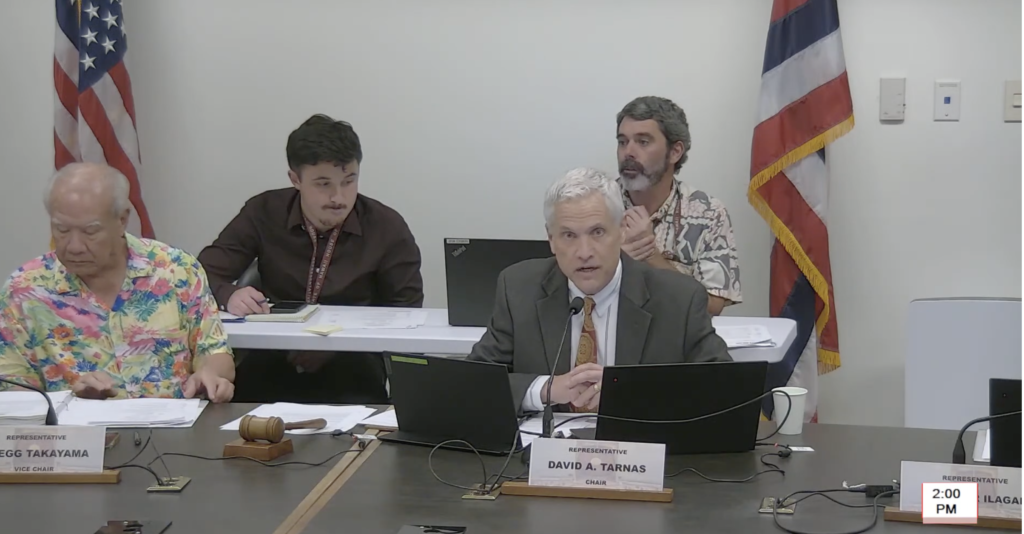
The House Committee on Judiciary & Hawaiian Affairs, whose members include Chairman David Tarnas and Vice Chair Gregg Takayama, approved HB 106 on Jan. 31. Its report states in part:
“Your committee finds that authorizing the counties to collect on liens filed on properties through a nonjudicial foreclosure process provides some leverage over property owners to comply or lose their property. If a property owner fails to comply and the property is foreclosed upon, this measure would enable the property to be put to productive use, allow liens attached to the property to be satisfied, and stop the accrual of additional debt or taxes on the property.”
Hawaii’s state legislators should recognize that most ordinary residents sacrifice and work their tails off to achieve real property ownership. Each county’s goal should be to help property owners comply with the law and correct their violations, not summarily seize their properties.
HB 106 invites corruption and exposes residents, especially those who have fewer financial resources available to them, as easy casualties of this potential power of sale. All Hawaii counties would be affected.
It should be noted the U.S. Supreme Court ruled unanimously on Feb. 20, 2019 (Timbs vs Indiana), that the Constitution’s ban on excessive fines — civil asset forfeitures are a type of fine — applies to state and local governments, thus limiting their ability to use fines to raise revenue.
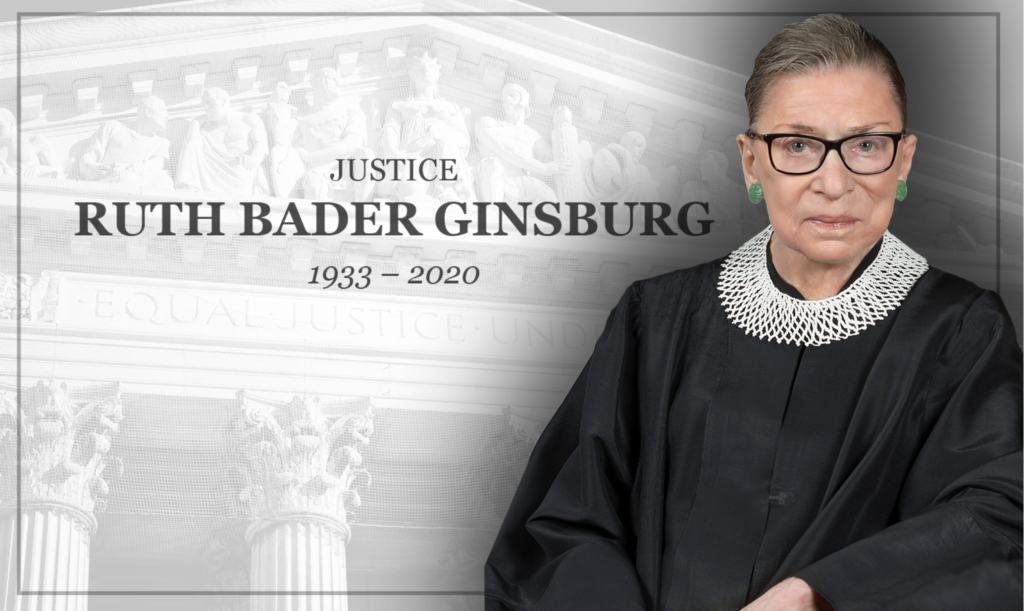
The late Justice Ruth Bader Ginsburg also astutely argued fines could be used to retaliate against political enemies and had been used as a source to raise revenue.
Hawaii has a few egregious property owners, but this tyrannical bill is not the solution. We urge our legislators to vote “no” on HB 106.
###
AUTHORS: Natalie Iwasa is a CPA and certified fraud examiner; Choon James is a residential Realtor and farmer. They have spent combined decades of civic participation at Honolulu Hale as community advocates for good governance.

Ohana Hale Marketplace in Kaka’ako Tenants have to vacate by April 16, 2022. This start-up incubator hub for about 100 small businesses opened in 2018. The tenants supposedly have a 10-year lease from Landlord Howard Hughes. Apparently, there must be a clause that allows the landlord to terminate earlier.
This is just an inkling of what will be happening to small businesses and owners as gentrification continues to encroach on Oahu’s small businesses. Not only are commercial spaces for mom-and-pop businesses hard to find, the leases are becoming too expensive.
These is also another impending landscape change that most residents may not appear to be aware of.
Here is an article that I wrote in CIVIL BEAT on November 12, 2012 about future upheaval and displacement. It will be the small mom-and-pop outfits that will be most affected.
Rail’s Transit-Oriented Development An Assault on Private Property
(Excerpts)
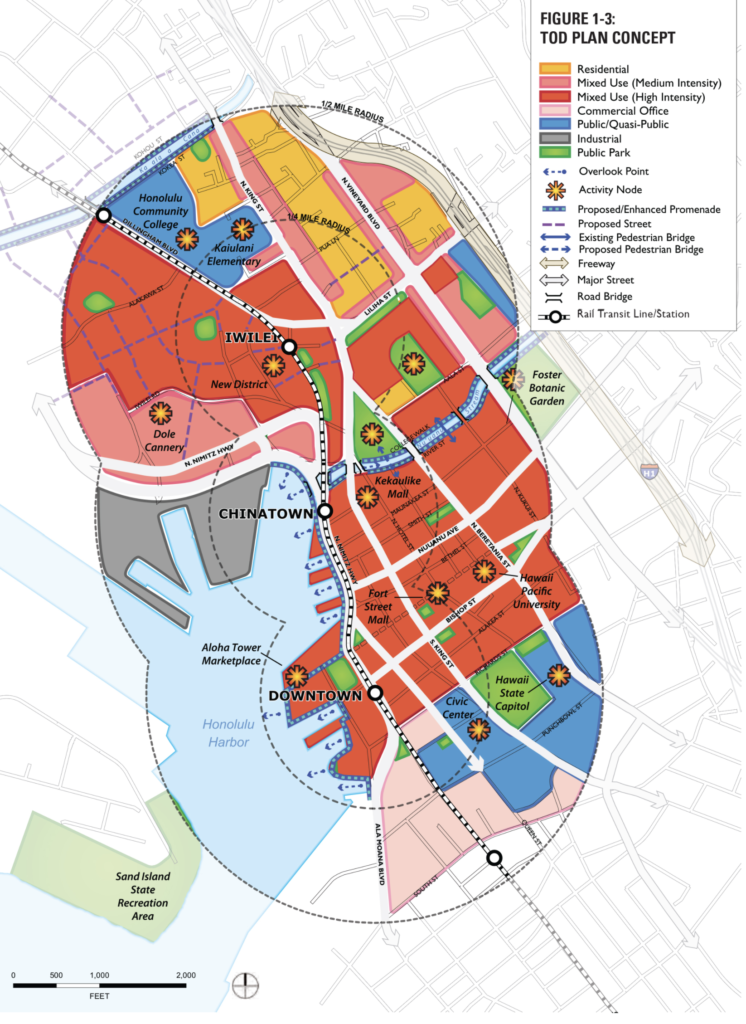
” At each of the proposed 21 rail stations, the city wants TODs “within half a mile radius” vicinity.
At each of the proposed 21 rail stations, the city wants TODs “within half a mile radius” vicinity. The proposed rail stations are located at every mile; this means the whole land area along the entire 21-mile rail corridor is up for grabs. “Half a mile radius” sounds so harmless!
To covet and seize an additional 20 square miles area along this rail corridor on our small island pose a huge economical, social and cultural impact!
It’s not as if private owners can easily relocate down the road. Family inheritances, investments, and businesses built with sweat, equity, and sacrifices will be placed under the mercy of absolute powers of eminent domain. Kama’aina owners and businesses will be pushed out to pave the way for national and international investors.
Here in Hawaii, we observe a similar “revitalization” process has been set in motion. City “experts” are holding “Community Visioning” meetings to discuss “Neighborhood TOD Planning”.
The city wants to “take advantage of rail to its optimal level” and to “concentrate population” along this rail corridor.
The dangerous potential for the city to seize 21 square miles of private properties for transfer to private investors has to be reckoned with, today. The proposed Honolulu Rail is not only ugly, noisy, and a black hole for Oahu’s taxpayers; its accompanied TOD is a direct assault on private property rights.
No Oahu residents should sit idly by and condone such autocratic land-use plans for our island home. It is wrong. It’s dangerous. It’s unAmerican. It goes against the core tenets of our free society.
City planning and developments must conform within the constitutional parameters of private property rights. This should have been a big part of the public deliberations. Any “exemption” laws to skirt this right must be rejected. Too many big decisions have been manipulated and controlled by raw crony capitalism and special interests. Private property owners continue to trampled on and pushed aside by the big boys.
We must take our government back.”
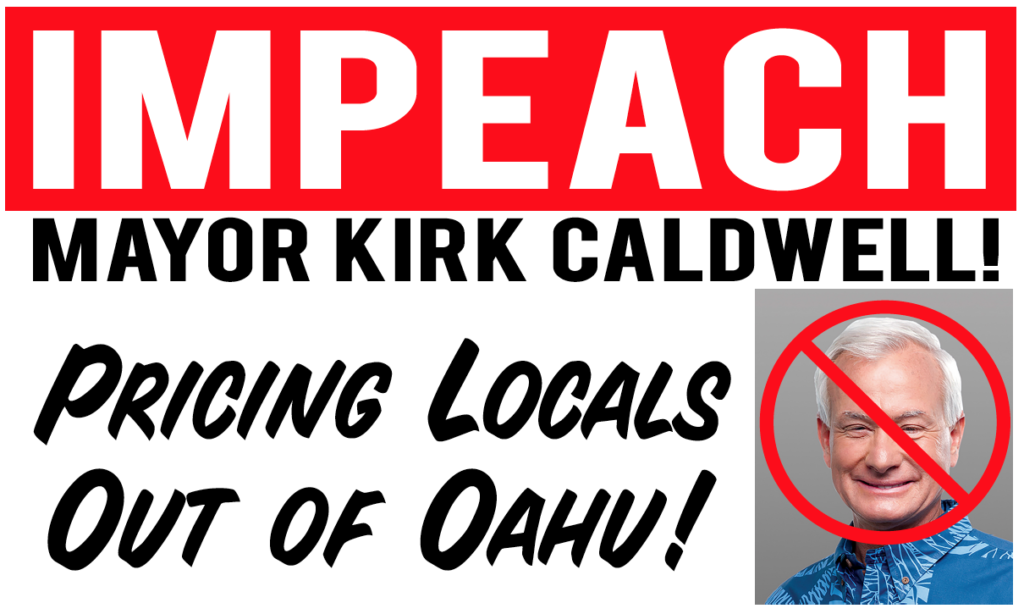
Download Petition here! http://www.ImpeachMayorKirkCaldwell2019.com
Not registered to vote? No Problem! REGISTER to vote here!
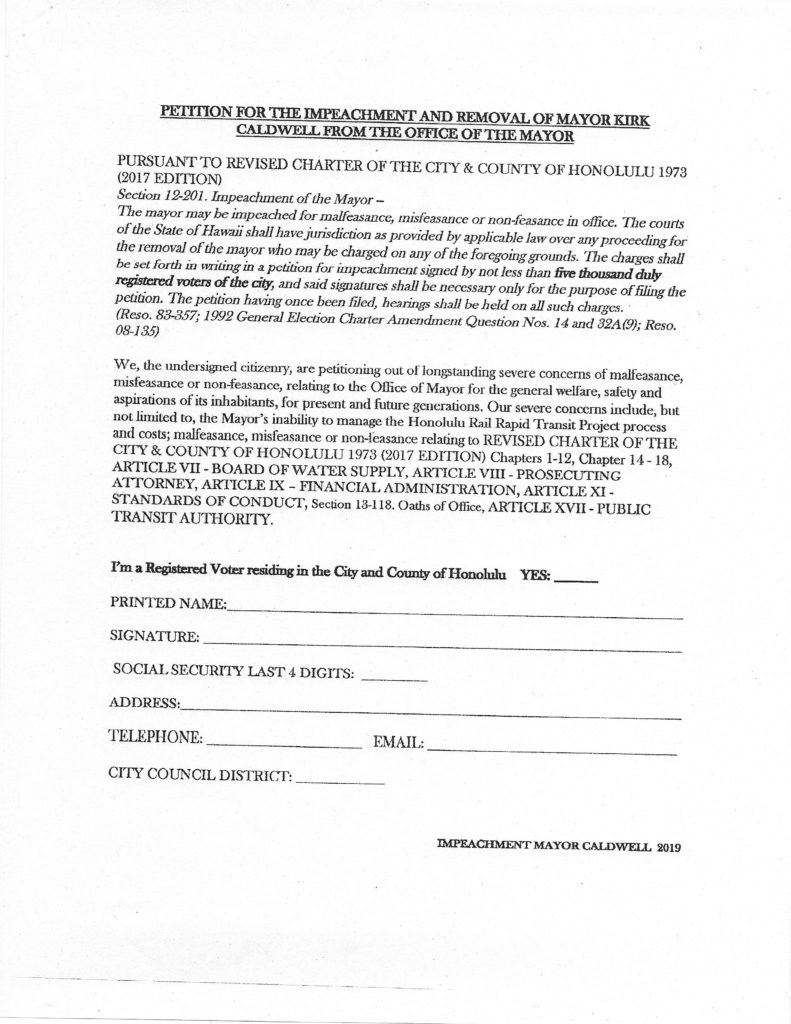
PETITIONS TO IMPEACH MAYOR KIRK CALDWELL
Persons of contact: Choon James 808 293 8888 Kapohuolahaina Moniz Pa Dave Moskowitz 203 8898 EMAIL: ImpeachMayorCaldwell2019@gmail.com
We are severely concerned with the malfeasance, misfeasance, and non-feasance behavior that have been happening at City Hall.
We have watched with horror the escalating mismanagement and runaway costs of the mismanaged and outdated Honolulu Rail Transit project. The Rail project was grossly under-estimated at $2.7 BILLION in 2006. Today, it’s escalating to $10 Billion with unknown costs. Even the Operations & Maintenance costs and ridership revenues are unknown. The Rail project is now under federal investigations. There are relentless reports of mismanagement and fiscal mishaps about the rail but Mayor Caldwell acts oblivious to them.
Consequently, core services are being undermined while our taxes and fees are escalating. GET/property taxes have increased. “Residential A” property taxes for local landlords who provide services to long-term renters have tripled, triggering rent increases. Other fees like vehicle registrations, sewer and water fees have increased. Our mainstream residents are struggling with these escalating costs of living.
The last two years had more Hawaii residents LEAVING, due mostly to “high costs of living”. We’re being priced out of our house and home.
The list of Mayor Caldwell’s arrogance, corruption, and mismanagement includes, but not limited to, the following: The independent Ethics Commission Director Mr. Chuck Totto was ousted. The former Honolulu Police Chief Louis Kealoha is on trial at the federal courts. The Mayor’s chief Corporation Counsel Donna Leong is on paid leave, related to the Kealoha federal investigations. The city’s Prosecutor is being investigated and on paid leave.
Homelessness, crime, environmental degradation, monster homes, violations of residents’ civil rights, violations of state and US Constitution that force the city to pay for settlement awards, abuse of the Community Development Block Grants and so on. Mayor Caldwell is not responding to severe land-use and planning concerns relating to, but not limited to, the Ala Moana Regional Beach Park, the Sherwood Forest Beach Park in Waimanalo. The cries of residents to have basic clean and well-managed beach parks and other public facilities in ALL parts of Oahu are ignored.
Every day, we see the Mayor’s bad behavior and we feel angry but helpless. We see our beloved island worsening. We see ourselves being forced to pay the price for his bad management and bad decisions.
We cannot afford to give Mayor Caldwell any more time to further destroy our island and price us out of our homes and island.
Today, we’re taking a stand and rising up. We need and want new leadership of honesty and transparency and putting RESIDENTS FIRST!
We want fairness, even application of the law and city’s funds across Oahu.
We want to do away with political “pay to play” games at the taxpayers’ expense.
We want our neighborhoods to be clean and safe.
We want to protect Oahu’s overarching environment, sustainability, safety, and prosperity for our children and their future.
We want to live in our beautiful island and not be priced out!
We want to take our government back!!!
Please kokua. Stand up and be counted! Please sign the petition to impeach Mayor Caldwell to send him a message that we’re not happy with the direction Oahu is heading! Mahalo!
There have been various suggestions ranging from work schedules amongst civil government workers or UH and public/private schools students, bus rapid transit, telecommuting, and so forth.
I am no expert in this area. I could list some of the ideas put forth by others but it does not do the city justice.
What I think would be good is if we offer a substantial cash prize for a traffic decongestion competition.
NASA does competitions regularly for solutions.
We need to be sure to keep the lobbyists, publicists, marketeers, and the good old boys club at bay.
Allow the independent and fresh minds to have a go at the solutions.
Then, allow the public to review and opine on the ideas put forth and choose the most viable and effective ones that reflect our island values and sense of place.
Our residents have valuable local knowledge and wisdom and can contribute to the solutions.


The Honolulu City Charter clearly states the purpose for its being:
“Section 2-102. Purposes — All city powers shall be used to serve and advance the general welfare, health, happiness, safety and aspirations of its inhabitants, present and future, and to encourage their full participation in the process of governance.”
Unfortunately, in real life, when Mayor Kirk Caldwell has his own pet project, the opportunities for citizen participation are met with disinformation, retaliation, and abuse of city powers/resources. The circle-the-wagon mentality kicks into gear from the top on down. Similar ill-thought justifications are parroted from top on down. Process reports and Budget Forms are filled with fabricated information. Lies are perpetuated top on down.
If citizens further resist, there are always the Mayor’s spokesperson and media trolls to vilify the messengers and to create confusion and distort facts. (There is an unspecified number of public relations and assistants, paid for by taxpayers, who service Mayor.)
An example of this dark side at City Hall would be Hauula Fire Station Relocation project. Despite robust protests and over 1,200 signatures against this extravagant relocation, the city stuck to its nefarious PR tactic to distract from the city’s gross malfeasance in this process.
The below August 18, 2008 letter is the “sale contract” that the city and clan freely disperse to the public to distract from its failures to provide due process to the most affected citizens in Hauula. The fact is, even if the owner DONATED the land to the city for the project, the city still has to provide due process to the people living next to this despised project. The city miserably failed its environmental review process to the people of Hauula.
August 18, 2008. This is the CHERRY-PICKED letter used by the city and clan to hoodwink the city council and the public. This letter does not even meet the basic rudimentary of a basic sale contract, if there was one.

July 2009 – This subsequent city notice is never provided to the public by the city – “This Notice is not a contractual offer or commitment to purchase your property”.


December 13, 2013 Deposition was taken under oath from Land Chief Thomas Miyata where he finally had to stop his lies about an agreement to sell and confess that “ there was no agreement between Miss James and the City for the City to purchase or Miss James to sell her property.” Page 120.


Additionally, when Hauula residents protested with signs against the extravagant relocation of the $13 Million Hauula Fire Station Relocation, Mayor Kirk Caldwell dispatched the Department of Maintenance & Facilities from Halawa (under the supervision of William D. Balfour, Jr.) to seize the free speech signs. The federal judge had since ordered the City and County of Honolulu to pay the legal fees of the Plaintiff.

Mayor Kirk Caldwell further engaged the City Corporation Counsel to bully the residents by erecting threatening signs to forcefully close down the recycling center that many depended on. The irony is the Mayor has already stolen $4.6 Million of federal HUD Community Development Block Grants ( CDBG) for this pork project. CDBG funds are meant to improve the quality of lives and economic opportunities in low-income communities. Recycling is a critical cottage industry where even the homeless recycle daily to buy themselves a hot meal! The people are asking for “bread’ but this Mayor is forcing “cake” on them.
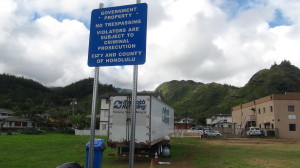

When residents further protested with new signs below, the Mayor dispatched city county inspectors to threaten private property owners with a daily $50 fine if they did not remove the signs!

As of this writing, there are three Hawaiian kupuna ( 2 of them in their 80s) resisting Mayor Caldwell in the federal courts now. Federal Judge Leslie Kobayashi is hearing the case. CV No: 15-00193 LEK-RLP
Additionally, in April 2017, Mayor Kirk Caldwell opened this controversial project up for bids ( for $7M) when the funds have been deleted by the city council!
Residents are thinking that Mayor Kirk Caldwell is employing the same tactics – SUNKEN COST FALLACY – as he does for the Honolulu Rail. He’s hoping to encumber as much costs as he can, hoping the judge will not take a bold action against his malfeasance.
A citizen should not be surprised at these capricious and nefarious tactics. Whether it’s a huge project like the Honolulu Rail or this relocation project, the same modus operandi – lies, distractions and retaliations – is implemented.
Honolulu deserves better.
