

Tag Archives: Honolulu City Council

Hawaii Legislators Introduce House Bill 1861 to Deny Due Process to ALL Counties

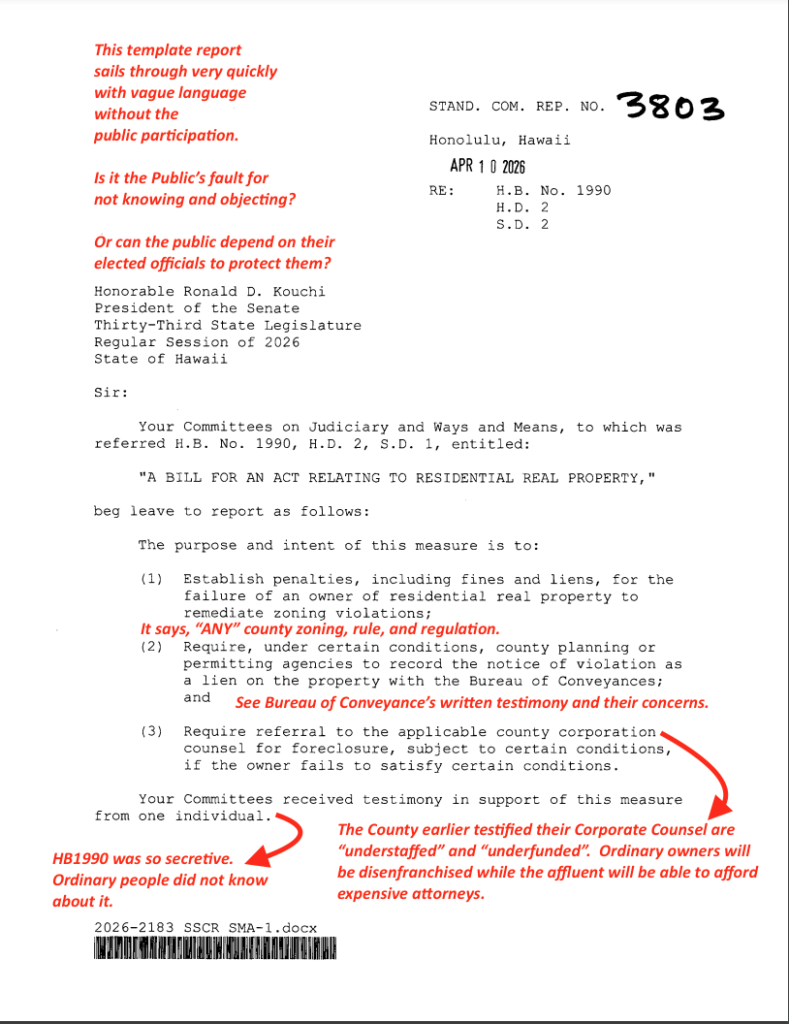
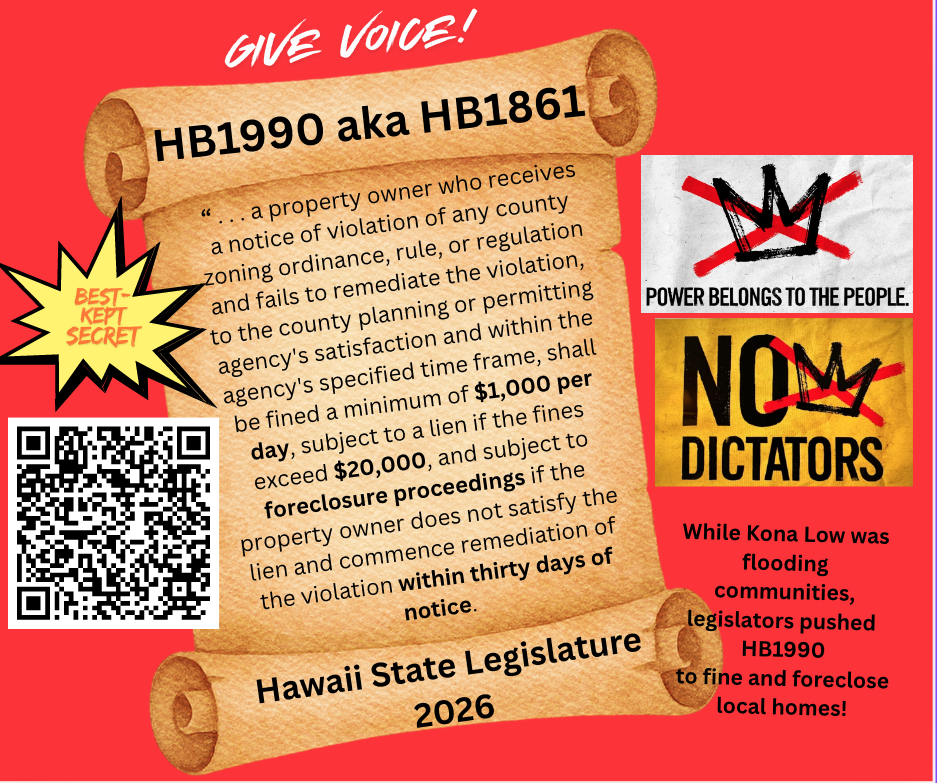
Hawaii Legislators want to remove DUE PROCESS from Private Property Rights through HB1861 aka HB29. New NON-Judicial Power of Sale to seize private properties based on county fines. No court. Just Non-Judicial Foreclosure.

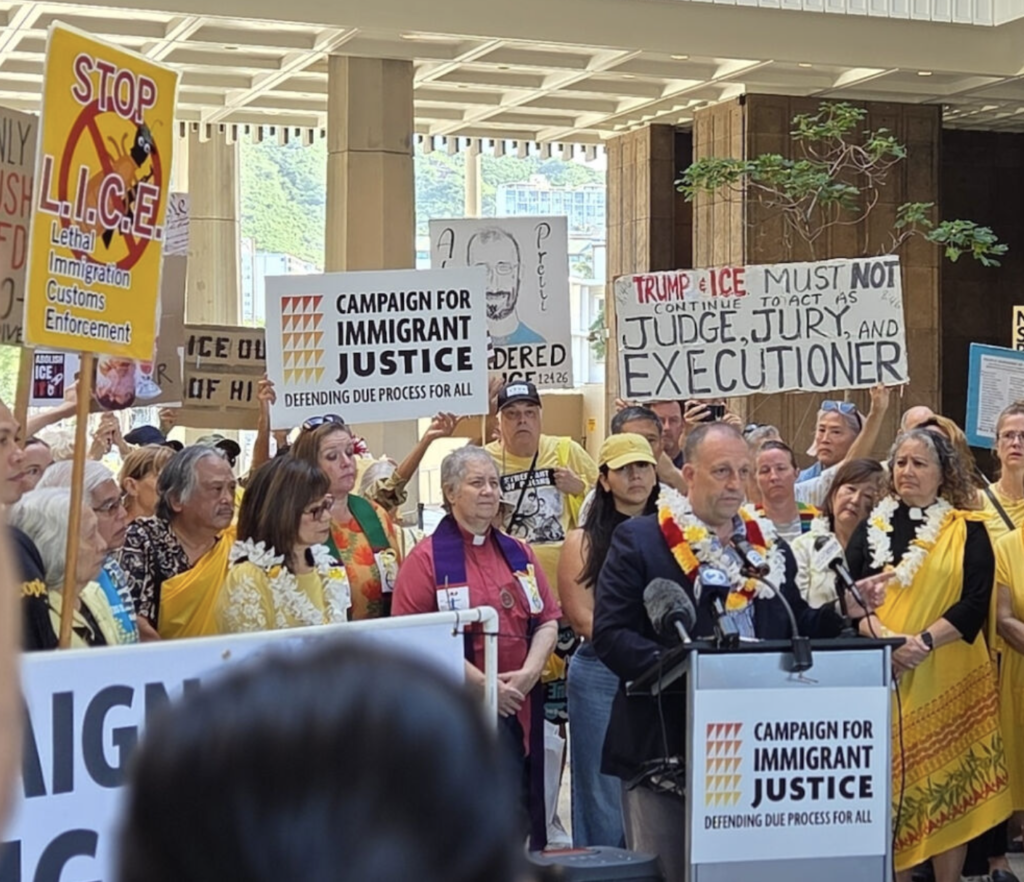
On the other hand, Democratic Party affiliated protesters organized nation-wide civic resistance – “No Dictators” protests against the Trump administration’s policies relating to civil rights, Due Process and democracy in October, 2025.

Such rallies were held the Hawaii State Capitol and neighbor islands including Hilo, Waimea, Kona, and Kahului.

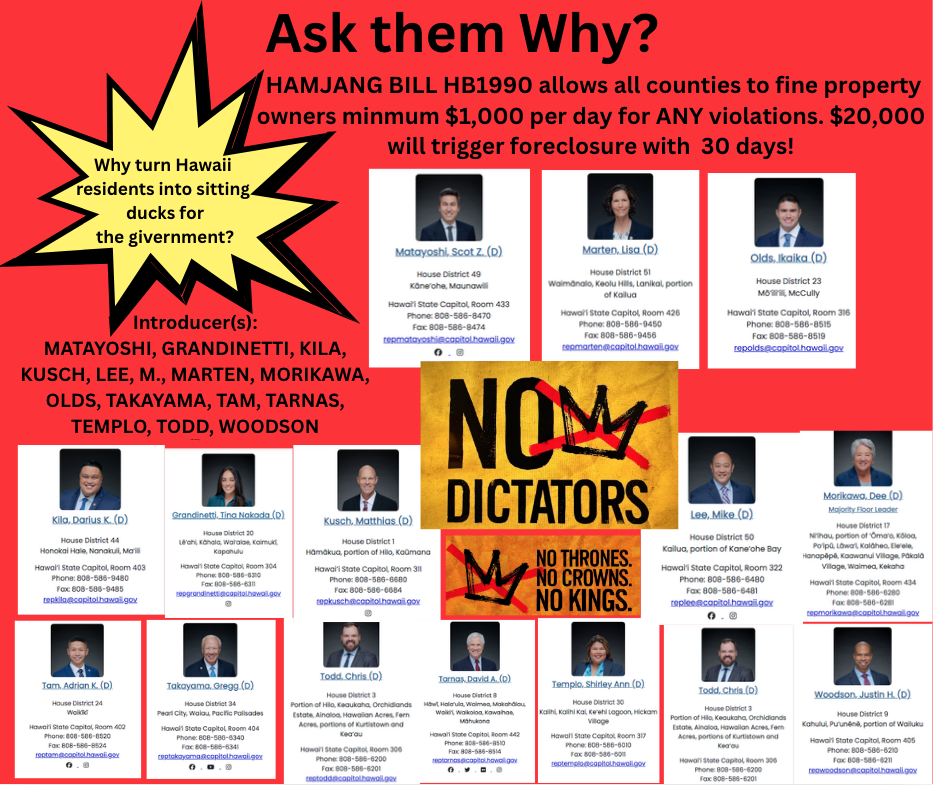
In January 2026, these four Hawaii Legislators want to remove DUE PROCESS from private property owners through HB1861 aka HB29.

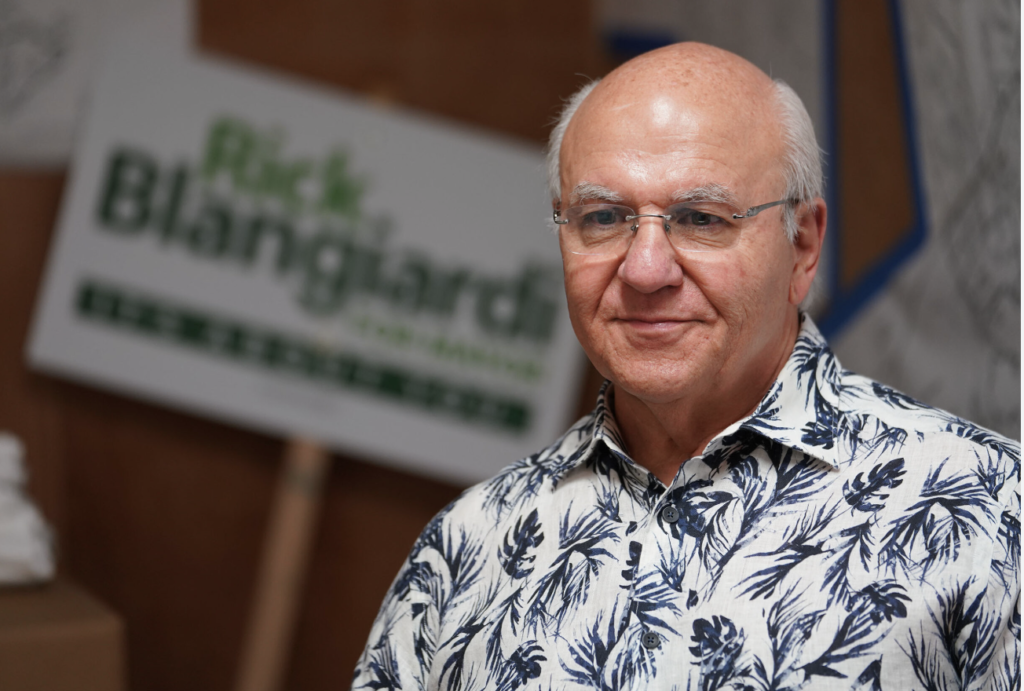
This unconstitutional Tyranny agenda began with Honolulu City County in 2021. The Blangiardi Administration introduced NON-Judicial Power of Sale in 2021. The Department of Planning and Permitting (DPP) gets to issue violations, place fines and to seize property without no Due Process of going to court. They want a fast Power of Sale based on DPP fines – no court Due Process.

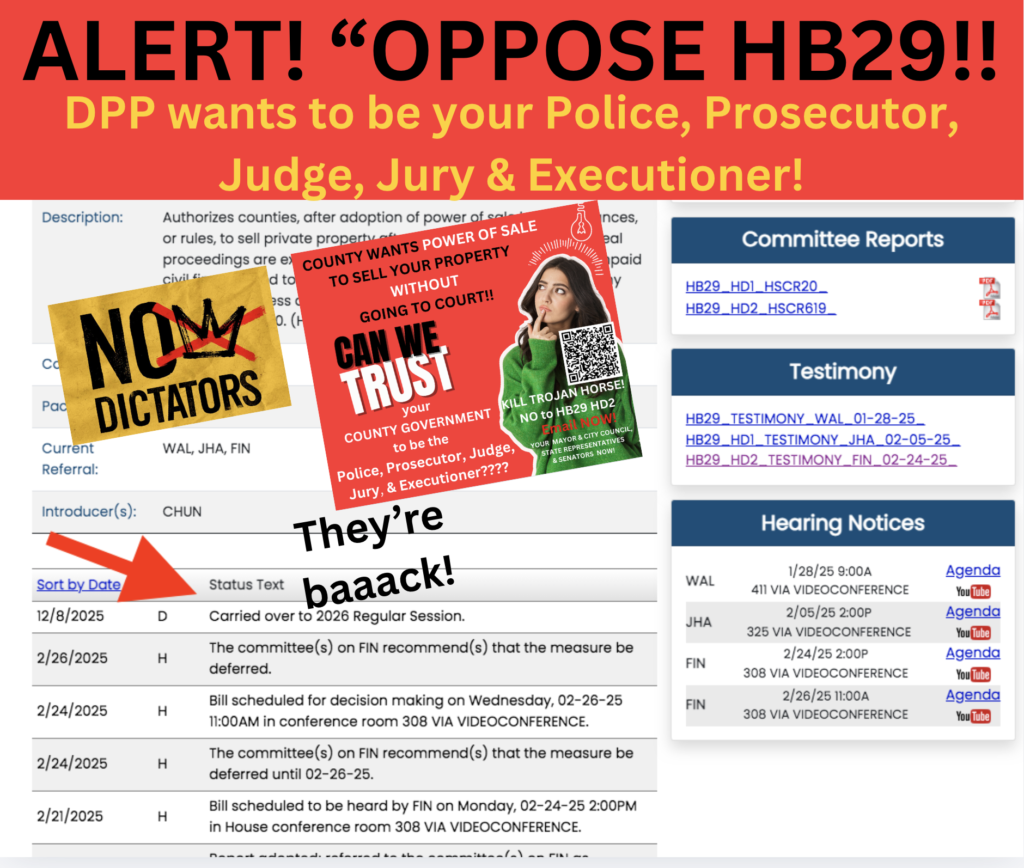
Who wants to give more powers to the long arm of the government? Who wants DPP to be the Police, Prosecutor, Judge, Jury, and Executioner?

Private Property owners will be stripped of Due Process if these non-judicial Power of Sale are adopted by the Hawaii State Legislature this year.

It’s ironic that the Unhoused now has more rights than ordinary private property owners and renters if non-judicial Power of Sale based on county civil fines is adopted through HB1861 aka HB29.

Below excerpt is for educational purposes. The Unhoused is guaranteed an expanded Due Process Rights while private property owners will be denied Due Process in court.

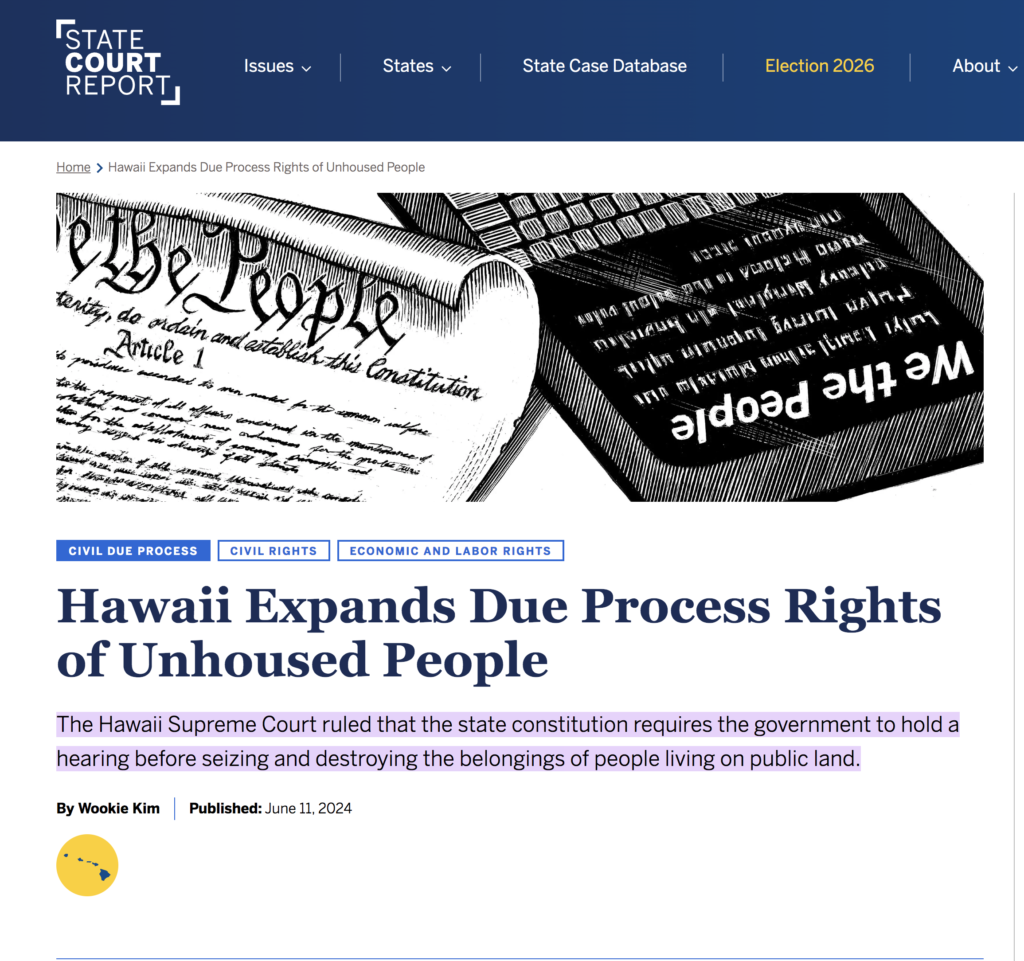
Due Process in Hawaii is fundamentally guaranteed by Article I, Section 5 of the Hawaii Constitution, protecting life, liberty, and property from arbitrary government action. It ensures fair legal proceedings, including the right to counsel in specific cases, and has been recently applied to protect the property rights of unhoused individuals and the rights of parents in child protective proceedings.

Wookie Kim is the legal director of the ACLU of Hawaiʻi, which represented the plaintiffs in Davis v. Bissen.

On September 20, 2021, a group of unhoused people living near Kanahā Beach Park in central Maui were awakened by police officers and other Maui County workers armed with forklifts, dump trucks, and other heavy machinery. Wielding the threat of arrest and prosecution for criminal trespass, they forced everyone living in the park to leave immediately — with or without their personal belongings.

The county seized everything that was left behind. All told, the county impounded dozens of vehicles and immediately destroyed tons of property, including tents, clothes, pots and pans, child car seats, strollers, and water tanks.

Earlier this year, the Hawaii Supreme Court unanimously ruled in Davis v. Bissen that the county’s actions violated the due process rights of the people whose property was seized.

In an opinion authored by Justice Sabrina McKenna, the court held that “unabandoned possessions of houseless persons” were a “classic form” of property protected by Article I, Section 5, of the state constitution, even if such property was in a public space. The private interest at stake was “significant,” the court said, and the county’s “unchecked decision to seize and destroy the plaintiffs’ personal property posed a high risk of erroneous deprivation of property.” 

Moreover, the court held, because “the county’s plan was to destroy (instead of store) seized property,” it could not carry out the sweep without first conducting a “contested case” hearing under the Hawaii Administrative Procedure Act. A contested case hearing is a proceeding before the relevant agency (here, Maui County) in which the agency considers evidence, hears testimony, allows for cross-examination of witnesses, holds oral arguments, and renders a decision about the legality of a planned action, much like a court proceeding.

Here, the plaintiffs had formally requested such a hearing before the sweep occurred, but Maui County ignored those requests. As later court filings would reveal, the county’s stance was that it did not need to hold any hearings. Why? Because, it maintained, unhoused people’s property was “on government property without permission and in violation of trespassing laws” and, therefore, was not protected by due process in the first instance. But, as the court’s decision confirms, one does not forfeit due process protections simply by leaving property in a public space.

The ruling paves the way for a potential first: the holding of a contested case hearing before a local government conducts a sweep of a houseless encampment. While such a hearing would be routine for, say, a landowner challenging the state’s decision to bulldoze a home erected on her property, to my knowledge no municipality in the country has ever held or been required to hold such a robust hearing before destroying the property of unhoused people. While the plaintiffs in this case may only get a post-deprivation hearing on remand, going forward unhoused people in Hawaii may be entitled to a full-blown contested case hearing before a planned sweep.

This could have significant practical effect on the lives of an immense number of people in Hawaii: As of 2023, there were 6,223 houseless people in in the state. Native Hawaiian women, including two of the four plaintiffs, are disproportionally impacted by Hawaii’s housing crisis. Maui County uses sweeps to force — or, as Honolulu officials euphemistically describe it, “gently coerce” — unhoused people into pulling themselves up by their bootstraps. (Never mind that many unhoused people in Hawaii are employed, including all but one of the plaintiffs in this case, who work in service jobs tailored to Maui’s tourism industry.) Rather than helping people get off the streets, sweeps only perpetuate the homeless crisis.

Beyond its practical impact, a state supreme court win squarely vindicating the due process rights of unhoused people also carries symbolic weight. Our legal system structurally disfavors unhoused people: as scholar Wayne Wagner has written, “homeless persons possess fewer and lesser legal rights” than those who live in houses or apartments. Many of our constitutional rights — including those relating to privacy and autonomy — are predicated on owning or having possession of real property, a place to which one can retreat from governmental interference. Further, in lacking access to conventional housing, unhoused people are more likely to be politically disempowered because of difficulties in proving identity or residence when registering to vote. The Hawaii Supreme Court’s declaration that government actors are bound to respect due process for everyone, unhoused or not, at all times, is a victory for the principle of equality under the law.

Finally, the court’s decision is notable not only for its holding but for the way it got there. The court applied what it calls the “state-constitution-first approach” to constitutional interpretation. Under that approach, the court “interpret[s] the Hawaii constitutional provision before its federal analogue.” The court adopted this approach less than a month earlier in State v. Wilson — a case construing the Hawaii Constitution’s analogue to the Second Amendment — to govern how it would resolve cases in which a party “invokes both the Hawaii and United States Constitutions.”

In choosing to interpret and rely exclusively on the state constitution in its Davis decision, the Hawaii Supreme Court has highlighted the “distinct role [of state constitutions] under our nation’s system of federalism” and reminded us, once again, that state constitutions can be as important a source of rights as the U.S. Constitution.

Suggested Citation: Wookie Kim, Hawaii Expands Due Process Rights of Unhoused People, Sᴛᴀᴛᴇ Cᴏᴜʀᴛ Rᴇᴘᴏʀᴛ (Jun. 11, 2024), https://statecourtreport.org/our-work/analysis-opinion/hawaii-expands-due-process-rights-unhoused-people.  

KILL House Bill 1861 aka HB29 –  Best-Kept Secret Hamajang to Deny DUE PROCESS to HAWAII 

Hawaii is vigorously protesting “NO KING – NO TYRANT – NO ICE ” to demand constitutional Due Process for all.

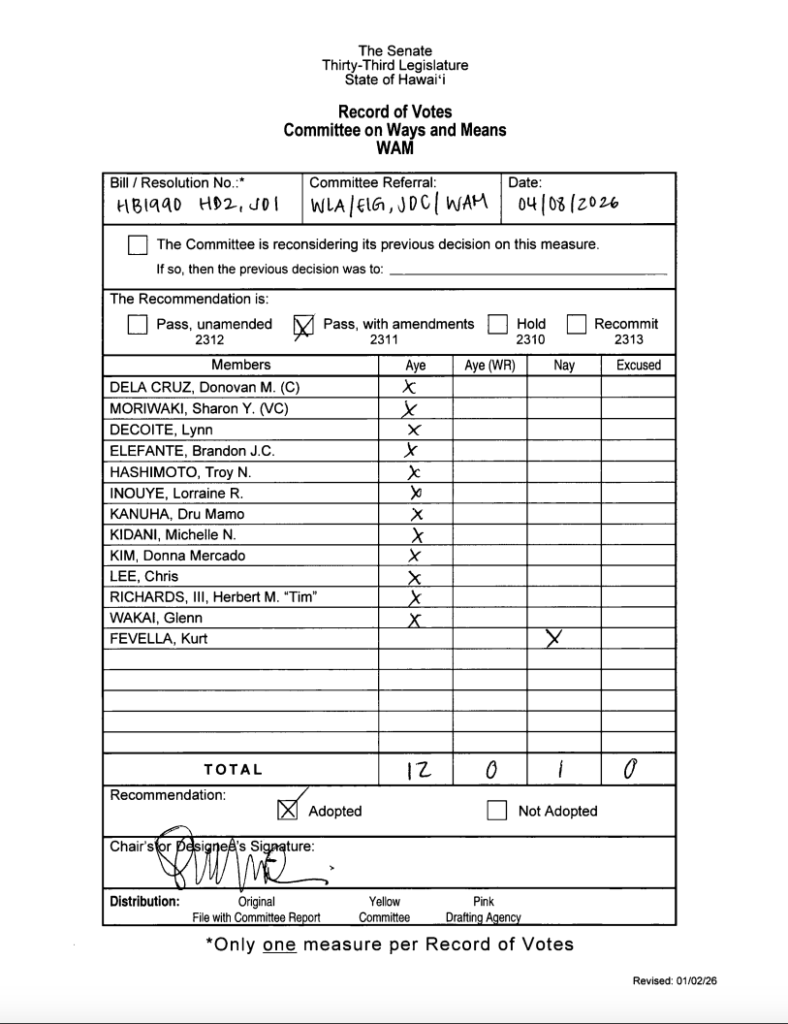
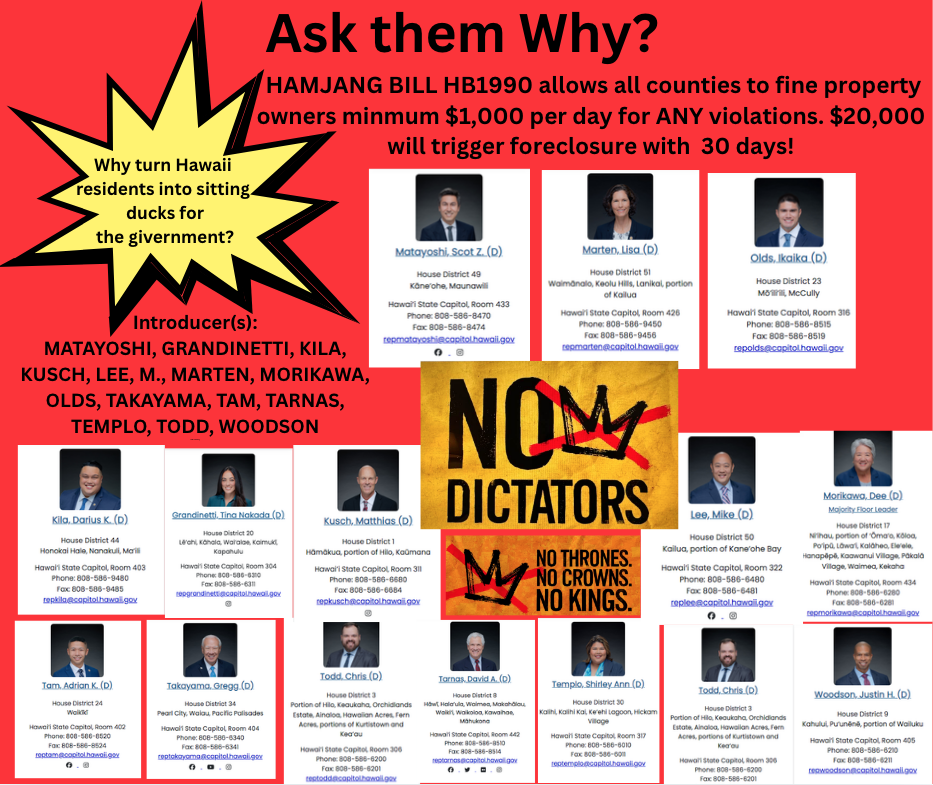
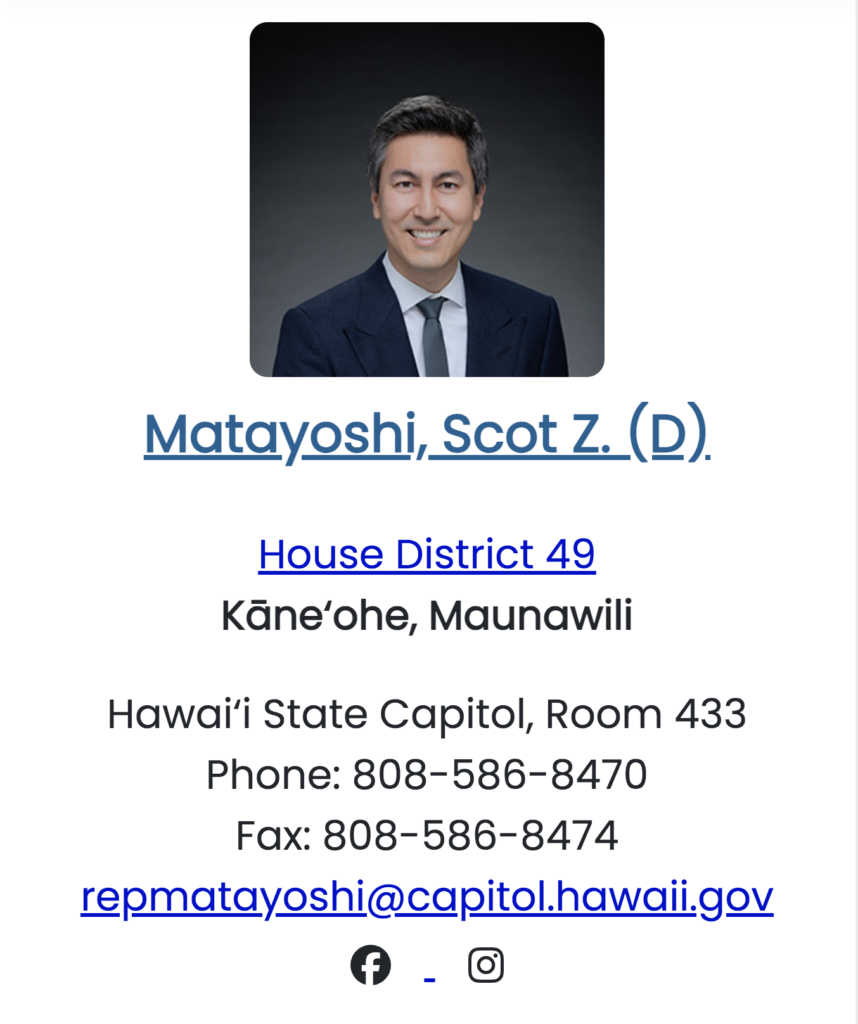
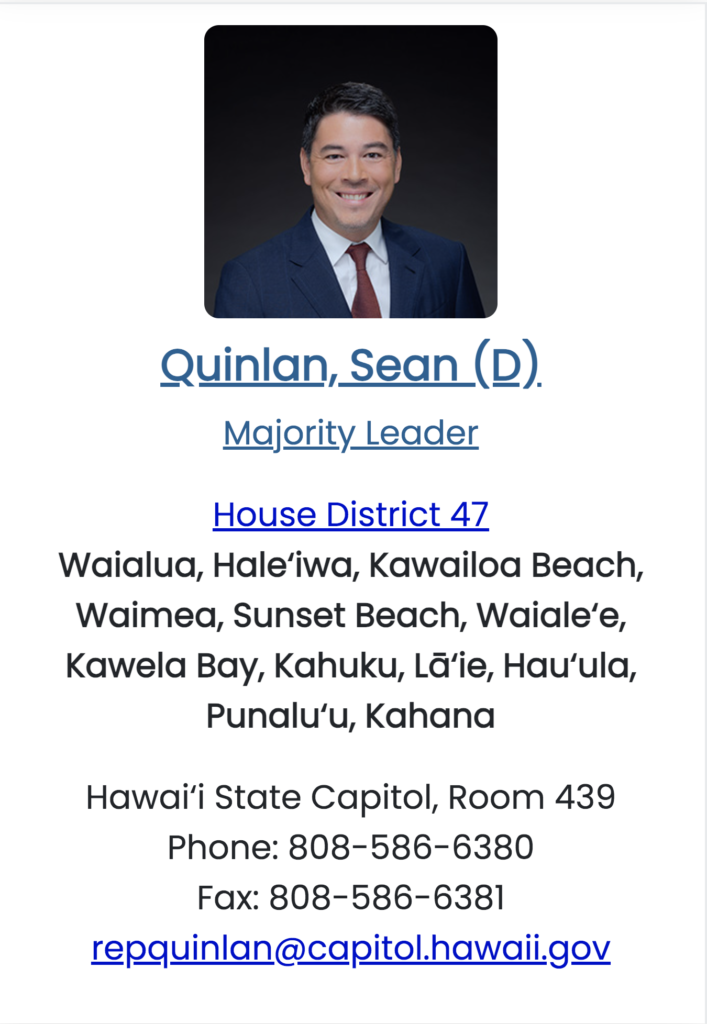
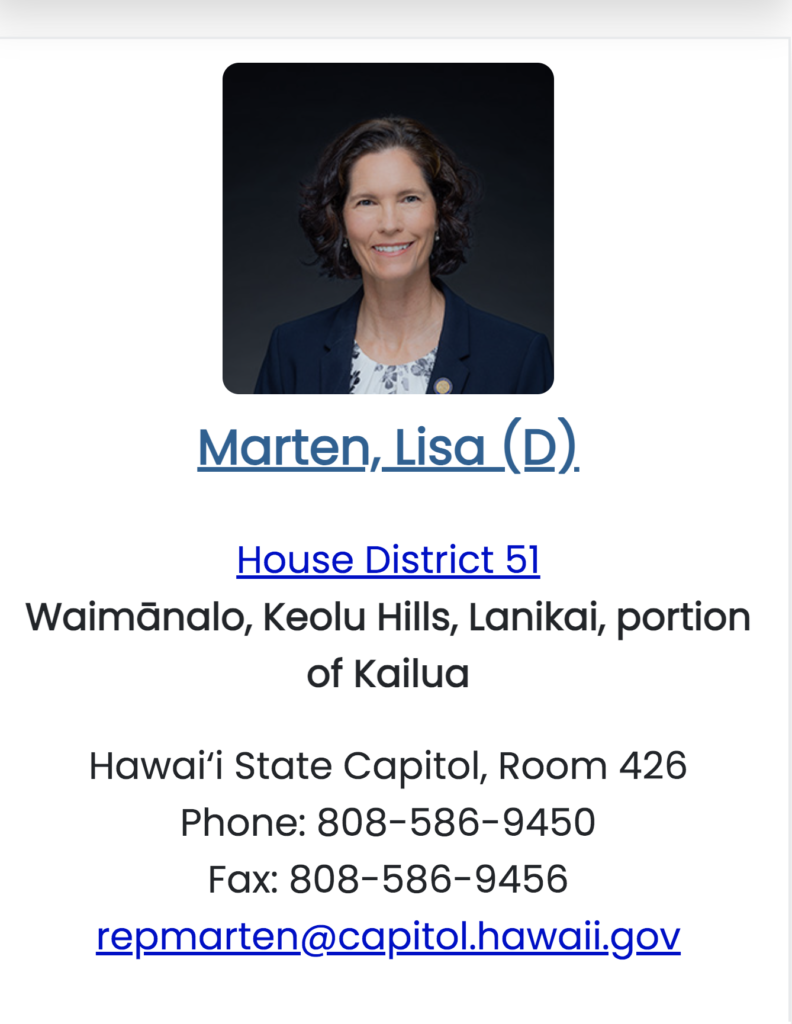
Yet, four (4) Hawaii State House Representatives – Sean Quinlan, Scott Matayoshi, Lisa Marten, and Ikaika Olds – have introduced House Bill 1861 aka HB29 to deny DUE Process to all Hawaii counties. 

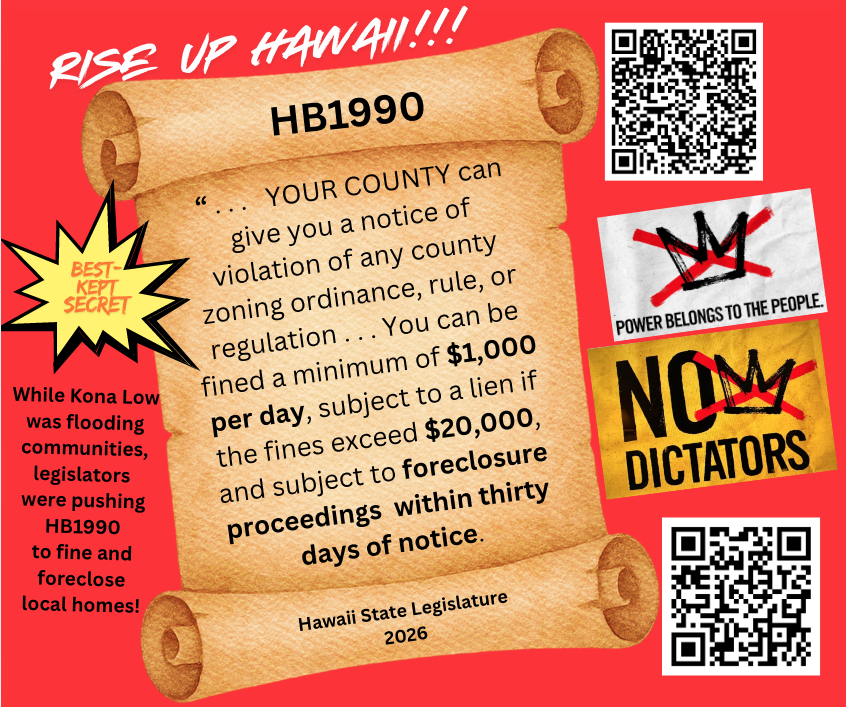
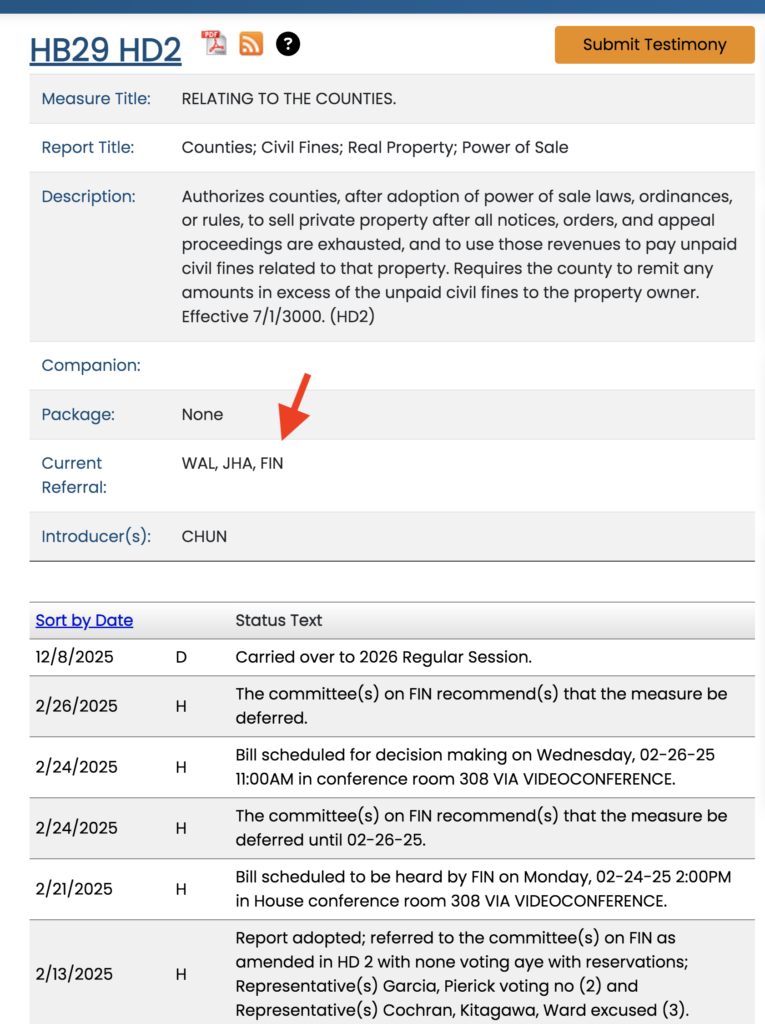
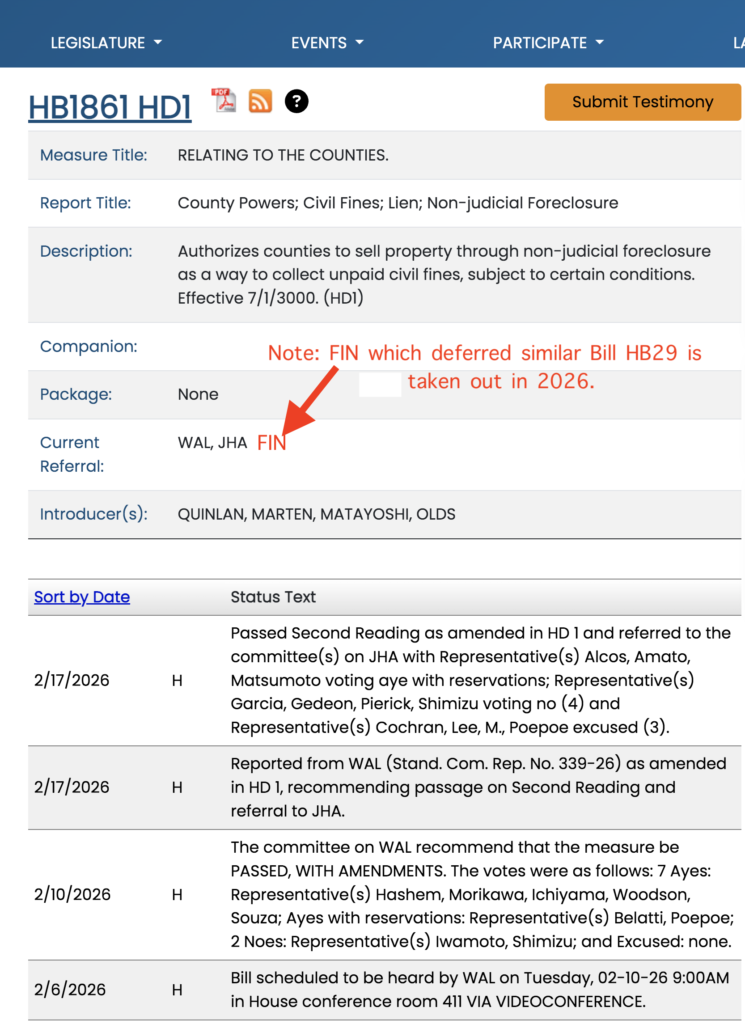
HB1861 (2026) authorizes counties to sell property through non-judicial foreclosure as a way to collect unpaid civil fines. Owners cannot go to court to explain or protect themselves. Period. Judicial Due Process is denied.

Yet, four (4) Hawaii State House Representatives – Sean Quinlan, Scott Matayoshi, Lisa Marten, and Ikaika Olds – have introduced House Bill 1861 aka HB29 to deny DUE Process to all Hawaii counties. 

HB1861 (2026) authorizes counties to sell property through non-judicial foreclosure as a way to collect unpaid civil fines. Owners cannot go to court to explain or protect themselves. Period. Judicial Due Process is denied.

This stealth anti Due Process agenda has been happening for five years!    

The Honolulu County Blangiardi Administration spear-headed this hamajang in 2021 through House Bill 1434 /Senate Bill 2110  – requesting a new NON-JUDICIAL Power of Sale based on the Department of Planning and Permitting (DPP) civil fines. The Mayor’s DPP Director testified that existing “Eminent Domain” was too slow, took manpower, and resources.

Can you trust the troubled DPP to be your Police, Prosecutor, Judge, Jury, and Executioner?

Look at Kalihi, Kamuki, Kailua, Kaneohe, Kahuku. Look at Waimanalo, Waianae, Wahiawa and Whitmore.  What about Palolo, Mo’ili’ili, Sunset Beach, and Haleiwa? How many residents have turned their garages into extra living space or other additions to accommodate generational living or a little extra income to help pay for their mortgage? Is housing a huge problem in Hawaii?

This ill-thought unconstitutional bill will turn Hawaii’s private property owners and renters into perennial sitting ducks. The long arm of the government will be allowed to create a new source of revenue, bully, do political mischief, or issue violations at will that can morph into significant fines, ripe for non-judicial foreclosure.

Which legislator in 2026 would deny basic Constitutional Due Process Rights (through HB1861) as a  “quick solution” to various issues some Counties have no will to manage.

No amount of contorted promises of “Due Process” through county appeals can justify this sweeping unconstitutional invasion and violation of Civil Rights to all Hawaii. 

HB1861 aka HB29 is burning down a Cathedral to fry an egg.

Give Voice Now. Don’t complain AFTER-THE-FACT. Contact your legislators, Mayors, and City Councils. Elected legislators must stay inside the Constitutional Path for the Public Good.

Kill HB1861 hamajang!

Nothing good can come out by giving the long arm of government MORE new powers to control its people.

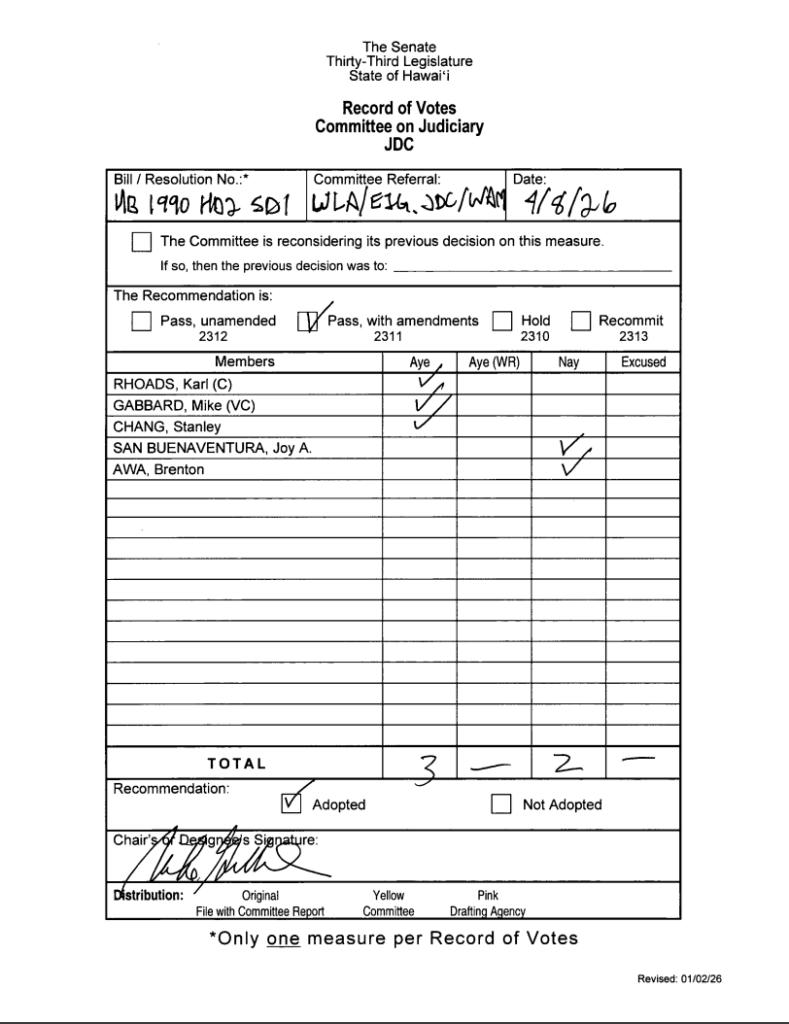
STATUS OF HB1861 ONLY Representatives Garcia, Gedeon, Pierick, Shimizu voting no. “Reservations is a YES vote.”

2/17/2026HPassed Second Reading as amended in HD 1 and referred to the committee(s) on JHA with Representative(s) Alcos, Amato, Matsumoto voting aye with reservations; Representative(s) Garcia, Gedeon, Pierick, Shimizu voting no (4) and Representative(s) Cochran, Lee, M., Poepoe excused (3).
2/17/2026HReported from WAL (Stand. Com. Rep. No. 339-26) as amended in HD 1, recommending passage on Second Reading and referral to JHA.
2/10/2026HThe committee on WAL recommend that the measure be PASSED, WITH AMENDMENTS. The votes were as follows: 7 Ayes: Representative(s) Hashem, Morikawa, Ichiyama, Woodson, Souza; Ayes with reservations: Representative(s) Belatti, Poepoe; 2 Noes: Representative(s) Iwamoto, Shimizu; and Excused: none.
2/6/2026HBill scheduled to be heard by WAL on Tuesday, 02-10-26 9:00AM in House conference room 411 VIA VIDEOCONFERENCE.
1/26/2026HReferred to WAL, JHA, referral sheet 2 (FINANCE COMMITTEE IS DELETED in 2026. FINANCE COMMITTEE DEFERRED SIMILAR BILL HB29 in 2025.)
1/26/2026HIntroduced and Pass First Reading.
1/23/2026HPending introduction.

Counties want to be the Police, Prosecutor, Judge, Jury and Executioner!

Best-kept secret is HB29 HD1 that is being quietly pushed through at the Hawaii State Legislature.

#HB29 is getting weirder by the minute. An attorney from Ashford & Wriston representing the Hawaii Bankers Association (HBA( testified that Hawaii already has a non-judicial foreclosure for delinquent mortgages, which is true. She cited the Hawaii Revised Statutes HRS 667 on foreclosure.

So, Chair #DavidTarnas said he would incorporate the bankers’ testimony into their HB29. amendment.

But, why? It doesn’t make sense. There is NO Mortgage involved. No private property owner applied or got a mortgage from the County.

We’re talking heavy smokes and mirrors, apples and oranges here. Expectedly, Bankers can force a NON-JUDICIAL foreclosure if a private property borrower does not pay. A property owner knowingly entered into a mortgage contract with promise to pay the bank.

But with this new POWER OF SALE HB29, it’s a forced “taking”. The County wants to sell a private property — based on a County civil fine — WITHOUT going to court. EVERY private property owner becomes a sitting duck.

This is really spooky. It exposes all private property owners to the whims of the government. HB29 HD1 is a fast lane to Tyranny.

Give voice. I testified that allowing the Counties Non-Judicial POWER OF SALE – – to sell private properties based on DPP’s civil fines WITHOUT going to court – – is unconstitutional and violates the 14th US Amendment. I asked if the public can trust DPP to be the POLICE, PROSECUTOR, JUDGE, JURY, & EXECUTIONER!

You can also see the Honolulu Department of Planning and Permitting’s reasons for wanting more easy Powers here. Dawn Takeuchi Apana‘s excuses for this quick Power of Sale are that their existing eminent domain power is too slow and costly and the city is short-staffed.

Do we really want to trust DPP who does not respect basic Constitutional Private Property Rights?

Sort by Date Status Tex

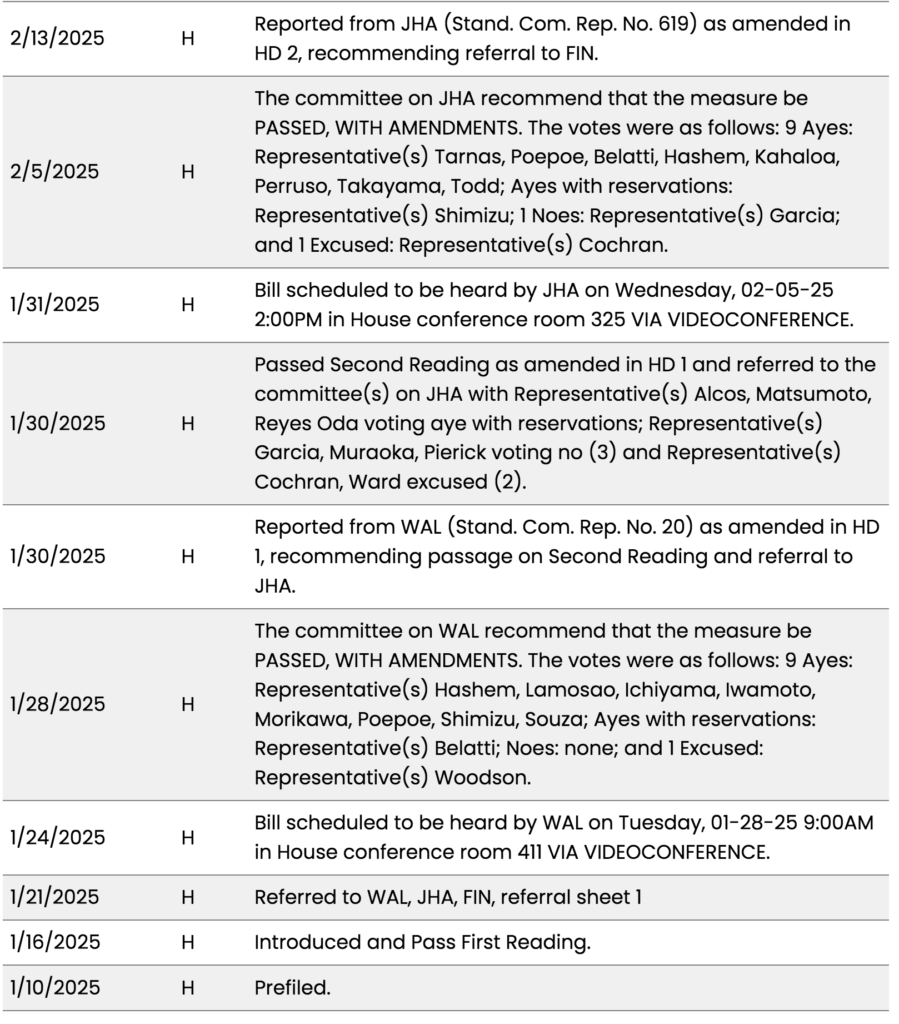
2/5/2025 H The committee on JHA recommend that the measure be PASSED, WITH AMENDMENTS. The votes were as follows: 9 Ayes: Representative(s) #Tarnas, #Poepoe, #Belatti, #Hashem, #Kahaloa, #Perruso, #Takayama, #Todd;
Ayes with reservations: Representative(s) #Shimizu;
1 Noes: Representative(s) #Garcia; and
1 Excused: Representative(s) #Cochran.

1/31/2025 H Bill scheduled to be heard by JHA on Wednesday, 02-05-25 2:00PM in House conference room 325 VIA VIDEOCONFERENCE.

1/30/2025 H Passed Second Reading as amended in HD 1 and referred to the committee(s) on JHA with Representative(s) #Alcos, #Matsumoto, #Reyes Oda voting aye with reservations; Representative(s) #Garcia, #Muraoka, #Pierick voting no (3) and Representative(s) #Cochran, #Ward excused (2).

1/30/2025 H Reported from WAL (Stand. Com. Rep. No. 20) as amended in HD 1, recommending passage on Second Reading and referral to JHA.

1/28/2025 H The committee on WAL recommend that the measure be PASSED, WITH AMENDMENTS. The votes were as follows: 9 Ayes: Representative(s) #Hashem,
#Lamosao, #Ichiyama, #Iwamoto, #Morikawa, #Poepoe, #Shimizu, #Souza; Ayes with reservations: Representative(s) #Belatti; Noes: none; and 1 Excused: Representative(s) #Woodson.

1/24/2025 H Bill scheduled to be heard by WAL on Tuesday, 01-28-25 9:00AM in House conference room 411 VIA VIDEOCONFERENCE.

Civil Beat pseudonym Keala_Kaanui regurgitates his falsehoods about the Hauula Fire Station Relocation Project again. What’s the motive?

It’s Elections Time again! Civil Beat allows Candidates to answer their questions.

Choon James’ answers to Civil Beat’s Questions & Answers can be found here.

What is puzzling is that pseudonym Keala_Kaanui, perhaps the most prolific daily commenter for Civil Beat, is allowed to continue to post fake news like this:

Keala_Kaanuii: The great irony of someone lauding the first responders, who spent a good five years trying to prevent the City from building a badly needed new fire station because she realized she could have negotiated a higher price for her vacant parcel of land after she had signed the contract. Choon forced the city to spend thousands of dollars to condem the property after she tried to back out…

But, here is a quick summary collected by a supporter:

Hawaii Fire Station Relocation Controversy YOU-TUBE #1.

This youtube is a must to watch. Once you watch this, you will get how off-base Civil Beat pseudonym Keala_Kaanui continues to be.

The Hauula folks were authentic in their opposition towards this project. Choon James sided with the Hauula folks. There was no legal contract to sell to the City.

The Honolulu City Council deleted the budget for this project for five years. Yet Mayor Caldwell fought on. In the end, the Hauula folks even correctly predicted who the contractor was for this project.

The community of Hauula did not want a new fire station that the Laie Community Association was pushing and testifying for. Hauula felt that it was a public facility checklist for Laie to pursue more developments like Envision Laie. Public facilities like a fire station is not a profiteering project. Just like the Kahuku Police Station is not a profiteering project.

Hauula wanted to keep the two remaining Commercial-zoned parcels for Recycling and small business. They and the homeless people depended on the Recycling. The homeless would collect in the area and then buy themselves a hot meal with their profit.

“Public Use” can also be very arbitrary. In the case of the Hauula Fire Station Relocation in the rural town of Hauula. The people overwhelming were against it. But Mayor Kirk Caldwell bullied his way through despite the city council of Honolulu continuously deleted the funding.

Hawaii needs to know that Mayor Kirk Caldwell SECRETLY siphoned $1.4 Million (in August 2014) from Community Development Block Grants (CDBG) funds for homeless shelter renovations such as Hale Pauahi in Chinatown to “plan and design” his Neiman Marcus firehouse in rural Hauula.

The City Council had deleted and defunded the extravagant project for 5 years but Caldwell is fixated on this $13M relocation project that will not increase personnel or area of service. The relocation project will decimate the last two commercial lots that locals want to keep for Recycling as well as other business start-ups. Ironically, the homeless in Hau’ula sustain themselves by recycling daily to buy themselves a hot meal. Caldwell governs by misguided agenda, not sound public policy.

Condemnation Honolulu Style – You-Tube #2

This is another compulsory watch.

Honolulu City Council adopted Resolution to condemn two commercial lots on February 24, 2010. This process was advanced in 42 days. It’s Hau’ula today, are you next? Do you live along the Rail Transit route?

UPDATE:  The legislative Honolulu City Council has not funded the project since 2011. But Mayor Kirk Caldwell is still pursuing eminent domain by alleged necessity in court. http://www.kitv.com/news/1200-signature-petition-protests-plans-for-new-hauula-fire-station/25103002#!bmO9B4 The city ‘expert witness’ is saying they need a fire station to bring in bigger – from 8′ x 25′ to 8′ x 32′  fire engines! Hello! The garbage trucks are already having a tough time with our country roads. This is going from ‘ridiculous’ to ‘insane’.

Update: May 15, 2010 Mufi Hannemann city corporation attorneys have filed lawsuit against owners for possession of the land.. Owners have filed lawsuit against city. What a waste of taxpayers’ money in today’s budget crisis!

Update: Owners subpoenaed city officials but Mufi Hannemann’s attorneys quashed on basis that public officials are very busy; owners are a nuisance, harassing and inconveniencing these officials. Ironically, on their way home to Hauula, owners saw Bryan Mick – City Community Relations sign-waving for Mufi Hannemann in front of Nimitz City Mill at 11:34 am August 11, 201

Here’s more information:

Woman Criticizes Honolulu’s Government, Has Her Protest Signs Bulldozed

Nick Sibilla Senior Contributor Institute For Justice

Updated Sep 1, 2014, 10:36am EDT

This article is more than 10 years old.

How people respond to criticism can reveal a lot about their character.  Some might try to debate or reason with those they disagree with.  Others prefer to ignore critics.  City officials in Honolulu take a different approach: They use a bulldozer.

Choon James is a successful real estate broker with over two decades of experience in Hawaii.  But the city of Honolulu is seeking to seize property she’s owned for almost a decade to build what she calls a “super-sized” fire station in rural Hauula.

Since January 2010, she has put up signs to protest Honolulu’s use of eminent domain.  These signs declare “Eminent Domain Abuse: Who’s Next?” and “YouTube Eminent Domain Abuse—Hawaii.”  For more than three years these signs have been up without any incident.

Bulldozing Free Speech

But now the city is showing a callous disregard for Choon’s freedom of speech.  Back in May, Honolulu seized two of her eminent domain protest signs.  Without her consent, city employees went onto the property and seized and impounded her signs before damaging them. Even worse, the city slapped her with a notice for trespassing, for property she is trying to defend in court.

After these signs were torn down, Choon placed three more signs there.  These lasted just a few months before the city once again seized the signs.  This time, Honolulu was much more dramatic.  On October 18, city workers, backed by police officers, squad cars and a bulldozer, came by and literally bulldozed those protest signs.

The city’s actions show a shameful lack of respect for the First and Fourth Amendments.  Citizens have a right to protest government actions.  The First Amendment was enacted precisely to protect citizens who criticize the government from retaliation.  Lawsuits challenging Honolulu’s unreasonable seizures and chilling attacks on free speech are now pending in federal court.

Unfortunately, Honolulu is not alone in trying to silence critics who question eminent domain.  The Institute for Justice has represented citizens in St. Louis, Mo., Norfolk, Va., Tennessee, and Texas who protested abusive property seizures and faced censorship.  Out of these four cases, IJ successfully defended free speech in three cases, while the fourth is currently in litigation.

After 24 of his buildings were taken by St. Louis, Jim Roos painted a giant mural on a building he owned advocating “End Eminent Domain Abuse.”  But St. Louis labeled the mural an “illegal sign” and wanted to force Jim to remove

the sign (and stifle his right to protest) or face code violations.  He teamed up with the Institute for Justice and sued the city.  In a major win for the First Amendment, in July 2011, the Eighth U.S. Circuit Court of Appeals ruled in favor of Jim and allowed the mural to stay up.

In a similar vein, IJ has defended grassroots activists from a frivolous defamation lawsuit and protected an investigative journalist’s right to free speech from a vindictive private developer.

More recently, the Institute for Justice is suing the city of Norfolk for trying to squash a small business owner’s eminent domain protest sign.  The Central Radio Company,

a repair shop, has been in Norfolk for almost eight decades.  But Norfolk had plans to seize the property with eminent domain for a private redevelopment project.

To protest, owner Bob Wilson displayed a huge banner on-site.  The city responded by telling Bob he had to take down the sign or face fines of up to $1,000 per day.  Fortunately, the Virginia Supreme Court unanimously struck down the city’s attempt to seize Bob’s land; his free speech case is still in federal court.
As the cases make clear, courts routinely respect Americans’ First Amendment rights.  Honolulu should do the same.

Nick Sibilla

I’m a policy wonk and legal correspondent with a decade of experience analyzing and reporting on legislation and court cases. 

Outside of Forbes, my work has appeared in The Atlantic, The Washington Post, The Wall Street Journal, The New York Times, Slate, Wired, Reason, and numerous other outlets nationwide.

As Mayor, I will invite INDEPENDENT experts to re-examine the Honolulu Rail Skyline

I’m  originally from Singapore and I appreciate efficient multi-modal transportation. 

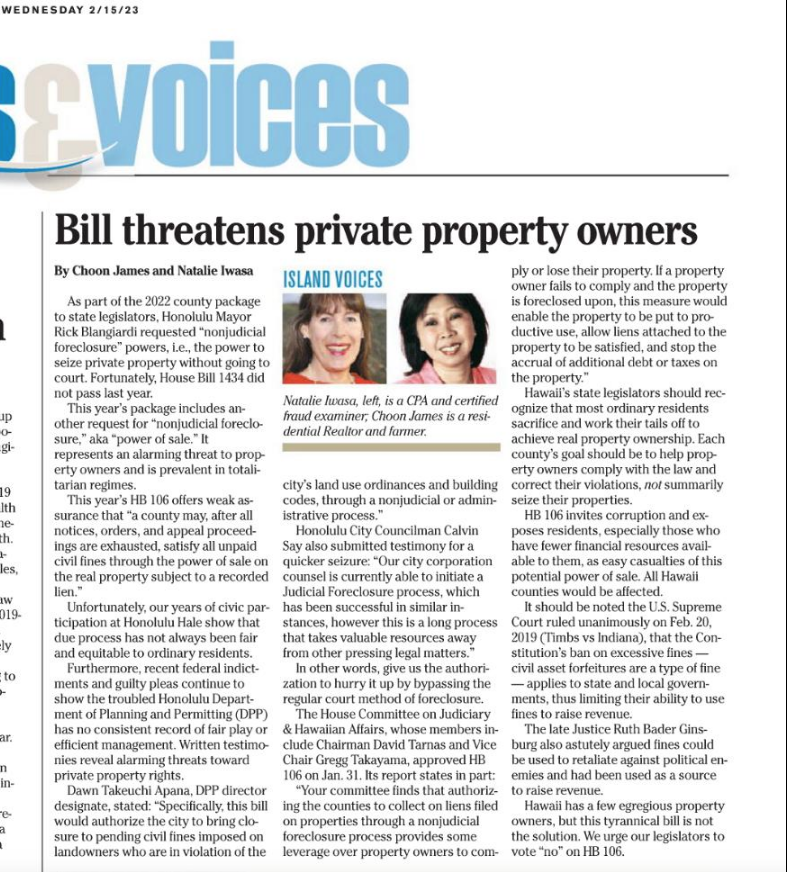
My trusted friend Natalie Iwasa, CPA and Certified Fraud Examiner, and I have been participating and observing City Hall for the last two decades. We know the good, the bad and the ugly.
​We must stop the social media games and be honest with the Public.
Status Quo will not cut it.

The Rail Skyline is out of control.

If we do not control and reset these project costs, our children will pay for today’s mistakes.

As Mayor, I will do the following:

Every one is coming from a good place. I will gather all stakeholders, including City Council and HART back to the round table to analyze this project. INDEPENDENT experts in contracts, legal, costs-analysis, engineering, budget, environment, cultural, and others will be invited.

The public will have its say in this much needed reassessment. 

Should HART be dissolved? 

Should Rail Skyline be under the Transportation Department?

​There will be no sacred cows; no tail wagging the dogs. There will be no hiding behind or blaming the FTA. FTA is not the monster or the Wizard of Oz behind the curtains. FTA is here to help and respect State Rights. 

There should be no managing Rail Skyline through Public Relations handlers and insulting the Public Intelligence from the Mayor’s Office.

​I have zero donations from lobbyists or PACs. I can be 100% independent to question the project with independent industry experts.

​Together with all stakeholders and Oahu residents, we can decide the most pragmatic solutions for Oahu.

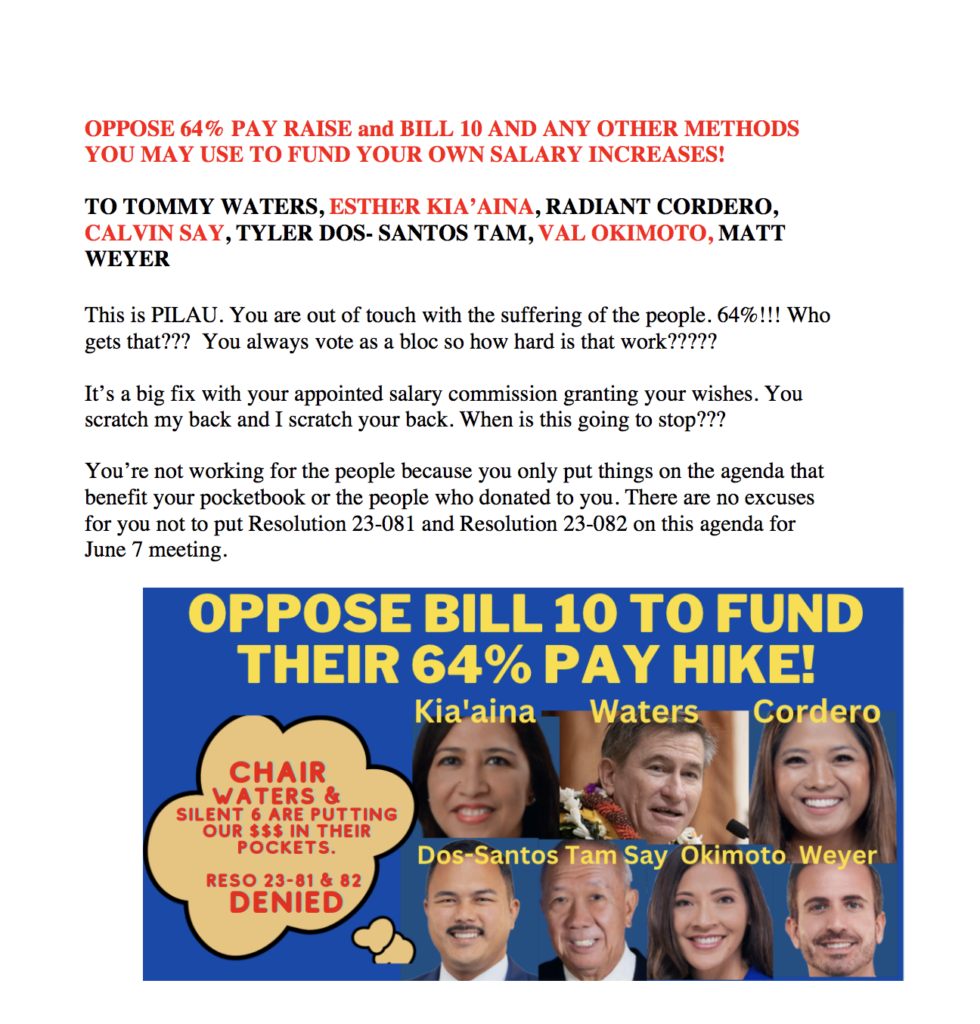
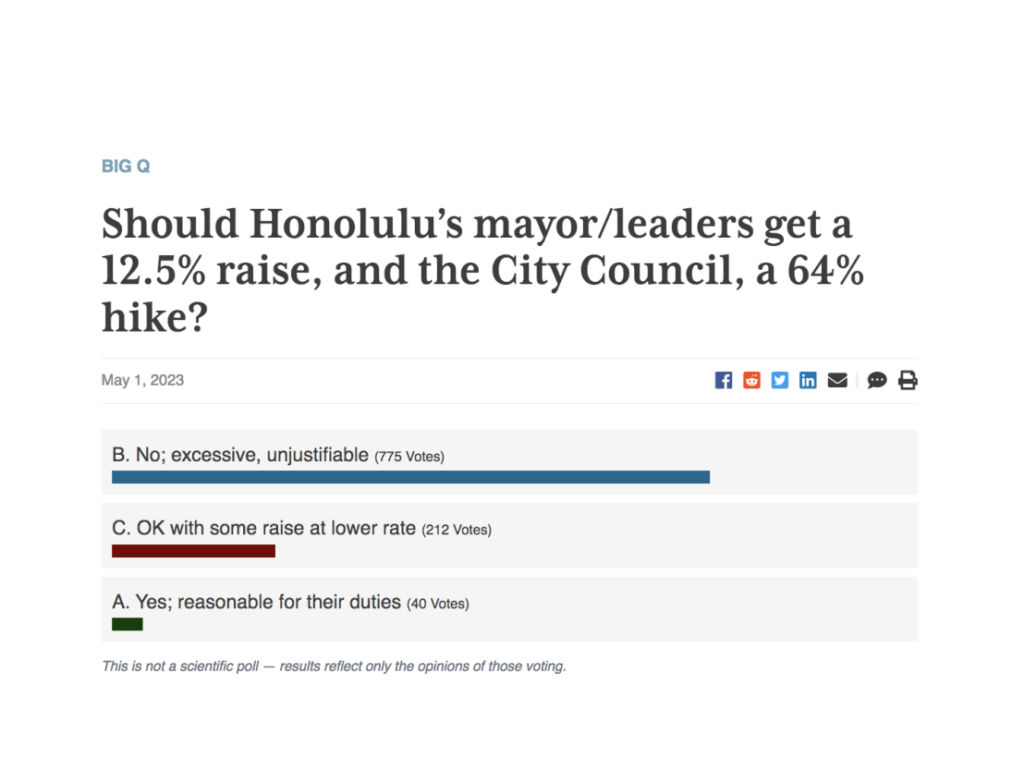
Honolulu City Council – 64% Pay Increase for FY 2024

There are lots of twists and turns, machinations, and colouring to this pay increase controversy.

The fundamental question is whether the Council Chair Tommy Waters would place Resolutions 23-81 and Resolutions 23-82 on the June 7, 2023 Public Hearing Agenda to address the 64% pay increase.

Resolutions 81 & 82 continue to be ignored and time is quickly running out.

If no actions are taken against the Salary Commission‘s recommended increase, these 64% pay raises automatically become effective as of July 1, 2023.

Also, Tommy Waters and Mayor Blangiardi’s rationale for salary raises can be read in their testimonies to the Salary Commission. Salary Commission members are nominated by Mayor and approved by City Council.

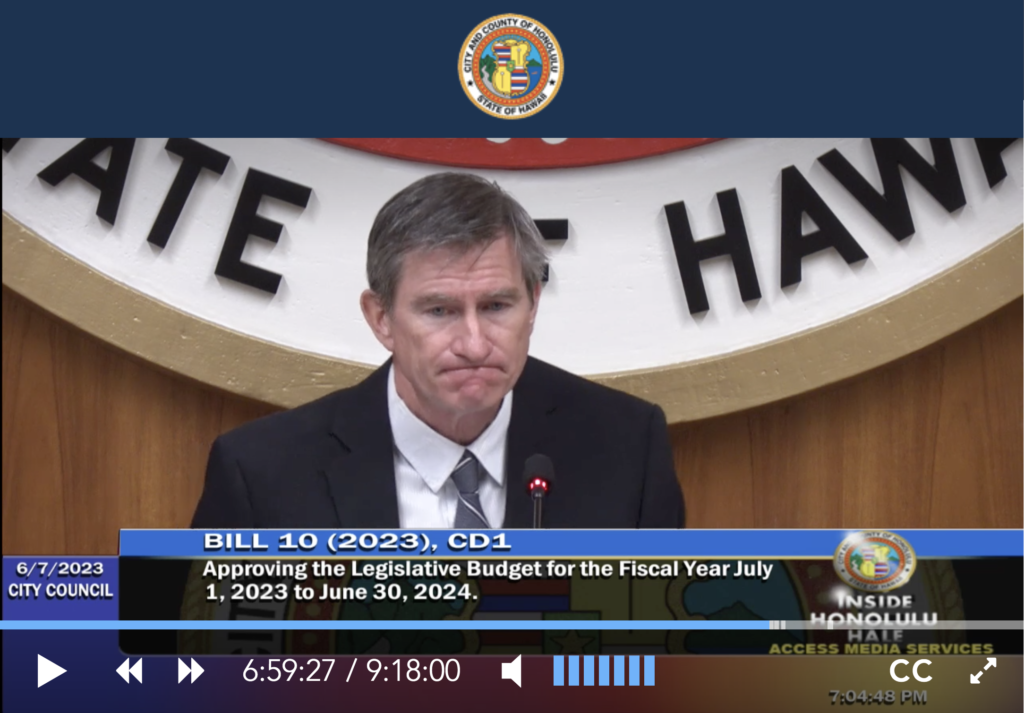
The public’s most awaited meeting was June 7, 2023 – – to see whether the Council would reject the huge leap in pay raise for themselves. Scroll to 6:59 thereabouts to hear Bill10 on Page 27 Agenda.

Honolulu City Council Chair Tommy Waters presided at the June 7. The 10 AM Hearing started at 10:45 AM and finished about nine hours later. Chair Waters did not place Resolutions 23-81 and 23-82 relating to the 64% salary increases on the Agenda.

Bill 10 was the most appropriate agenda item to opine on this 64% raise. Bill 10 was a comprehensive legislative packet to approve the County Budget for the Fiscal Year July 1, 2023 to June 20, 2024. Bill 10 would be where the funds for these pay raises needed to be penciled in. You can look at the June 7 Agenda and click Bill 10 (Page 27) to watch the video proceedings.

Residents were unhappy that Bill 10 was pushed to the back of the agenda. The opportunity for the public to testify began at about 7:00 p.m. Some residents had to leave. The marathon 10:00 AM Council Hearing began at 10:45 AM.

Written testimonies were also submitted earlier by the public. There was also an online petition – “Don’t hide, let the people decide your 64% pay raise”.

Despite the public uproar, Chair Waters dug in his heels and denied public participation by ignoring Resolutions 81 and 82.

Here is brief chronology for this 64% pay raise issue:

January 19, 2023: The nomination of Rebecca Soon through Resolution 23-7 to the Honolulu Salary Commission was submitted by Chair Tommy Waters.

Rebecca Soon is the daughter of Ray Soon (Former Chief of Staff to Mayor Kirk Caldwell) and Cheryl Soon.

January 25, 2023: Listen to the conversation beginning at 4:00 between Salary Commission nominee Rebecca Soon with Waters, Kia’aina, and Cordero.

Listen to the conversation between Chair Tommy Waters, Esther Kia’aina and Radiant Cordero about “full-time” or “part-time” and what salary compensation should be. Beginning at 4:00 pm with this Video

March 21. 2023: Local news media like KITV were following this issue. KHON2 also covered the Proposed Salary for City Council and Administration. The Salary Commission Meeting Agenda included FOR ACTION for deliberation and decision-making relating to the City pay raises:

April 25, 2023: Honolulu Salary Commission’s Press Release adopting its FY24 Salary Schedule and Calls For Action To Attract Public Servants To The City.

The Pearl City Neighborhood Board, a citizen grassroots advisory board, voted to oppose the proposed Salary Increases.

April 27, 2023: Two Resolutions responding to the Salary increases were introduced By City Council members Augie Tulba and Andria Tupola – – Resolutions 23-81 and Resolutions 23-82 to partially or impartially reject the increases.

But City Council Chair Tommy Waters refused to allow these two resolutions a public hearing. Doing nothing about the Salary Commission recommended increases would automatically triggers the increases on July 1, 2023.

May 15, 2023: Chair Tommy Waters signed REQUEST FOR SEALED BIDS ( “RFB”) to perform a salary analysis and comparison study for the Honolulu Salary Commission. Closed Date May 30m 2023. Cost was supposedly $100,000.00 A curious person would ask who received this very seemingly short-noticed request and turn-around report.

May 19, 2023: Maikiki Neighborhood Board also opposed the salary hikes. Makiki Board Chair wrote its opposing resolution due to unprecedented negative reactions to the pay raises.

May 25, 2023: With a horse before the cart action, Chair Waters and Vice-Chair Esther Kia’aina introduced Bill 33 and Resolution 23-109 to prohibit outside empolyment for city council members. Written testimonies on his two similar actions point to “distractions” intentions.

Resolutions 81 and 82 to reject the 64% increase continued to be denied a public hearing by Chair Waters.

June 7, 2023: City Council approves salary increase through inaction in Bill 10. Scroll to 6:57 to watch proceedings. Only Augie Tulba and Andria Tupola voted “NO” in addressing the pay raises. Bill 33 to Prohibit Outside Employment was rescinded and cancelled. Companion Resolution 12-109 passed First Reading. No funds were penciled into the Budget to address the 64% salary increases at this hearing. (However, keep it mind that there is an allowed shell game of moving funds without public votes.)

The two potent Resolutions 23-81 and Resolutions 23-82 to partially or impartially reject the increases remain ignored.

However, the D-Day is June 25 for Chair Tommy Waters to reverse this decision. Waters can still call a Special Hearing. Funds for these 64% pay increases have to be penciled in. The next question is: Where will these salary funds be taken from?

During the entire course of this 64% pay increase controversy, Chair Tommy Waters offered many contradicting rationale, including Conflicts of Interests and why the City Council should not vote for its own salary increases.

However, the Director of the Honolulu Ethics Commission Jan Yamane, who was invited to the June 7 Hearing, also clarified that City Council members could vote on these salary issues by filing a Conflict of Interest Disclosure. A flurry of Conflict of Interests was filed subsequently by the council members.

Contrary to what current Council Chair Waters is insisting about not being able to vote against the Honolulu Salary Commission, here is an example of another City Council Chair Ernie Martin who rejected pay raises in 2013 by introducing Resolution 13-88 himself.

The City Council 64% Pay Raise will go into effect on July 1, 2023 unless the City Council rejects it

Two city council members have introduced two Resolutions to reject the 2023 Salary Commission’s recommendations for the pay raises.

  1. Resolution 23-81 REJECTS the ENTIRE Salary Commission’s recommendation. This will freeze the salaries as is.

BE IT RESOLVED by the Council of the City and County of Honolulu that this
body, by at least a three-quarters affirmative vote of its entire membership, rejects the
entire resolution of the 2023 Salary Commission
submitted to the City Council under
Council Communication 111(2023) and the salary and salary schedule increases
recommended therein; and
. . .”

2. Resolution 23-82 REJECTS IN PART Salary Commission’s recommendation.

WHEREAS, the Council wishes to express its appreciation for the work of the
2023 Salary Commission, but concludes that the salary increases and salary schedule
adjustments recommended by the 2023 Salary Commission for Fiscal Year 2023-24
should be rejected in part;

Some facts for clarifications:

  1. If the city council does not adopt a resolution to reject the pay raise now, the recommendations of the Salary Commission will automatically become in effect on July 1, 2023.
  2. Chair Tommy Waters has to put the above two resolutions in the Honolulu city Council Agenda pretty quickly. Will Waters promptly allow these two Resolutions or others to be on the Council agenda? Will he come up with his own resolution or let the clock run out?
  3. Chair Tommy Waters publicly states that he’s “totally open to that idea” for the public to determine whether the city council position is a full-time or part-time job through a Honolulu City Charter amendment. Chair Tommy Waters, Vice-Chair Esther Kia’aina, and Budget Chair Radiant Cordera have publicly determined their position as “full-time”.
  4. Through the decades, the position has always been respected as part-time and no council has asked for a huge salary raise based on the platform that it’s a “full-time” position. Former City Council member Ann Kobayashi, amongst others, has publicly said, “You run for public office, you know what the salary is, you know what the hours are, and you do the best you can and the public service. The point is not to get in there and try to change the salary.”
  5. The public participation opportunity to approve the increase salary to “full-time” scale or not is obviously backward.
  6. The City Charter amendment procedure as to whether the Council deserves “full-time” salary cannot be decided before the default date of July 1, 2023. The earliest the city charter amendment process can happen is at next year’s 2024 election ballot. Keep in mind again that this suggested amendment action is separate from #1 timeline.
  7. It has always been the expectation that the city council position is a part-time salary. The council members have health benefits and other benefits. Each council member has 5 full-time staff, the Council Services, and the city departments to assist upon request.

The most recent confirmation of Rebecca Soon to the Honolulu Salary Commission can be viewed at the 4:03 video mark during the Council Hearing on January 25, 2023. The video shows the interactions between the council members and the nominee Soon about pay raises.

Rebecca aka Becky Soon has a lot of experience with Honolulu Hale as the latest addition to the Salary commission. Her father Ray Soon was Mayor Kirk Caldwell’s Chief of Staff. Her mother Cheryl Soon held many positions, including Director of Department of Transportation Services and member of the 2018 Honolulu City Charter Review Commission.

The Honolulu Salary Commission:

The current Honolulu Salary Commission Chair is Malia Espinda. The Salary Commission is made up of commissioners nominated by the Mayor and the City Council in this arrangement: 3 members appointed by mayor, 3 members appointed by council, 1 member appointed by mayor & confirmed by council.

City Employee expresses his personal views against windowless units as a private citizen in Bill 21

Bill 21, authored by City Councilman Tyler Dos Santos-Tam, asks for changes to the City County Housing Code to be consistent with the International Building Code (IBC) that allows windowless (no natural light and ventilation) housing units.

Santos-Tam, a construction industry lobbyist, said that the county needs to build 25,000 housing units and thus “optionality” is necessary in housing development. The statement begs many questions as to who these units are for and do we want Oahu to follow other countries’ values and standards. Is this about helping developers or is this about meeting the needs of our local residents?

Below is an excellent example of a local government worker with lots of expertise and experience standing up for the public good, rather than developers. Michael O Silva, speaking as a private citizen, should be commended for speaking up. His testimony is free from self-interests but filled with common sense and aloha for the ordinary local residents. Read the testimonies here.

Listen to Bill 21 here. It starts around the 1:46 mark.

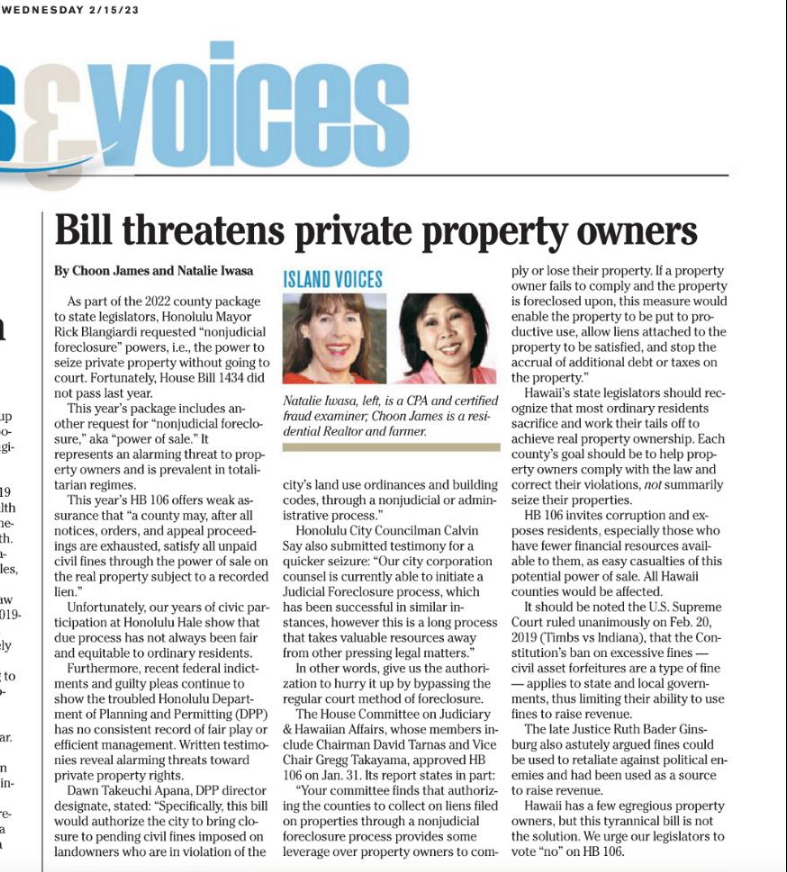
Who’s behind these non-judicial Power of Sale bills?

UPDATE: SB 875 & HB 15 are speeding on. ( HB 538 is quite similar.)

Keep in mind the counties already have “Judicial Foreclosure” and “Eminent Domain” powers in place. But the justification is that these processes take too long.

In other words, these bills will allow the counties to be the Police, Prosecutor, Jury, Judge, and Executioner. The Judicial Due Process will be cut off.

We’re asked who started these non-judicial foreclosure bills to forced sale of a private property, based on the Honolulu Department of Planning and Permitting (DPP) fines, without going to court.

Here are some quick answers:

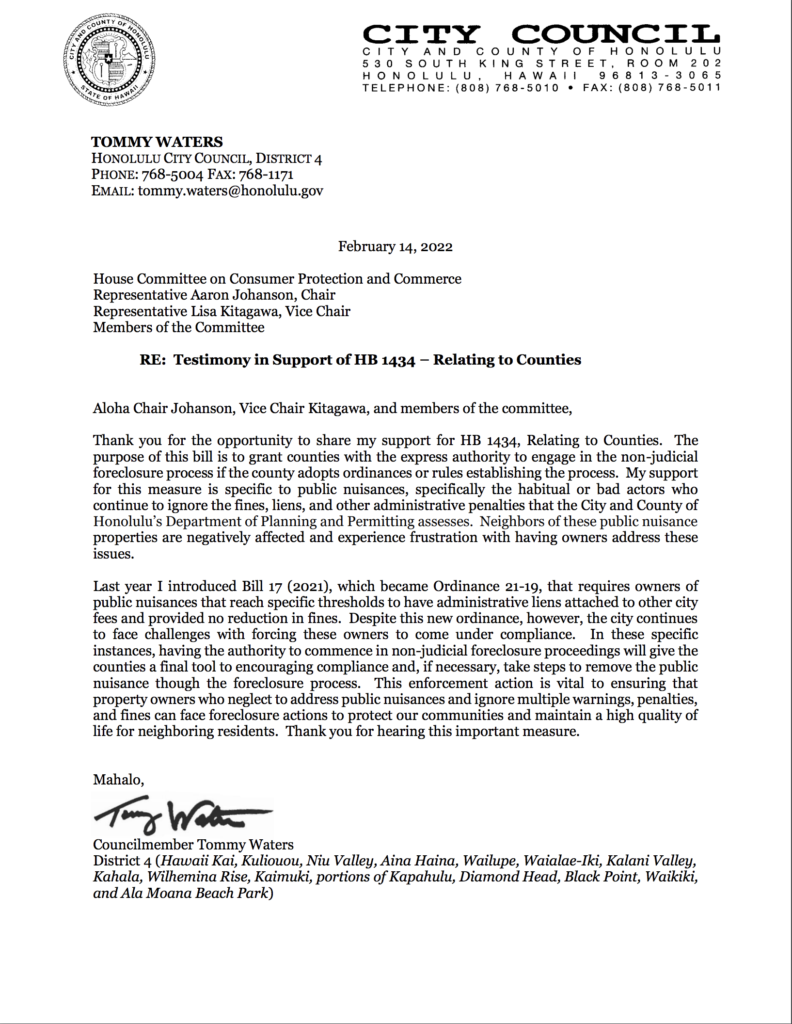
It originated in 2022 as HB 1434 with Honolulu Mayor Rick Blangiardi. Keep it mind that this Power of Sale requests applied to ALL Counties in Hawaii. Based on my observations of him, it’s unlikely that this non-judicial Power of Sale idea originated from Blangiardi unless he’s hoping for a new stream of revenues from fines and sale of properties.

If I have to take a guess, it would be his Managing Director Mike Formby, formerly with the Pacific Resource Partnership (PRP) or former Department of Planning and Permitting (DPP) Director Dean Uchida.

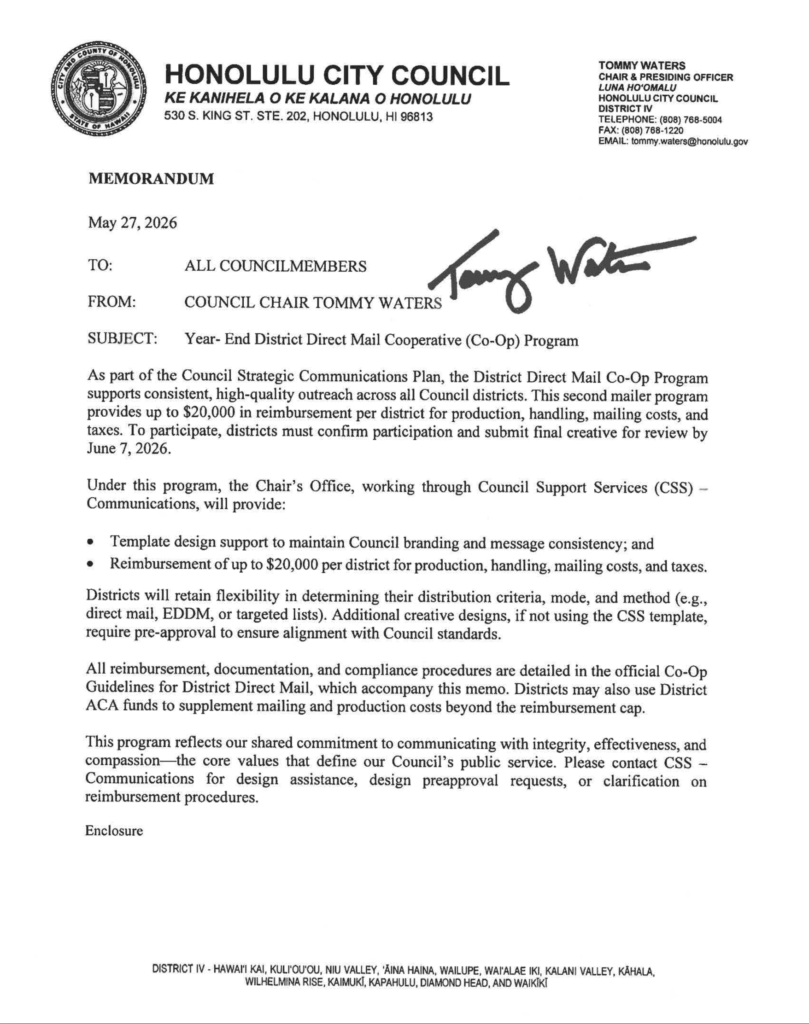
Five (5) City Council members, known as the Gang of 5, also submitted testimony – Chair Tommy Waters, Esther Kia’iana, Brandon Elefante, Calvin Say, and Radiant Cordera.

What were the underlying motives?

Fortunately, Bill 1434 failed to pass last year.

I was in the same Mayoral campaign with Rick Blangiardi in 2020. Based on my observations and
his words, he had very shallow understanding about Honolulu City Hall workings.

This year 2023, Mayor Blangiardi is back with HB 106 and SB 216 by request to Senate President Ron Kouchi and House Speaker Scott Saiki.

However, presto! The tactics have changed a bit this year. There are five (5) clone bills with the same agenda speeding through.

Google Searches show no county mayors, state legislators or city council members appear to have warned Hawaii about this draconian assault on private properties.

Here are the rest of the three (3) bills.

SB875 is introduced by Senators Stanley Chang, Donovan Dela Cruz and Sharon Moriwaki. This bill is alive and has crossed over on March 7, 2023.

This time around, written testimonies come from only Honolulu City Council former Budget Chair Calvin Say and DPP Director Dawn Takeuchi Apuna.

Companion Bill HB498 is introduced by Representative Jackson Sayama.

HB 15 is introduced by Representative David Tarnas (D) It has no senate companion bill but it has crossed over on March 7, 2023.

HB538 is another similar one that includes judicial or non-judicial foreclosure. It is introduced by MATAYOSHI, BELATTI, HASHIMOTO, HOLT, KILA, KITAGAWA, LAMOSAO, MARTEN, NISHIMOTO, TAKENOUCHI, TARNAS, Chun.

The time line provided in this bill is too unrealistic. It assumes that DPP is 100% efficient. In actual fact, it takes a very long time to get a permit. Some permits take a much longer time because it may need a shoreline certified shoreline. This could easily take six months to complete.

REJECT HB 106: Authorizes a county to proceed with a power of sale on real property subject to city fines.

The City and County of Honolulu is asking to have POWER of SALE on Oahu’s property owners based on DPP liens. Bill 106 will affect ALL Counties.

JHA 1/31/23 2:00 PM Tuesday
325 VIA VIDEOCONFERENCE

BILL 106 and companion SB 216 may sound harmless in an ideal world with perfect fairness and equity and justice for all.

But in real life, these bills are too over-reaching and will further marginalize Private Property Rights. 

Bill 106 slams Due Process for ordinary citizens. There are systemic failures of discrimination, inequity, and entrenched bureaucracy at Honolulu Hale. This Power of Sale will expose every property owner to the possible whim of politicians, government officials and its powerful political machine. 

Although there is supposedly a fair “process” in place, our decades of participating at Honolulu Hale and the records have shown otherwise. Repeatedly we have witnessed that this same “process” has been unfair and inequitable to ordinary citizens. No matter how thin the cheese is sliced, there are always two sides to it. But the government almost always wins because it has the upper-hand, resources and a legal corporate team to ignore or fight ordinary citizens.

Most ordinary citizens are not born with a silver spoon in their mouth. They work their tails off to achieve real property ownership. The County’s role ought to be helping property owners correct their violations and be in compliance; not be too eager to seize private properties through fines. 

Unfortunately, the Honolulu Department of Planning and Permitting (DPP) does not have a consistent and good record. This is no way to live in a Democracy where Big Brother and its long arm of government continues to become more powerful and subvert Due Process due its citizen.

This POWER of SALE is NOT about a mortgage company foreclosing based on non-payments of a borrower. This is about the government seizing properties, based on DPP fines.

There is an alleged reason or justification that this Power of Sale is needed to enforce “monster homes” or “illegal vacation rentals”.

The isolated problems with monster homes and illegal vacation rentals are not compelling enough to provide counties with this unfettered powers. DPP needs to examine why monster homes are approved for permits in the first place. There was a time when a property owner could only build up to 50% of its land area. Incrementally, the city has approved regulations and ordinances that allow increased density in its land-use legislation.

As a matter of public policy making and with a bigger picture, providing all counties with this Power of Sale for the above alleged reason is akin to tearing down a Cathedral to fry an egg.

Ordinary citizens cannot afford expensive legal representation to make sure their side of the story is heard and fairly considered in the legislative decision-making.

Affluent and well-connected citizens have the means to circumvent DPP. Ordinary citizens will become the casualties of this powerful and overreaching legislation.

This Power of Sale (aka Non-judicial Foreclosure) is overreaching and tyrannical. This Power of Sale authority makes every property owner a sitting duck at the whim of the city.

Basing a POWER of SALE ( aka NON-Judicial Foreclosure) through DPP fines and recorded liens is the worst possible exposure for more corruption and possible political retaliation.  

The City and County of Honolulu requested this same power aka “non-judicial foreclosure” in 2022. 

Please read the 2022 written testimonies that provide a very brief summary of this issue. This far-reaching governmental power will affect all Counties but it was one of the best-kept secrets in 2022. It is the same in 2023.

Please protect Due Process and protect private property rights. As if Eminent Domain is insufficient for the government, the Honolulu County is again asking for a quick Power of Sale aka non-judicial foreclosure.

This governmental power is too much to bear in a democratic society. Private Property Rights must be revered as one of Democracy’s foundational pillars. The counties have other options.