“AQ” was not a personal friend. I wish she was. But someone told me a funny story about her. I remember her roaming the State Capitol in her senior years the few times I was there. The Honolulu Hale is my familiar space, not the State Capitol. That person said she would roam the halls of the Hawaii State Capitol. She was fearless. It came to a point where politicians would see her coming and evade her.
She was known to tell a politician in her or his face and asked, “What’s wrong with you?”.
We need more Ah Quons!
The following excerpt is copied for educational purposes:
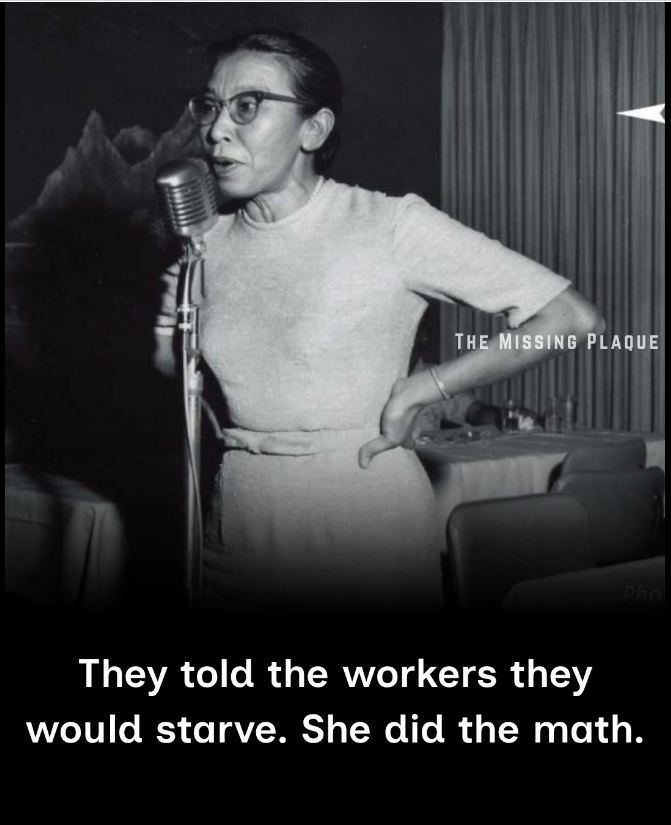
The Missing Plaque
ornSpdstoeu2g32tPg2tg3my1 a1i 3f12a2 1:62g00tlltaMM1c88mmgu ·
In 1946, Hawaiian sugar plantation workers made 24 cents an hour. The five corporations that owned the islands also owned the houses, the hospitals, the water lines, and the grocery stores. They were known simply as the Big Five. If a worker complained about the heat, the twelve-hour shifts, or the cane dust coating their lungs, they were evicted. If they struck, they starved.
Ah Quon McElrath knew exactly how the math of poverty worked. She was born directly into it. The daughter of Chinese immigrants, she grew up in the shadow of the Iwilei canneries and the massive sugar estates. Her father died when she was just a child. She watched her mother take in laundry, washing heavy work clothes by hand over a wooden board to keep the family from eviction. The territory in the decades before statehood was not the tourist paradise advertised in mainland magazines. It was an industrial fiefdom.
Five massive sugar agencies. Castle & Cooke. Alexander & Baldwin. C. Brewer. American Factors. Theo H. Davies. They controlled ninety percent of the economy. They dictated the price of land. They owned the shipping routes. They wrote the laws in the territorial legislature. They set the daily wages of the men who swung the machetes in the fields.
Ah Quon had managed to secure a university degree in sociology, but she remained rooted in the world of the laborers. She walked with a slight physical limp from a severe childhood burn, moving deliberately through the dirt roads of the camps, carrying notebooks filled with grocery prices, medical costs, and the true cost of living.
On September 1, 1946, the plantations went completely silent. The International Longshore and Warehouse Union (ILWU) called a territory-wide strike. Seventy-nine thousand workers and their dependents walked out of the fields. The cane stopped moving to the mills. The harvesting machines sat idle in the sun.
The Big Five responded exactly as expected. They locked the heavy wooden doors to the company-owned plantation stores. They cut off all lines of credit for rice and flour. They drafted eviction notices for the company-owned shacks. The plantation managers assumed the workers would return in a matter of days. A man might risk his own job, the corporate logic went, but he would not let his children go hungry. The isolation of the islands meant no outside help could arrive by train or truck. The workers were geographically trapped.
Records show the Big Five deliberately imported laborers from different countries over the decades—Japan, the Philippines, Portugal, Korea, China. The companies housed them in strictly segregated camps and paid them different wages based entirely on their ethnicity. At the time, the prevailing corporate strategy documented in management ledgers assumed that groups who could not speak the same language, worship in the same way, or eat the same food could never organize a unified strike. The division was not accidental. It was a highly calibrated structural mechanism of control.
The system the companies relied on was known formally as the perquisite system. Under this arrangement, housing, medical care, and fuel were not purchased by the workers with their own money. They were provided directly by the plantation as part of their compensation. It looked like benevolence on paper. In practice, it meant the company held absolute authority over a family’s daily survival.
When the strike began, the companies immediately weaponized the perquisites. Plantation doctors were instructed to turn away striking families. Water lines to the camps were threatened with shutoffs. The message was delivered without emotion or fanfare: the company owned the infrastructure of life, and the company was shutting it down.
During the second week of the strike, the eviction warnings appeared. Small, typed pieces of paper pinned to the wooden doors of the camp houses. The workers had no savings to rent apartments in Honolulu. They had no vehicles to leave the rural estates. There was literally nowhere else to go.
Ah Quon McElrath did not speak five languages. She spoke arithmetic. The ILWU named her its first social worker. Her job was not to stand on a soapbox and deliver speeches about the dignity of labor. Her job was to keep 79,000 people alive long enough to break the monopoly.
She started with rice. She calculated exactly how many calories a human body needed to survive without working in the fields. She organized massive hunting and fishing committees, sending men into the mountains for wild pigs and to the ocean for daily catch. She bypassed the company stores entirely, negotiating directly with independent farmers for vegetables that the Big Five did not control. One of the independent farmers who sold them cabbage asked to remain anonymous on the receipts. He still lost his land lease two years later.
When the plantation doctors locked their doors, she set up parallel dispensaries. She recruited sympathetic physicians from the city and gathered donated medical supplies. It was not glamorous work. She kept the union’s emergency medical fund in a battered cardboard box under her bed because she did not trust the local banks. The banks, like the shipping lines and the stores, belonged to the sugar companies.
Every morning, she updated her ledgers. She tracked which families had infants needing milk, which camps had pregnant women requiring care, and which locations were running low on staple grains. The strike stretched into October. Then November. The companies waited for the hunger to fracture the picket lines along the old ethnic boundaries. The hunger never came. The massive soup kitchens ran on her schedules, feeding Japanese, Filipino, Chinese, and Portuguese workers from the very same pots.
The companies divided them by language. She organized them by arithmetic.
On November 18, after 79 days of total paralysis, the Big Five broke. The strike ended. The workers secured a 19-cent-per-hour raise, a guaranteed 48-hour work week, and an absolute end to the perquisite system. The companies were forced to convert housing and medical care into cash wages. The mechanism of control was permanently dismantled.
Ah Quon McElrath spent the next fifty years auditing pension plans, enforcing safety regulations, and negotiating healthcare benefits for the laborers. She never sought fame. She kept her office in the union hall, surrounded by filing cabinets.
The sugar plantations are mostly gone now. The vast fields where the laborers walked out have been paved over for luxury resorts, residential subdivisions, and golf courses. The company stores are closed. The ledgers she filled with the exact price of rice and milk in the autumn of 1946 are boxed away in the University of Hawaii archives. The numbers on the pages are still perfectly legible.
Ah Quon McElrath: the woman who outcalculated an empire.
Source: Center for Labor Education and Research, University of Hawaii.
Verified via: The ILWU Archives, Densho Digital Repository.
(Some details summarized for brevity.)