Wishing you a happy, healthy, and prosperous NEW YEAR!
I missed January 1, 2022! So this is my second chance to start a “NEW YEAR” resolution to highlight or share issues that affect us. I resolve to write something useful every day on this blog!
So much have happened since the advent of COVID19 in 2020. Here we are on February 1st, 2022 and we’re still struggling with this pandemic. COVID19 has brought out the worst and the best in humanity.
I will share this testimony below as my first post since I’ve just submitted it to the Hawaii State Legislature. If you feel this is an important issue, please write a quick testimony to let your senators know what you think. We should let them know of our expectations. Click on this SB 1357 to submit a quick testimony.
It’s very obvious that this SB 1357 is created to shut down citizen participation and involvement in Hawaii. There is no quarrel that Democracy can be messy, loud, and unpleasant, especially to authorities who are being resisted against.
Free speech, the freedom to protest, and to assemble with expressions must not be shut down through this thinly-veiled facade of “ Traffic violations to PROHIBIT display of any material that distracts, obstructs the view of, or affects the safety of other drivers, including but not limited to flags, towels, sheets, and cloths, on vehicles being operated or moved on a public street, road, or highway, except when required to be displayed for loads that extend beyond the vehicle. Sets a fine.”
The public knows this SB 1357 is targeted at the recent displays of protests and discontent amongst many Hawaii residents. The displays of civil discontent have been displayed through banners and flags options that are available to the people. There have been no raids or violence or vandalism.
Instead of trying to shut down citizenship participation and discontent, it would be more democratic and effective to figure out how the government can improve to lessen this growing discontent.
SB 1357 is too over-bearing and tyrannical. It violates the basic fundamental rights of a citizen to express oneself in a free society. This SB 1357 not only tries to stamp out dissension, it also wants to punish those who participate through their expressions.
Please defer Bill 1357. It’s over-bearing and tyrannical to say the least. No elected official in the Hawaii State Legislature should think or behave like they are akin to the Community Party of China – to crush and shut down public participation through various means.
We are deeply disappointed that we
have received the silent treatment from Governor David Ige at this point.
“The most affected people and the most affected community have been opposing these additional eight (8) industrial turbines for over ten (10) years. The answer to the authorities had always been ‘no’ to the Fortune 500 Corporations, HECO and also those involved in the Environment Review Process.
However, their voices have
consistently been ignored and dissed.
Kahuku already has twelve (12)
industrial turbines. It is already bearing the disproportionate burden of wind
energy. Its residents have already been
suffering the health impacts from these existing turbines.
The PUC action of December 31, 2014
was a blatant violation of Hawaii’s renowned Environmental Laws specifically
contained in the HAR Chapter 343. Consultation with the affected community is
the first of several elements of public participation in the environmental
review process established under Chapter 343.
The centrality of public participation to rational environmental
management has long been recognized as good policy, and it is explicitly
identified as a founding principle in the legislative findings that preface the
EIS law.
§343-1 Findings and purpose. The legislature finds that the quality of
humanity’s environment is critical to humanity’s well being, that humanity’s
activities have broad and profound effects upon the interrelations of all
components of the environment, and that an environmental review process will
integrate the review of environmental concerns with existing planning processes
of the State and counties and alert decision makers to significant
environmental effects which may result from the implementation of certain
actions. The legislature further finds
that the process of reviewing environmental effects is desirable because
environmental consciousness is enhanced, cooperation and coordination are
encouraged, and public participation during the review process benefits all
parties involved and society as a whole.
To further violate the standing
environmental laws to the face of the most affected people, the Public
Utilities Commission further violated the laws by approving the contract
between HECO and then Champlin/GEI in order to assist the corporations in its
federal tax incentives deadline.
Recently, a former PUC Counsel revealed that he counseled against the December 31, 2014 decision because the EIS for this project was pending and NOT completed yet.
Furthermore, the Hawaii Consumer Advocate at the time, Jeffrey Ono, also advised for
PUC to wait for the environmental review to be completed before approving the
wind farm. Mr.Ono’s opinion was that the “EIS
could inform a decision on whether the project was in the public interest:
specifically whether its benefits outweighed its negative impacts on the
community.”
Because of the flawed process, there continues to be controversies. Approximately 200 residents were arrested in resistance to this process.
Keep the North Shore Country has filed a lawsuit challenging the Hawaii
Board of Land and Natural Resources’ acceptance of a conservation plan and
license to kill certain numbers of endangered Hawaiian hoary bats as an
incidental side effect of the project.
Life of the Land’s challenge focuses on the PUC’s approval of the
contract between the wind farm and HECO, which the PUC approved.
Governor Ige’s
statement by his communications team that “we were told
Despite all the known facts about
this flawed process, the AES COO, Mark Miller continues his arrogant and
robotic PR answer to all compelling concerns:
“We remain in close touch with people throughout the North Shore
community – including those who have lingering questions about our project. We
are here and ready to talk to anyone interested in learning more.” But he
pushing onward and forward and not taking “no” for an answer.
On October 16, 2019 to the Star
Advertiser, “The company planning to
build a wind farm in Kahuku “should be allowed to proceed,” Gov. David
Ige’s office.
We call on Governor Ige to take
care of his primary kuleana – to put the public interest nor the well being of
his constituents’, including the children, interests and well-being. The
industrial turbines will be too close to the Kahuku Elementary School, the
Kahuku High School, residential homes, hospital and farmer’s dwellings, and
also the Bobby Benson Center.
What are residents supposed to do
if the very government regulatory agencies that must protect the process and
the public interest violated its very laws and rules on the books?
When residents exercise their
desperate protests to be heard, they are met with the strong force of the HPD
and arrests.
We call on Governor Ige to implement
pono leadership on these irreparable damages being done to his constituents
today.
1. To allow the citizen’s various
legal pending processes to be heard before allowing further deliveries to the
sites.
2, to direct the Attorney General
to expunge the approx.127 arrests made thus far. The people were simply trying
to be heard because the very agencies that are supposed to protect them broke
its own laws and regulations.
Hawaii has one of the best
environmental laws in the nation. If all state and county agencies had adhered
to the laws in the books, these acrimonious and actions could have been easily
avoided.
Kahuku residents cannot continue to
be guinea pigs. Green Energy is important for our island home but environment
justice and social justice must integral parts of this movement.
NOTE: HAR 11-200-9(C) requires
agencies proposing an action to analyze alternatives to the nominal project
proposal in the environmental assessment.
Consideration of alternatives is a
core element of the environmental planning process and offers one of the key
tools available to achieve the purpose of environmental impact
minimization. The OEQC Guidebook
includes specific instructions regarding the discussion of alternatives.
Consider alternative methods and
modes of your project, and discuss them in the draft EA. Select the one with the least detrimental
effect to the environment. Alternatives
to consider include:
•
Different sites: is one site less
likely to infringe on an environment
that needs protection, such as a wetlands or an historic district?
•
Different facility configurations:
is one configuration less likely to intrude on scenic viewplanes?
•
Different implementation methods:
can a rocky area be cleared by backhoe removal rather than blasting?
Alternative analysis should include
input from the community. Community
members may be aware of concerns and impacts that make a particular alternative
more or less desirable. [OEQC Guidebook, p.15]
The Guidebook also offers insight
into what’s expected in an EA in the way of alternatives analysis in its
discussion of questions to ask when reviewing an EA.
Are alternatives to the proposed project (including no project at all) adequately explored? Are there other ways to carry out the project which may be less damaging to the environment? Are different designs or approaches discussed sufficiently? What basic improvements can you suggest? [OEQC Guidebook, p.9]
Thus, alternatives to discuss include not just the no action case, but also actions of a significantly different nature that would provide similar benefits with different minimal impacts, different designs or project details, different locations, different facility configurations, and even the alternative of postponing an action pending development of a more viable proposal.
The
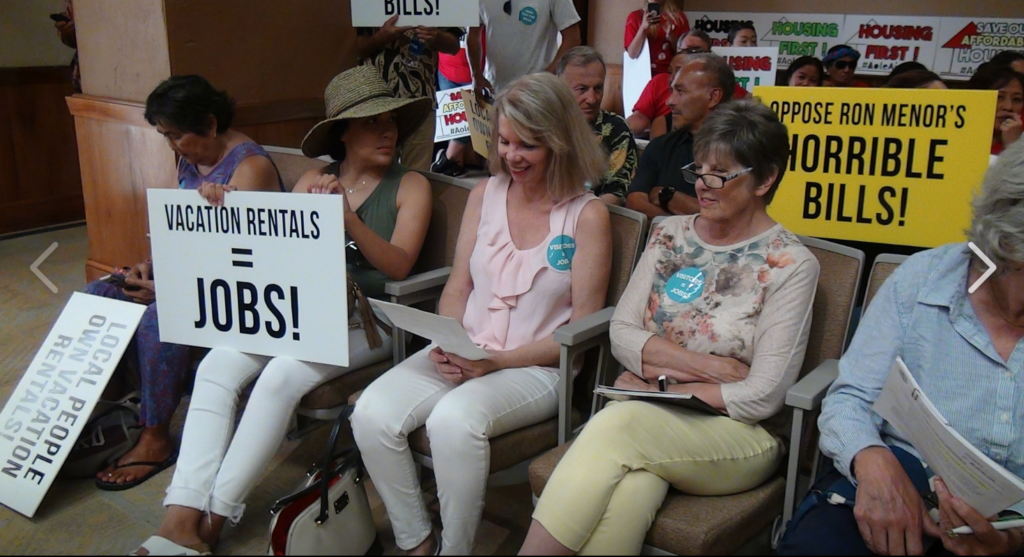
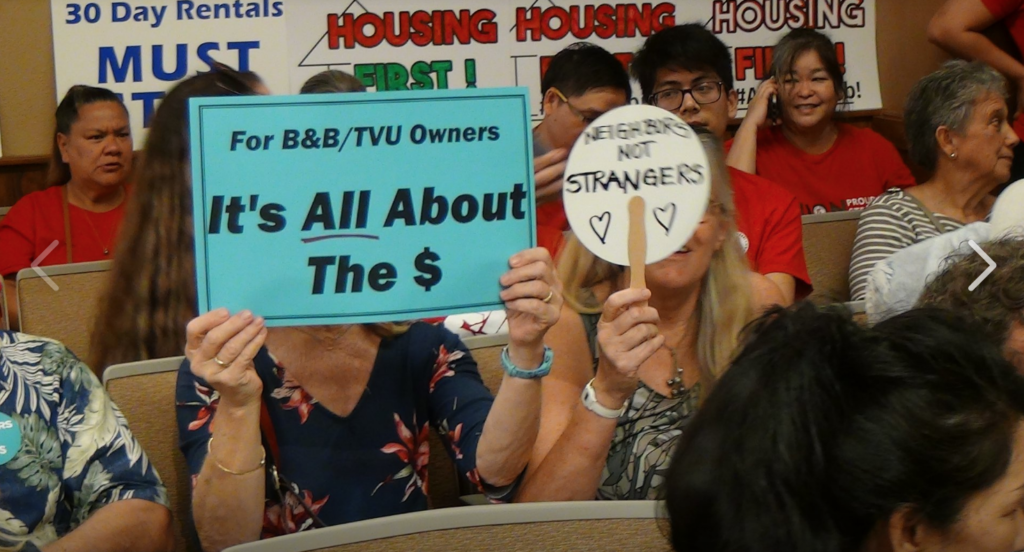
City and County of Honolulu City Council adopted Bill 89 and Bill 85 on June
17, 2019 after many long and contentious hearings.
Honolulu
Mayor Kirk Caldwell signed Bill 89 into law on June 25, 2019. On July 3, the
City Council chose not to address Bill 85 Veto.
Here is the
information provided by the Department of Planning and Permitting:
June 21, 2019
City Department of Planning and Permitting
New
Regulations on Short-Term Rentals
Bill 89 CD2
was adopted by City Council on Monday, June 17. It is awaiting action by Mayor
Kirk Caldwell. Its main points:
_Allows a limited number of new Bed and Breakfast Homes
(B&B) in non-resort areas under a new registration process, with annual
renewal required.
_Continues to prohibit Transient Vacation Units, or
“unhosted” rentals, in non-resort areas, unless the dwelling has a
Nonconforming Use Certificate (NUC).
_Regulates hosting platforms, such as Expedia or Airbnb,
requiring monthly reports to be filed with the Department of Planning and
Permitting, which will share the information with City Council.
_Makes
illegal any form of advertising short-term rentals which are not in compliance
with zoning regulations as provided in Bill 89. Bill 89 CD2:
http://bit.ly/2Kt9Qu9
The following
Questions and Answers are based on the assumption that Bill 89 CD2 will shortly
be enacted into law.
ADVERTISING
I own an
unhosted, “whole house,” or Transient Vacation Unit. I pay taxes. Can I
continue to advertise online and in the local newspaper?
Only if the
dwelling has a NUC or is located in a resort district.
When will
the department start enforcing the new advertising restrictions?
Beginning
August 1, 2019.
What are
the fines for illegal advertising?
Owners of the
property involved in illegal advertising will be notified, and if the
advertisement is taken down in 7 days, no fine will be imposed for a first
offense. If not taken down within this deadline, fines of between $1,000 and
$10,000 can be imposed for each day the advertisement remains on display.
If the management company
for my property places an illegal ad, will the company get cited?
They may be cited, but Bill 89
CD2 says, “The burden of proof is on the owner of the subject real property to
establish that the property is not being used as a bed and breakfast home or
transient vacation unit or that the advertisement was placed without the
property owner’s knowledge or consent.”
REGISTRATION OF NEW BED AND
BREAKFAST HOMES
I have been operating a Bed
and Breakfast Home for several years. Do I still have to obtain a registration
number?
Yes, unless you have a NUC.
I only rent out my house for
more than 30 days at a time. Do I need to register?
No.
I only rent my house while
my family spends 2 weeks each year visiting family on the mainland. Do I need
to register? When can I register?
Registration will begin no
sooner than October 1, 2020.
Why do we have to wait more
than year to register?
The time is required for the
Department to develop more specific procedures for implementing Bill 89 CD2,
including the adoption of rules, and creating the software to help with
enforcement and the registration process. If necessary, it provides time to
acquire more staff and to train them.
What are the registration
requirements?
There are more than a dozen
requirements. Most notable:
_Applicants must be “natural persons,” and not an organization or company
_Applicants must have a home exemption granted under real property tax law
_There must be insurance coverage for bed and breakfast use
_The initial registration fee is $1,000. For annual renewals, the fee is $2,000
_No more than 2 bedrooms can be used for visitor accommodations
_Quiet hours must be observed between 10 pm and 8 am
_If part of a homeowners or apartment owners association, approval by that
association must be obtained
_Neighbors within 250 feet
must be given a phone number to contact to make complaints 24 hours a day
For the complete list of
requirements, refer to Bill 89 CD2: http://bit.ly/2Kt9Qu9 3
Are there other
requirements?
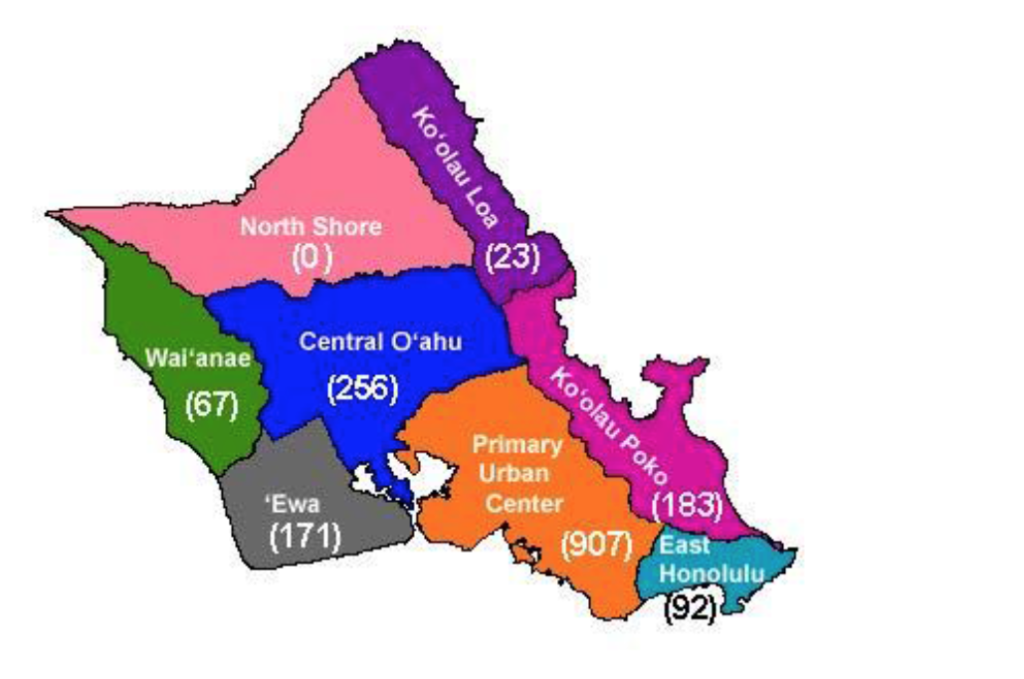
Density Limit.
No more than 0.5% of the total number of dwelling units in each regional
development plan area (DPA) can be used as B&Bs. Here are the limits by
area:
New B&Bs are not allowed in
the North Shore area, based on directives of the North Shore Sustainable
Communities Plan: http://bit.ly/2Y4QpLg
Condominium Limit. Up to 50% of
units in a condominium building may be allowed a B&B, subject to AOAO
approval.
Nontransferable. Registration
numbers are not transferable to another property, nor transferable to another
homeowner.
Separation Minimum. B&Bs
must be at least 1,000 feet from each other. This does not apply to units in
resort areas and NUCs.
Renewal Criteria. Noise and
other nuisance complaints can be grounds to deny renewal requests.
It is not yet determined. An
online registration process is anticipated, but certain requirements will have
to be verified; e.g. compliance with parking requirements.
If only a
limited number of registration numbers will be given out, how can I guarantee
to get one?
There is no
provision for guarantees.
How will it
be determined who gets a registration number?
Generally on
first-come, first-served basis. If the number of requests exceeds the limit for
a DPA, then a lottery will be held.
How will
the lottery system work?
This will be
fleshed out in the Rules. There will be a public hearing on the draft Rules
before they are finalized.
I am
currently operating a B&B, and do not have a NUC, so will need to register.
Will I get priority in the registration process?
No.
Can I
advertise and operate a short-term rental once I register?
No. To avoid a
citation, operation cannot occur until the registration process has been
completed and registration number issued.
MORE
INFORMATION
Note that
DPP has not mentioned about the property tax designation to “Resort”. It’s
unclear whether it would be based only on the two bedrooms of a home.
Previous elected office, if any: Community Associations.
Community organizations/prior offices held
Chair, Defend Oahu Coalition – Keep The Country Country; president, BYU-Hawaii Alumni Association; president, Laie Point Community Association; board member, Laie Community Association; founding member, Kahuku Hospital Board, Save Oahu Farmlands Alliance; member, Honolulu Board of Realtors; producer, Olelo Community Media; member, Hawaii Thousand Friends; member, Sierra Club; member, Ko’olauloa Sustainable Communities Advisory Planning Committee; member, Amnesty International; member, Friends of South Pass City; member, Relief Society Women’s Organization; merit badge counselor, Aloha Council BSA.
Is there anything else you would like voters to know about you?
I’m a citizen candidate. I do not accept donations from lobbyists or corporations. I owe nobody favors or fear except to work with you residents to improve some basic challenges facing us.
I have severe concerns about the direction that Honolulu is heading. We cannot continue to fund the runaway Honolulu Rail without firm fiscal scrutiny and accountability. I’m volunteering myself as an able and trained alternative to “business as usual” politics.
You can rely on my decades-old record of activism and advocacy. I have been consistent. I maintain a world-view outlook. But I also recognize that we live on a small island.
Additionally, my profession as a real estate broker allows me to work with people from all walks of life and status. We treat every client with care and respect. Should there be a challenge, we quickly and methodically address them with all parties and professionals concerned and find solutions to the benefit of all.
I have great confidence we can tackle Oahu’s challenges together! It doesn’t matter if we’re young or old, rich or poor, Democrat or Republican, military or civilian, unionized or not – – we all have the same dreams for ourselves and our children. We can be fair and reasonable in decision-making; we can all win! There are solutions to the challenges on our island home.
You the residents have valuable local knowledge and wisdom to share. Many of us also have international experience, professionally combed the world, and gained insights and expertise. Collectively, we can improve our island home! Let’s put YOUR smarts, imagination, expertise, common sense, and aloha together to improve our lives and communities.
Let’s gang up for the public good! I humbly ask for YOUR vote.
Previous elected office, if any: Community Associations
Community organizations/prior offices held
Chair, Defend Oahu Coalition – Keep The Country Country; president, BYU-Hawaii Alumni Association; president, Laie Point Community Association; board member, Laie Community Association; founding member, Kahuku Hospital Board, Save Oahu Farmlands Alliance; member, Honolulu Board of Realtors; producer, Olelo Community Media; member, Hawaii Thousand Friends; member, Sierra Club; member, Ko’olauloa Sustainable Communities Advisory Planning Committee; member, Amnesty International; member, Friends of South Pass City; member, Relief Society Women’s Organization; merit badge counselor, Aloha Council BSA.
What are the top three challenges facing the voters you seek to represent?
District 2 is the most diversified and largest land area in the City Council. We span rural communities from Kahalu’u to Wahiawa to an award-winning planned community in Mililani Mauka. We have wonderful residents!
1. Costs of Living & Housing – Hawaii is such a beautiful place with a stable political environment that does not discriminate real estate ownership; our local residents have to compete with international investors for real estate holdings. Increased property values and property taxes outpace many residents’ fixed social security and income. Our residents are feeling priced out on so many different levels.
Many work 2-3 jobs to make ends meet and sustain themselves. Our young people have to resort to exchange babysitting in parking lots on the way to work! Kupuna are worried about sustaining themselves in their golden years and passing on the family home to their children.
Most of us work very hard to make a living.
The government must deliberate carefully before imposing escalating fees and taxes on our people. Residents are not eternal money trees.
2. Quality of Life Ko’olauloa and North Shore is the Oahu’s golden goose for tourism. While residents are welcoming, the quality of life must be considered. Residents are overwhelmed by the increased amount of tourists. Tourism’ multiplier impacts on our infrastructure and public space are real. Traffic is a constant aggravation. The one hundred- year-old Kamehameha Highway, parks, other finite natural resources and other municipal services have to be considered into policy-making and deliberations .
3. Economic Opportunities This cash economy is leaving many of our residents behind. Homelessness is on the rise in our District. We have homeless camping in the streets, mountains, and other public places. This is not good for them and not good for the public. The world is changing. Jobs that are here today will not be here tomorrow.
Fortunately, we have very successful residents who are willing to help and share. As a city councilwoman for my District, I will also focus on this area – to help our residents explore start-ups, resources, education and options to lift ourselves and our families to the countless opportunities out there for economic gain.
Let’s gang up for the public good! I humbly ask for YOUR vote.
Previous elected office, if any: Community Associations
Community organizations/prior offices held
Chair, Defend Oahu Coalition – Keep The Country Country; president, BYU-Hawaii Alumni Association; president, Laie Point Community Association; board member, Laie Community Association; founding member, Kahuku Hospital Board, Save Oahu Farmlands Alliance; member, Honolulu Board of Realtors; producer, Olelo Community Media; member, Hawaii Thousand Friends; member, Sierra Club; member, Ko’olauloa Sustainable Communities Advisory Planning Committee; member, Amnesty International; member, Friends of South Pass City; member, Relief Society Women’s Organization; merit badge counselor, Aloha Council BSA.
If elected, what will be your highest legislative priority?
Many residents have several jobs to keep themselves afloat. Our seniors have to postpone retirement. Kupuna are worried about being priced out of house and home and not being able to pass the family inheritance on to the next generation. Our residents worry when the government is going to slam them with more taxes and fees!
We must protect our home front first! I want to champion and work with the other 8 council members to
~ ~ provide a property tax cap for local homeowners who have lived in their homes for 15 years or more. ( California did Prop 13 in 1978!)
~~ provide incentives to property owners who rent long-term to long term residents.
~~ Focus on increasing truly affordable rentals/homes inventory These foundation improvements will help mitigate some of the challenges we face in Oahu today. It will also protect our residents’ ability to remain in our island home and not be priced out.
Let’s gang up for the public good! I humbly ask for YOUR vote.
Previous elected office, if any: Community Associations
What qualifies you to represent the people of Hawaii?
I’m a CITIZEN CANDIDATE, not a career politician or a career bureaucrat, like some candidates. I’ve been a successful small businesswoman for 30 years.
Status Quo has not served us well. I want to positively improve Oahu for my children and your children. I
do not accept donations from special interests so I’m not beholden to do their bidding or owe any favors. I’ve mostly paid for this campaign on my own. I’ve been happily involved in civic and public affairs for decades with no compensation expected.
I have been an environmental, social and economic justice advocate and activist at City Hall with land use issues such as “Keep The Country Country”, preserving farmlands, food sustainability, open space, preserving parks, capital spending issues and others.
For the past 10 years, I’ve personally been involved in budgeting process and workings of Honolulu Hale. I’ve grown older and impatient and wish to make a difference INSIDE City Hall. I don’t have an ego nor am I looking to save my job. I truly believe that a public office is to serve the public good; it’s not a profiteering office.
I have severe concerns about the direction that Honolulu is heading. We cannot continue to fund the runaway Honolulu Rail without firm fiscal scrutiny and accountability. I’m volunteering myself as an able and trained alternative to “business as usual” politics.
Let’s gang up for the public good! I humbly ask for YOUR vote.
Previous elected office, if any: Community Associations
Community organizations/prior offices held
Chair, Defend Oahu Coalition – Keep The Country Country; president, BYU-Hawaii Alumni Association; president, Laie Point Community Association; board member, Laie Community Association; founding member, Kahuku Hospital Board, Save Oahu Farmlands Alliance; member, Honolulu Board of Realtors; producer, Olelo Community Media; member, Hawaii Thousand Friends; member, Sierra Club; member, Ko’olauloa Sustainable Communities Advisory Planning Committee; member, Amnesty International; member, Friends of South Pass City; member, Relief Society Women’s Organization; merit badge counselor, Aloha Council BSA.
What qualifies you to represent the people of Hawaii?
I’m a CITIZEN CANDIDATE, not a career politician or a career bureaucrat, like some candidates. I’ve been a successful small businesswoman for 30 years.
Status Quo has not served us well. I want to positively improve Oahu for my children and your children. I
do not accept donations from special interests so I’m not beholden to do their bidding or owe any favors. I’ve mostly paid for this campaign on my own. I’ve been happily involved in civic and public affairs for decades with no compensation expected.
I have been an environmental, social and economic justice advocate and activist at City Hall with land use issues such as “Keep The Country Country”, preserving farmlands, food sustainability, open space, preserving parks, capital spending issues and others.
For the past 10 years, I’ve personally been involved in budgeting process and workings of Honolulu Hale. I’ve grown older and impatient and wish to make a difference INSIDE City Hall. I don’t have an ego nor am I looking to save my job. I truly believe that a public office is to serve the public good; it’s not a profiteering office.
If elected, what will be your highest legislative priority?
Many residents have several jobs to keep themselves afloat. Our seniors have to postpone retirement. Kupuna are worried about being priced out of house and home and not being able to pass the family inheritance on to the next generation. Our residents worry when the government is going to slam them with more taxes and fees!
We must protect our home front first! I want to champion and work with the other 8 council members to
~ ~ provide a property tax cap for local homeowners who have lived in their homes for 15 years or more. ( California did Prop 13 in 1978!)
~~ provide incentives to property owners who rent long-term to long term residents.
~~ Focus on increasing truly affordable rentals/homes inventory These foundation improvements will help mitigate some of the challenges we face in Oahu today. It will also protect our residents’ ability to remain in our island home and not be priced out.
What are the top three challenges facing the voters you seek to represent?
District 2 is the most diversified and largest land area in the City Council. We span rural communities from Kahalu’u to Wahiawa to an award-winning planned community in Mililani Mauka. We have wonderful residents!
1. Costs of Living & Housing – Hawaii is such a beautiful place with a stable political environment that does not discriminate real estate ownership; our local residents have to compete with international investors for real estate holdings. Increased property values and property taxes outpace many residents’ fixed social security and income. Our residents are feeling priced out on so many different levels.
Many work 2-3 jobs to make ends meet and sustain themselves. Our young people have to resort to exchange babysitting in parking lots on the way to work! Kupuna are worried about sustaining themselves in their golden years and passing on the family home to their children.
Most of us work very hard to make a living.
The government must deliberate carefully before imposing escalating fees and taxes on our people. Residents are not eternal money trees.
2. Quality of Life Ko’olauloa and North Shore is the Oahu’s golden goose for tourism. While residents are welcoming, the quality of life must be considered. Residents are overwhelmed by the increased amount of tourists. Tourism’ multiplier impacts on our infrastructure and public space are real. Traffic is a constant aggravation. The one hundred- year-old Kamehameha Highway, parks, other finite natural resources and other municipal services have to be considered into policy-making and deliberations .
3. Economic Opportunities This cash economy is leaving many of our residents behind. Homelessness is on the rise in our District. We have homeless camping in the streets, mountains, and other public places. This is not good for them and not good for the public. The world is changing. Jobs that are here today will not be here tomorrow.
Fortunately, we have very successful residents who are willing to help and share. As a city councilwoman for my District, I will also focus on this area – to help our residents explore start-ups, resources, education and options to lift ourselves and our families to the countless opportunities out there for economic gain.
If elected, what can you do to improve the lives of your constituents?
Our residents are working very hard to make a living and sustaining themselves. I truly believe government is for betterment of the happiness, welfare and prosperity of our people.
1. Thus, I will be very firm and cognizant in fiscal decision-making. Is the spending good for the residents? Are local residents the primary beneficiaries? Is it absolutely necessary?
2. We also need to maintain clean, safe, and efficient core municipal services for our communities.
3. I will become your good friend. I will visit you in YOUR neighborhood and work with you.
4. We MUST protect our residents FIRST. They are the major stakeholders in Oahu. The Honolulu City Council has tremendous leverage and oversight to mitigate development agendas for Oahu.
5. We must have an over-arching understanding of what we wish Oahu to become. We must base our decision-making consistent with the Oahu General Plan (and Hawaii 2050), which offers objectives and policy guidelines for Population, Economic, Social, Cultural and Recreation, Tourism, Natural Environment, Transportation, Energy, Public Safety, Health & Education, Government Operations and Fiscal management to sustain and maintain our island home.
Is there anything else you would like voters to know about you?
I’m a citizen candidate. I do not accept donations from lobbyists or corporations. I owe nobody favors or fear except to work with you residents to improve some basic challenges facing us.
I have severe concerns about the direction that Honolulu is heading. We cannot continue to fund the runaway Honolulu Rail without firm fiscal scrutiny and accountability. I’m volunteering myself as an able and trained alternative to “business as usual” politics.
You can rely on my decades-old record of activism and advocacy. I have been consistent. I maintain a world-view outlook. But I also recognize that we live on a small island.
Additionally, my profession as a real estate broker allows me to work with people from all walks of life and status. We treat every client with care and respect. Should there be a challenge, we quickly and methodically address them with all parties and professionals concerned and find solutions to the benefit of all.
I have great confidence we can tackle Oahu’s challenges together! It doesn’t matter if we’re young or old, rich or poor, Democrat or Republican, military or civilian, unionized or not – – we all have the same dreams for ourselves and our children. We can be fair and reasonable in decision-making; we can all win! There are solutions to the challenges on our island home.
You the residents have valuable local knowledge and wisdom to share. Many of us also have international experience, professionally combed the world, and gained insights and expertise. Collectively, we can improve our island home! Let’s put YOUR smarts, imagination, expertise, common sense, and aloha together to improve our lives and communities.
Let’s gang up for the public good! I humbly ask for YOUR vote.
Why would anyone want to enter politics in today’s hyper-polarized environment? Seeking public offices to offer solutions and honest service is severely needed in our democracy! Not every one is into that political pool of polarization and name-calling. Being hyper-polarized is not conducive to our democracy. I’m happy that there are candidates who focus on issues/solutions in a civil and thoughtful manner.
Civil Beat set out to answer that question by interviewing eight candidates who hadn’t run for elected office before this year. They said they were lured by issues like Hawaii’s high cost of living, climate change, a desire for lower taxes and the need for more efficient and transparent government. Yes!
And while those are subjects longtime politicians frequently cite as well, new blood might be the key to actually addressing them, some newcomers say. I submit that insanity is doing the same thing over and over again and expecting different results. Are you happy with the direction Oahu is heading? Longtime politicians and bureaucrats had their chances, what have they done?
Zack Stoddard, a 31-year-old City Council candidate, works as a city planner.
Cory Lum/Civil Beat
Anti-abortion candidate Andrew Kayes, a nonpartisan candidate for the state House seat that covers the greater Kahului area, decided to pull papers after the Legislature passed a bill to legalize medical aid in dying, which he opposes.
Others say politicians have stopped listening to the constituents who elected them.
“I’ve just been frustrated with politicians and how they don’t seem to really care at all about working-class people,” said Zack Stoddard, a candidate for Honolulu City Council District 6 that stretches from Makiki to Kalihi. “That’s essentially the number one thing I hear from people.”
Stoddard isn’t a total stranger to local politics. Last year he was appointed to the neighborhood board for the Nuuanu and Punchbowl areas. He volunteered to fill a vacancy for the seat that represents his community during the first board meeting he attended.
He decided to run for the City Council after the District 6 incumbent, Carol Fukunaga, killed a bill to ban styrofoam food containers.
Stoddard said he was concerned about the influence of money in politics. He was one of a few new candidates interviewed by Civil Beat who said they are declining donations and paying their own way.
But Tina Wildberger, a progressive socialist Democrat who’s running to represent the state House seat district that covers Kihei to Wailea-Makena, has a different philosophy about campaign finance.
“I feel like if the people that know about me, care about me, and the people in my community don’t want to support my campaign, I don’t have any business being in that office,” she said.
Wildberger, who advocated for environmental issues and managed Kelly King’s successful campaign for a Maui County Council post, said her run was partly inspired by the #MeToo movement, the Parkland, Florida, school shootings and women’s marches.
In a way, Wildberger got in the race by accident. She had approached Rep. Kaniela Ing, a congressional candidate who will soon vacate the district Wildberger is running to represent, to pick his brain. Wildberger was still weighing a run when she got a call from a reporter who said Ing had endorsed her.
“If we were not experiencing the systematic dismantling of our democratic and environmental protections and protections against women … I don’t know that I would’ve been motivated this much to run,” she said.
Fresh Faces
Some other first-time candidates got into their races without any political experience.
Kelly Kitashima, a candidate running to represent Honolulu City Council District 8 that spans Aiea, Pearl City and Waipahu, became politically engaged when she was promoted to higher management at the hotel where she worked. She opposed efforts to increase taxes on the state’s tourism industry and began submitting testimony to officials.
Kitashima said she found a council run appealing because the office handles topics such as rail, infrastructure and property taxes — issues that affect people’s everyday lives.
Kitashima, whose kids play sports, was frustrated with the state of local fields.
“I am a mom, and I know it sounds so repetitive, but I’m just deathly afraid that my kids won’t be able to live here,” Kitashima said. “It kind of felt like I had to roll up my sleeves and step up.”
Kitashima, a self-described “local girl,” said she started tuning into politics when Donald Trump became president.
“I definitely would say I became a little bit more vigilant that year,” she said, adding there was “more media coverage around politics that you couldn’t ignore.”
Kayes, the candidate for Kahului’s House seat, is also new to politics. He said Hawaii’s political atmosphere is an echo chamber for Democrats. The pro-life physician was vehemently opposed to the medical aid in dying law passed by the Legislature last session.
“I felt like our state was better than this, and I was shocked and I pulled papers within a week of that happening,” he said.
Donald Trump’s ‘Silver Lining’
Many new candidates disagree with President Trump’s politics, but said it’s a good thing that more people who aren’t career politicians have started running for office.
“The silver lining of this administration is that he made (running for office) so accessible to the everyday person that we realized we don’t have to have a Harvard law degree to run for office, we need community members,” said Natalia Hussey-Burdick, a Democratic candidate for a House seat in the Kaneohe area.
Hussey-Burdick has quite a bit of political experience for a first-timer — the 28-year-old has served as a community advocate and legislative clerk and held positions in the Democratic Party.
Natalia Hussey-Burdick says she sees another side to politics as a legislative clerk.
A self-described “political nerd,” said she had always felt she was too opinionated and unpolished to run for office.
She changed her mind after attending the Kuleana Academy bootcamp hosted by the nonprofit Hawaii Alliance for Progressive Action. It’s free for prospective candidates or their staff members, but attendees who end up running are expected to fundraise and donate $1,000 to HAPA.
State Sens. Laura Thielen, Russell Ruderman and Donna Mercado Kim and Reps. Gene Ward, Andria Tupola, Nicole Lowen and Matt LoPresti spoke at the program Hussey-Burdick attended.
Democratic Party executive director Laura Nevitt told the participants that “women will give themselves 100 reasons why they shouldn’t” run for office. That resonated with Hussey-Burdick.
Choon James, a longtime testifier at the Honolulu City Council and now a candidate to represent District 2 on the North Shore, decided to run because she wasn’t happy with the way the field of candidates was shaping up to replace term-limited Councilman Ernie Martin. Being involved in civil and public affairs for over 3 decades and testifying at the City Council for the past ten years have taught me me a few things about Honolulu Hale! In fact, the only two city council candidates this election year who have been steadfastly participating at Honolulu Hale are Natalie Iwasa CPA, CFE and I.
It also helped that her kids moved out of the house. I’m an empty nester. My children are grown and are leading success and happy lives of their own. This allows me the opportunity to be more involved unlike my other friends with children or who have to take care of their parents and so forth.
James has been involved in environmental issues and the North Shore’s push to “Keep the Country Country.” I’ve also been a successful and experienced small businesswoman for 30 years. I’ve been involved in protecting private property right, social, economic and environment justice issues. She supports term limits for elected offices and caps on homeowners’ property taxes if they’ve lived on the property for 15 years. Our residents have severe concerns of being priced out of house and home. They want to live in their homes in their golden years and they want to pass on the home to their children. California enacted Proposition 13 in 1978. What are we waiting for? I will also work with the other 8 city council members to provide incentives for those who rent long term to local residents. We should also focus on increasing the rental inventory, instead of luxury condos to mitigate our housing problems.
She’s not looking to run again if she loses. I’m offering my candidacy as a Citizen Candidate. I do not accept donations from lobbyists or Corporations. I’m paying my way. I’m not running to protect my job. No one is making me run to become a status quo at the City Council. I’m running because I offer an independent voice for ordinary people. The residents’ happiness, welfare, and prosperity come first. I will put residents FIRST!
“I can say as a citizen candidate I honestly have no fear and I have no favor,” she said. “I’m getting old and I’m getting impatient.” Yes, after decades of being an activist and an advocate in land use, economic, social and environment issues, I have seen first hand the workings of Honolulu Hale. I see how status quo and the oligarchy continue to make life more miserable for our residents, not better. I’ve seen our residents having to work 2-3 jobs to sustain themselves. I’ve seen how the public treasury has been plundered and causing the costs of living to increase. If you are happy with the direction Honolulu is heading and happy with the escalating costs of living, then I’m NOT your candidate.
Thoughts on this or any other story? Write a Letter to the Editor. Send to news@civilbeat.org and put Letter in the subject line. 200 words max. You need to use your name and city and include a contact phone for verification purposes. And you can still comment on stories on our Facebook page.
How much do you value our journalism?
Civil Beat focuses exclusively on the kind of journalism most at risk of disappearing – in-depth, investigative and enterprise coverage of important local issues. While producing this type of journalism isn’t cheap, you won’t find our content hidden behind a paywall. We also never worry about upsetting advertisers – because we don’t allow any. As a nonprofit newsroom, we rely on donations from readers like you to help keep our stories free and accessible to everyone. If you value our journalism, show us with your support.
Oahu has one of the most expensive housing markets in the country. What specific proposals do you have to make housing more affordable?
Concentrate on true affordable rentals first.
However, placing time limits on affordable rentals with developers is kicking the can down the road. Housing affordability will only get worse in time.
I would check and see how many properties are owned by the city, state and federal and go on from there.
Singapore provided affordable rentals tied to a percentage of the tenants’ income.
It’s been estimated that it would take a 3.19 fireman, a 3.6 school teacher, or a 5.2 hotel clerk salary to afford a medium priced home in Oahu.
We don’t just have a housing issue; we have an income issue.