What is the vision for Kaka’ako Makai, Honolulu?

This is a photo circulating in facebook. It explains the situation clearly.  Many Hawaii residents are perturbed that Senate Bill 3122 will allow the Office of Hawaiian Affairs (OHA), a state agency to develop residential high-rises within Kaka’ako Makai (ocean-side) – Honolulu’s last remaining public shoreline area, where residential development is now prohibited by law.

Kaka'ako Makai

SB 3122 will be heard by the House Committee on Water and Land on Monday, March 10, 2014 at 8:45 am

Anyone can submit testimony via http://www.capitol.hawaii.gov/login/login.aspx
Hawaii’s Thousand Friends presents a clear and logical summary for its opposition to SB 3122:
“SB 3122 SD2 seeks to exempt OHA, now owner of several Kakaako Makai parcels, from the 2006 law which prohibited residential development of land makai of Ala Moana Boulevard between Honolulu Harbor and Kewalo Basin.Residential development in Kakaako Makai was banned by the legislature after massive citizen protests against an A&B proposal to construct several 200-foot condo towers there.
HCDA law §206E-31.5…prohibits the authority from: (2) Approving any plan or proposal for any residential development in that portion of the Kakaako community development district makai of Ala Moana Boulevard and between Kewalo Basin and the foreign trade zone.
From 2006 to 2010, in a planning process called by HCDA, people came together to guide the development of the Kakaako Waterfront for the benefit of not only the Kakaako community but for all the people of Hawaii. (4/6/11 staff report)
The result was a conceptual master plan for Kakaako Makai with 9 components, including park expansion/enhancement and waterfront access via parking and traffic circulation measures

Now, SB 3122 SD2 proposes to undo the prohibition of residential development in Kakaako Makai. This must not be allowed because

Kakaako Waterfront Park is one of the last strips of open space and parkland with public access to the shoreline along the urban Honolulu coastline.

With 30 new high-rise towers proposed for Kakaako Mauka and a projected population of 30,000+, there will be a need for this open park space

Kakaako Makai offers open access to shoreline fishing, diving and popular body boarding and surf sites, as well as a waterfront promenade, picnic areas, and significant panoramic views.

OHA knew of the residential restrictions when they accepted the Kakaako Makai property, but now wants to develop 4 or 5 condo towers.

In 2006 when legislators prohibited residential development in Kakaako Makai, with only 1 lawmaker in each chamber opposing, it was evident that the legislature had spoken. Are legislator’s votes only good for 8 years? “

SB 3122 SD2 Status: Hawaii Community Development Authority – Allows the OHA state agency to develop residential high-rises within Kaka’ako Makai ( oceanside) – Honolulu’s last remaining public shoreline where residential development is now prohibited by law.   
Introducer(s): GALUTERIA, DELA CRUZ, HEE, KAHELE, KIDANI, SOLOMON, Baker, Espero, Kouchi, Nishihara, Shimabukuro, Wakai
Measure Title: RELATING TO HAWAII COMMUNITY DEVELOPMENT AUTHORITY.
Report Title: Hawaii Community Development Authority; Residential Development
Description: Authorizes residential development on certain specified parcels of land owned by the office of Hawaiian affairs in Kakaako. Requires applicants for residential development to hold a public hearing regarding a plan or proposal for residential development in Kakaako and consider all written and oral submissions from the hearing prior to submitting the plan or proposal to HCDA for approval. Requires HCDA to hold a public hearing and fully consider all written and oral submissions received at the hearings held by the applicant and the HCDA prior to approving any plan or proposal for residential development. Establishes a Kakaako makai association fee and Kakaako makai special account to fund various public services and projects in Kakaako. Exempts the Office of Hawaiian Affairs from section 206E-12, HRS, regarding the dedication of public facilities by developers as a condition of development in Kakaako. 

Honolulu Mayor Kirk Caldwell on a Rampage

Woman Criticizes Honolulu’s Government, Has Her Protest Signs Bulldozed

Nick SibillaNick Sibilla, Contributor   

How people respond to criticism can reveal a lot about their character.  Some might try to debate or reason with those they disagree with.  Others prefer to ignore critics.  City officials in Honolulu take a different approach: They use a bulldozer.

Choon James is a successful real estate broker with over two decades of experience in Hawaii.  But the city of Honolulu is seeking to seize property she’s owned for almost a decade to build what she calls a “super-sized” fire station in rural Hauula.

Since January 2010, she has put up signs to protest Honolulu’s use of eminent domain.  These signs declare “Eminent Domain Abuse: Who’s Next?” and “YouTube Eminent Domain Abuse—Hawaii.”  For more than three years these signs have been up without any incident.

DSC07929DSC07926

But now the city is showing a callous disregard for Choon’s freedom of speech.  Back in May, Honolulu seized two of her eminent domain protest signs.  Without her consent, city employees went onto the property and seized and impounded her signs before damaging them. Even worse, the city slapped her with a notice for trespassing, for property she is trying to defend in court.

After these signs were torn down, Choon placed three more signs there.  These lasted just a few months before the city once again seized the signs.  This time, Honolulu was much more dramatic.  On October 18, city workers, backed by police officers, squad cars and a bulldozer, came by and literally bulldozed those protest signs.

The city’s actions show a shameful lack of respect for the First and Fourth Amendments.  Citizens have a right to protest government actions.  The First Amendment was enacted precisely to protect citizens who criticize the government from retaliation.  Lawsuits challenging Honolulu’s unreasonable seizures and chilling attacks on free speech are now pending in federal court.

Unfortunately, Honolulu is not alone in trying to silence critics who question eminent domain.  The Institute for Justice has represented citizens in St. Louis, Mo., Norfolk, Va., Tennessee, and Texas who protested abusive property seizures and faced censorship.  Out of these four cases, IJ successfully defended free speech in three cases, while the fourth is currently in litigation.

After 24 of his buildings were taken by St. Louis, Jim Roos painted a giant mural on a building he owned advocating “End Eminent Domain Abuse.”  But St. Louis labeled the mural an “illegal sign” and wanted to force Jim to remove the sign (and stifle his right to protest) or face code violations.  He teamed up with the Institute for Justice and sued the city.  In a major win for the First Amendment, in July 2011, the Eighth U.S. Circuit Court of Appeals ruled in favor of Jim and allowed the mural to stay up.

In a similar vein, IJ has defended grassroots activists from a frivolous defamation lawsuit and protected an investigative journalist’s right to free speech from a vindictive private developer.

More recently, the Institute for Justice is suing the city of Norfolk for trying to squash a small business owner’s eminent domain protest sign.  The Central Radio Company, a repair shop, has been in Norfolk for almost eight decades.  But Norfolk had plans to seize the property with eminent domain for a private redevelopment project.

To protest, owner Bob Wilson displayed a huge banner on-site.  The city responded by telling Bob he had to take down the sign or face fines of up to $1,000 per day.  Fortunately, the Virginia Supreme Court unanimously struck down the city’s attempt to seize Bob’s land; his free speech case is still infederal court.

As the cases make clear, courts routinely respect Americans’ First Amendment rights.  Honolulu should do the same.

DSC07922DSC07920
Postscript: Mayor Kirk Caldwell also shut down the owner’s business with Reynolds Recycling on October 21, 2013. Public push back forced the Mayor to cut a deal with Reynolds to return to the adjacent city Lot 64 on December 20, 2013. The Caldwell Administration did not disclose that it is on a month-to-month lease. Should the Mayor gets permission from the courts to condemn, the last two commercial zone lots will be decimated and recycling business  gone.
DSC07946DSC08057
The only valid reason for Mayor Kirk Caldwell to shove this extra expensive fire station onto this small rural community is he owes a plum building contract to a donor!  The Mayor  wants to build a huge Kapolei City station in the small rural town of Hauula.
The Mayor can be contacted at mayor@honolulu.gov    808 768-4141
City Council Chair Ernie Martin  at emartin@honolulu.gov   808 768-5002
Choon James at ChoonJamesHawaii@gmail.com   808 293 9111
Choon James: Kahuku Plantation Camp Eviction Watch – Seven (7) More Families to Go

“Keep the Country Country” — from Kahaluu to Haleiwa — is an integral part of needed diversity and versatility for a thriving and sustainable Oahu. This cause has never sounded so pragmatic and urgent for this iconic region as the first shoe of gentrification drops in Kahuku. It’s not about the past; it’s about the future.”
Kahuku Plantation Camp will soon see seven of its old-time families being evicted.  The circuit Judge ruled in favor of Continental Pacific, LLC in the eviction proceeds.
Continental Pacific, LLC bought the plantation from the Estate of James Campbell in 2006.
 DSC09799
Simplicio  and Lenora Caban will soon be evicted from their home in the background.
The other families include:
 Tejada
 Salanoa
 Fernandez
 Caulford
 Lagua
 Angel Adversalo is in his 90s.
DSC09814
Maghanoy was evicted during Thanksgiving of 2013.  Maghanoy claims that his personal possessions – guitars, deceased wife’s pearl jewelry, tools, and hidden cash were stolen during the eviction. He was on the mainland visiting his daughter during the eviction.
The Eugenio home may have been razed but the controversies continue.
DSC09829

Confirmed: Bloggers Have First Amendment Rights Too

Bloggers Have Same First Amendment Rights as Corporate Media!

Orwell

A big Mahalo to Crystal L. Cox and Eugence Volokh for their valiant efforts to protect free press and free speech!

On January 17, 2014, the 9th U.S. Circuit Court of Appeals sided with Crystal L. Cox from Eureka, Montana who was sued by for defamation by Kevin Padrick, an attorney and his company – Obsidian Finance Group, LLC.  Independent Blogger Cox had written posts exposing fraud, corruption, money-laundering and so forth.

I will quote the circumstances as reported in the Associated Press by journalist Jeff Barnard.

Crystal L. Cox, a blogger from Eureka, Mont., now living in Port Townshend, Wash., was sued for defamation by Bend attorney Kevin Padrick and his company, Obsidian Finance Group LLC, after she made posts on several websites she created accusing them of fraud, corruption, money-laundering and other illegal activities. The appeals court noted Padrick and Obsidian were hired by Summit Accommodators to advise them before filing for bankruptcy, and that the U.S. Bankruptcy Court later appointed Padrick trustee in the Chapter 11 case. The court added that Summit had defrauded investors in its real estate operations through a Ponzi scheme.

A jury in 2011 had awarded Padrick and Obsidian $2.5 million.

“Because Cox’s blog post addressed a matter of public concern, even assuming that Gertz is limited to such speech, the district court should have instructed the jury that it could not find Cox liable for defamation unless it found that she acted negligently,” judge Andrew D. Hurwitz wrote. “We hold that liability for a defamatory blog post involving a matter of public concern cannot be imposed without proof of fault and actual damages.”

The appeals court upheld rulings by the District Court that other posts by Cox were constitutionally protected opinion.

The Reports Committee for the Freedom of the Press also provided statements in Barnard’s article:

“Standards set by a 1974 U.S. Supreme Court ruling, Gertz v. Robert Welch Inc., apply to everyone, not just journalists.

It’s not a special right to the news media,” he said. “So it’s a good thing for bloggers and citizen journalists and others.”

Barnard further reported that:

Though Cox acted as her own attorney, UCLA law professor Eugene Volokh, who had written an article on the issue, learned of her case and offered to represent her in an appeal. Volokh said such cases usually end up settled without trial, and it was rare for one to reach the federal appeals court level.

“It makes clear that bloggers have the same First Amendment rights as professional journalists,” he said. “There had been similar precedents before concerning advocacy groups, other writers and book authors. This follows a fairly well established chain of precedents. I believe it is the first federal appeals court level ruling that applies to bloggers.”

This ruling should be a clear reminder to  misguided attorneys, corporations, developers or those with affluence  to cease the bullying or intimidating  those who report  the issues of the day.

Many concerned citizens have no choice but to create their own blogs and websites to level the playing field in this rampant media warfare.

The government has its plentiful PR specialists, paid for by taxpayers. Corporations and special interests have their own 24/7  PR consultants. The news media can be bought or controlled by big money or shut down. There are hired mercenaries who feel no qualms about spinning the facts or demonizing the messengers.

It’s not uncommon for the public to read articles or watch the TV news only to  lament the irregularities or inadequate reporting. Oftentimes, critical issues are shunned or ignored by the news media because of entwined relationships.

Bloggers who have information or have intimate experiences and clear understanding of issues are critically needed now, more than ever.

Blog away!


What Would Dr. Martin Luther King Think of Honolulu Mayor’s Behavior Today?

What would MLK think of Honolulu’s Mayor Kirk Caldwell’s  Persecution of the Poor  and  Civil &  Free Speech Rights today?

1512632_10151853580821363_1675407229_n-1

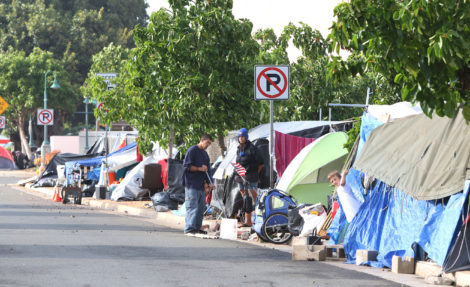
The houseless people continue to be harassed and penalized.

DSC09176

Citizens who push back are exposed to the Mayor’s strong arm tactics of raiding free speech signs and bullying in the courts, courtesy of  the city’s scarce fiscal resources.

DSC07927

Is Honolulu any better than the  Montgomery, Alabama of 1955 where those in office abused their power and bulldozed over civil rights because they could?

DSC04901

The physical segregation of race may appear to be over . But the segregation of  social classes – the rich & powerful versus the poor & the unconnected  – remains very problematic.

DSC09829

Many are involved in the fight for justice and equality in Hawaii.

As MLK said,

Injustice  anywhere is a threat to justice everywhere.”

just cause needs many helping hands and willing hearts!

Every one is needed.

9837_10152167586979910_1633777438_n

What would MLK say about the events of today in Honolulu?


Choon James: Kahuku Plantation Camp – Eugenio Family Evicted and Home Razed Down

The complexion and neighborhood of Kahuku Plantation Camp continue to change

Continental Pacific, LLC  from Florida purchased  available land acreages, including the Kahuku Plantation Camp,  from the Estate of James Campbell in 2006.

The gentrification of Oahu’s rural Kahuku Plantation Camp continues. About thirty-one (31) local families are facing evicting. The Eugenio Family home , next to the Kahuku Methodist Church, along  Kamehameha Highway has been razed as of yesterday.

BEFORE

cp3cp5

DSC07780

AFTER

DSC09829


DSC09833DSC09825

Today, the Kahuku Plantation Village of about 70 houses is in turmoil. Many are facing eviction from homes they’ve stayed in their entire lives. The sweat and equity of these inter-generational laborers; along with their heritage and roots are tied to this plantation camp.

What is occurring at the Kahuku Village Plantation Camp has happened elsewhere and can be quickly summarized in one word — “Gentrification”.

In a nutshell, gentrification is the compressed evolution of massive development in communities that produces “winners” and “losers.”

It’s obvious the “losers” are usually the less affluent.

Gentrification chases the less affluent out of their communities due to the influx of new money and spending power. The less affluent are unable to pay rising rents, property taxes, real estate and the accelerating costs of living. Local businesses may lose their leases under competition or have to keep up with newly built commercial spaces with higher built-in expenses. Development will provide short-term construction jobs to some but what happens next?

Gentrification can alter lifestyle, values, and identity of communities when left unchecked. It inevitably creates disconnect and conflicts in communities. In Hawaii, it’s become a volatile struggle to protecting the local culture and values, environment, finite resources, and a chosen island lifestyle that many hold dear.

Fortunately, Oahu has had a visionary General Plan since the 1970s under the leadership of then Gov. George Ariyoshi. Oahu was divided into eight different geographic areas, delineating different land-use policies that include Primary urban center (Honolulu), Secondary urban center (Kapolei), Urban – fringe (Koolauloa Poko), and Rural designations (Koolau Loa, North Shore, and Waianae).

This Oahu General Plan is a careful compromise to preserve what we hold hear about Hawaii and to address development.

To prevent urban sprawl and inevitable gentrification, decision makers must respect and adhere to the existing Oahu General Plan. There has to be a line of demarcation to safeguard viability and diversity in land-use decisions for Oahu. If we don’t stand for something, we’ll fall for anything.

This Oahu General Plan that protects the Koolau Loa and the North Shore’s charm of old Hawaii, finite resources, food security, watersheds, open space, recreational spaces, view planes, rural lifestyle, and especially the stability of kamaaina residents, must continue to be the basis for objective ‘Big Picture’ land-use planning. Decision makers must not allow big developers to hijack and amend this document to fit their own agenda.

“Keep the Country Country” — from Kahaluu to Haleiwa — is an integral part of needed diversity and versatility for a thriving and sustainable Oahu. This cause has never sounded so pragmatic and urgent for this iconic region as the first shoe of gentrification drops in Kahuku. It’s not about the past; it’s about the future.


Kahuku Plantation Village Residents Witnessed Re-internment of ‘Iwi kupuna’

Two re-internment ceremonies were held at Kahuku Plantation Camp amidst continuing controversies

DSC09725

On January 11, 2014, a group of Kahuku Plantation Camp residents witnessed the re-internment of ‘iwi kupuna’ that were found in the grounds around the decades-old plantation homes. Landowner Continental Pacific, LLC handling  of the ‘iwi kupuna’ cultural and other procedures had precipitated controversies.

At the ceremony, the Kahu distributed printed material of ” Aloha Aina Iwi Kupuna – Protocols – Ten Prayers ( oli, pule, mele )” to those in attendance. They were printed in English and Hawaiian Language versions. The Prayers include The Lord’s Prayers,  an ole written by Edith Kanaka’ole,  and the Queen’s Prayer ( Ke Aloha O Ka Haku) by Queen Lili’uokalani, as listed below:

The Queen’s Prayer

Your loving mercy

Is as high as Heaven

And your truth

So perfect

I live in sorrow

Imprisoned

You are my light

Your glory, my support

Behold not with malevolence

The sins of man

But forgive

And cleanse

And so, o Lord

Protect us beneath your wings

And let peace be our portion

Now and forever more 

 ~~~

The first ‘iwi kupuna’ was housed in a lauhala box and buried in about a three (3) feet deep setting;  fresh sand was shoveled into the plot and a cement block was placed on top of it. There would be a marker later on. (This site is located behind the Rainbow Schools vicinity.)

The two governmental agencies charged to address  and regulate ‘iwi kupuna’  issues are 1) The State Historic Preservation Division (SHPD) that falls in under the jurisdiction of the Department of Land and Natural Resources ( DLNR)  and 2) The Oahu Island Burial Council (OIBC).

There  was a DLNR ranger in uniform and also a DLNR  uniformed policeman  in attendance.
DSC09732

Kali Fermantez, a recently appointed member of the Oahu Island Burial Council was  also in attendance. He spoke a few words at the first ceremony focusing on respect for the ‘iwi kupuna’ and forgiveness despite the ‘pilikia’ surrounding the Kahuku Plantation Camp.

We later asked permission to video tape our questions and his responses regarding procedures but he declined, explaining he was a very private person. His wish was respected.

DSC09734

After the first re-internment ceremony, Kahuku villagers walked to the next re-internment  ceremony at Simplicio Caban’s home. ‘Iwi Kupuna’ human remains were found next to his house when water pipe trenching was being done.


DSC09750

Villagers gathered around in reverence as the second re-internment ceremony  (abbreviated this time)  was conducted.

DSC09762

DSC09746

Kawika Farm from SHPD held  the  second set of ‘iwi kupuna’ at  the Saturday’s re-internment ceremonies.

DSC09740DSC09789

This metal plate was provided by SHPD as a marker as well as a caution for future encounters with trenching in the area.  The metal plate should help reveal the significance of this site, according to Farm from SHPD.

DSC09791

The fresh sand covered SHPD’s metal plate. They said it would be leveled and finalized later.

On this day, the dead may appear to be put to rest but the living  are forced to fight on.

DSC09813

While the ceremonies were going on at the mauka side of the Kahuku Plantation Camp, golfers can be seen at the 122-acre Kahuku “Municipal” Golf Course on the makai side. The iconic beachfront course is also undergoing a watershed transformation; it’s on the verge of being sold to a Chinese investor. Residents worry that the course could be transformed into another resort-residential subdivision or an expensive golf course that the public can no longer afford.

DSC09819

In the meanwhile, the above Condominium Spatial Unit V- 21 has been cleared and footings can be seen for a  new house. This spatial unit is located next to Kahuku Village Plantation Association President Glen Maghanoy’s former plantation home in the background.

DSC09814

Maghanoy‘s eviction was approved by Judge Hillary Gangnes. Professional movers completed the Maghanoy eviction during the Thanksgiving of 2013. Maghanoy was on the mainland visiting with his daughter and claimed that valuable items were stolen from him, including his guitars, tool box, about $3,000 cash (hidden inside the house), and his children’s deceased mom’s black pearl jewelry.

Because Maghanoy was not present at the execution of the Writ of Possession by the movers, he could not take pictures of the event. Neighbors had signed declaration of seeing the guitars being laid on the grounds; in fact, one of the movers was playing  Maghanoy’s ukulele.

The  day’s re-internment ceremonies focused on respect for the ‘iwi kupuna’ along with  messages of forgiveness.

DSC06902

However, to many Kahuku Plantation Village residents, ‘forgiveness’ cannot be used as a convenient tool for Continental Pacific, LLC and its affiliates to absolve themselves of past wrongs and continuing pilikia that surround the camp.

DSC09799

About thirty-one (31) long time plantation camp families are in danger of being evicted.  Glen Maghanoy and the Eugenio family were the first in line to be evicted.


Choon James: Hau’ula Recycling Returns After City’s Retaliatory Shut-Down on Adjacent Private Owner

City shut down recycling business on Choon James’ Lot on October 21, 2013  by installing this sign in the middle of the entry way!  The lawsuit against eminent domain taking is not till March of 2014.


DSC08057

On December 20, 2013, the city moved Reynolds Recycling back onto the adjacent city-owned Lot 64!DSC09937Unhappy Hauula residents have been calling the Mayor’s office at 768-4141 about his irrational Reynolds Recycling Shut-Down. One mentioned he had been calling the office just about every day!

DSC07946

Regardless of  which lot Reynolds Recycling is situated, this is a temporary fix to appease irate residents. Reynolds is now operating on a short lease.

If Mayor Caldwell succeeds in hoisting his SUPER-EXPENSIVE $13 Million Hauula Fire Station Relocation project onto these last two remaining  commercial lots, the Recycling business will disappear for good.

There is no  other available commercial-zoned parcel to operate the recycling and related businesses in Hauula.

DSC09966

At the heart of this controversy is Mayor Caldwell’s insistence on additionally seizing the adjacent Choon James’ Lot 65. The city is vigorously suing in the circuit court to gain possession  of her Lot through eminent domain by ‘necessity’.

In fact, the city recently hired an Oakland, California architect for a “comprehensive study”  to justify that an “Ewa Beach” style fire station is appropriate for RURAL Hauula! We sure would like to know how much taxpayers had to pay for that study from Oakland, California.

DSC07250

The city already purchased  the middle Lot 64 in 2010. The 20, 297 square feet of land is sufficient to build a typical fire station in Oahu.

Curiously, Mayor Kirk Caldwell wants to build a SUPER-SIZED “Ewa Beach” style fire station in rural Hauula that requires Choon James’ Lot  and at triple the cost!

A typical Oahu fire station costs about $5 Million and sits on approximately 19,000 square feet of land.

Former Mayor Peter Carlisle was amicable to working with Hauula’s affected parties by exploring alternate sites for the Fire Station Relocation. However, when Kirk Caldwell became the Mayor in 2013, the culture of bullying was resurrected.  Caldwell was hell bent to push his irrational pet project forward.

Subsequently, on May 29, 2013, Mayor Kirk Caldwell’s Department of Maintenance Services from Halawa  conducted an illegal raid on Choon James’ free speech signs at her Lot 65, claiming the city had sole possession of the property.  Their court hearing on the eminent domain case is not till March of 2014.

Subsequently, Choon James additionally  filed a suit against the City and County of Honolulu’s illegal seizing of her free speech signs and violating her civil rights on August 13, 2013 .

DSC07929

New eminent domain signs were created and erected.  However, on October 18, 2013, Mayor Kirk Caldwell dispatched six police cars, a dozen city workers from Halawa Maintenance Facilities, a front end loader, and a couple commercial trucks to raid the signs, again!

DSC07926

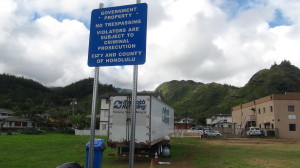
To further retaliate, on October 21, 2013, the city installed threatening signs on Choon James’  Lot of which she is still the fee owner. The NO TRESPASS sign was installed in the front entry to the Reynolds Recycling business.

DSC08057

The city’s abusive and retaliatory action shut down her business with Reynolds Recycling on her private Lot 65.

DSC08040

On the other hand, the city did not install  similar ‘NO TRESPASS’ sign at the entry to their city-owned Lot 64.

DSC08067

Nevertheless, residents are elated to have Reynolds Recycling return to Hauula.  The overwhelming will of the people in Hauula is to maintain the last two commercial-zoned lots for recycling and other small businesses. The fire station relocation project can always explore other sites.

DSC09978

DSC09938

However, the public wants an explanation as to why the Mayor forcibly shut down the Reynolds Recycling on private owner through the most egregious abuse of power   . . . and then turned around . . .  to have Reynolds Recycling return to its adjacent city-owned Lot 64 for business!

DSC09984

What monkey business is taking place at Honolulu City Hall? Why did the City and County of Honolulu steal business, through force and abusive power, from its private neighbor and force the same stolen business operation onto its city-owned property next door?


Choon James: Aloha Aina March – Kamehameha Schools: Evict Monsanto

  Aloha Aina March Parade Lured 1,000t Crowd to Haleiwa, Oahu

DSC09830

DSC09839

December 15, 2013 started with downpour of heavy rain along with “Alert Messages” from the Honolulu Department of Emergency of severe thunderstorm,  flash flood warnings and high surf in the north shore.

DSC09756

But the weather conditions did not stop concerned residents from the Aloha Aina March and to urge Kamehameha Schools to stop leasing acreages in the north shore to Monsanto and other mult-national biotech firms for GMO (Genetically Modified Organisms) crop experimentations.

DSC09784

Kamehameha Schools, formerly the Bishop Estate, is the largest private landowner in Hawaii.  Because of favorable all-year round weather, Hawaii has been the global center for open-field GMO testing that involves chemical sprays on a daily basis. Residents want the poisoning to stop.

DSC09807

These vast experimental acreages in the vicinity of north shore schools and living environment have raised severe concerns towards “pesticides bombing” and severe ramifications of GMO on health and the environment.

DSC09733

Preparation for the rally at the Haleiwa Beach Park began in the morning. There were talks by the police of canceling the March but when noon came around, the weather was perfect for the the Aloha Aina March.

DSC09818

Over a thousand stalwarts showed up. Drums and shouts of “A’ole GMO!” resonated throughout the historical Haleiwa town.  

DSC09838

DSC09836

DSC09839DSC09790

DSC09867

DSC09868
DSC09823
DSC09863
DSC09879
These bio-tech experimental enterprises also affect other islands like Moloka’i and Kauai.   Islanders have formed powerful alliances and resistance to aloha the aina through the various county legislatures.
DSC09779
The public sleeping giant has awakened and there is no going back. Corporations such as Monsanto, Dow, Syngenta, Dupont/Pioneer must exercise corporate conscience and accountability to its consumers. Hawaiians and supporters want to reclaim their rightful inheritance – the life-giving and life-naturing aina  – and the basic right to clean air, clean water, and clean soil.

Response to Honolulu Mayor Kirk Caldwell regarding the Controversial Hau’ula Fire Station Relocation

REPRINT: Response to Honolulu Mayor Kirk Caldwell regarding the Controversial Hau’ula Fire Station Relocation

A Response to Mayor Kirk Caldwell’s Letter to the Honolulu City Council  Relating to Provisions relating to the Deletion of the Hau’ula Fire Station Project.

http://www.civilbeat.com/articles/2013/06/21/19361-caldwell-brace-for-cuts-in-honolulu-city-services/

June 27, 2013

Aloha Mayor Kirk Caldwell,

Re: Your letter to the City Council Chair Ernest Y. Martin and Members of the City Council dated June 20, 2013 concerning Bill 12(2013) CD2, FD1, relating to the Executive Capital Budget; Provisions relating to the Deletion of the Hau’ula Fire Station Project. (Pages 4 & 5) 

Before we respond to your above-mentioned letter as distributed widely, including Civil Beat, we wish to share with you our family’s legacy with first responders.

My husband’s family has produced four generations of firefighters. His grandfather was buried in his fireman uniform.   We also have family members who are policemen, nurses, schoolteachers, and military servicemen. Many of our close friends are first responders, including lifeguards.  We are ever mindful of the services our first responders provide. We can never pay our first responders enough for the daily volatile and risky environment they’re thrust into.

Regarding your June 20, 2013 letter to the City Council, we also realize that any Mayor cannot possibly micro-manage or know every detail of city operations.  At face value, it’s understandable why you, as mayor, would object to the Deletion of the Hau’ula Fire Station Project this Budget session. We would probably react the same way if we were not intimately involved or had not carefully researched the facts and circumstances relating to this flawed Department of Design and Construction’s (DDC) relocation project.

Unfortunately, a person(s) with considerable influence continues to provide a overwhelming dose of one-sided bureaucratic jargon that does not provide a factual history of this controversial project. This bureaucratic process has become too politicized and evolves with ever-changing made-up premises along the way.

This modus operandi does not serve you as the Mayor, or the public, well.  No matter how thinly cheese is sliced, there are still two sides to it.

There are too much irregularities and evidences to put in this letter. The selected information we share with you here is based on documented facts and records.  We do not manipulate and fabricate new premises along this evolving process.

Mayor Caldwell, the GOOD NEWS is DDC can build another fire station in rural Hau’ula TODAY!

DDC supervised the purchase of Lot 64 TMK:1-5/4/18-24 of 20,297 square feet at 54-290 Kamehameha Highway, Hauula, 96717 on April 19, 2010, using Community Development Block Grant (CDBG) funds.


This City-owned Lot 64 with 20,297.00 square feet is adequate for a typical fire station in Oahu.

For example:
EMMcCullyMoiili_b
The new 2424 Date Street McCully-Moiliili Station, with an estimated price of $4.6M, sits on 19,555 sq. ft. lot and was dedicated on April 1, 2010.

EM FSwahiawa
The 640 California Ave Wahiawa Fire Station that serves a much denser population than rural Hau’ula sits on 20,000 sq. ft. lot.

EMKaneoheFS
The Kaneohe Fire Station sits on 20,075 sq. ft. lot. http://oeqc.doh.hawaii.gov/Shared%20Documents/EA_and_EIS_Online_Library/Oahu/1990s/1990-09-08-OA-FEA-KANEOHE-FIRE-STATION-RECONSTRUCTION.pdf


EMKaaawaFS
The Ka’a’awa Fire Station sits on 15, 493 sq. ft.

SONY DSC
The 1610 Makaloa Street Fire Station by the Pan Am building by Kapiolani Blvd sits on 18,953 sq. ft. lot.

This average lot size holds true on the mainland as well. Metropolitan West Seattle, Washington deems 15,000 sq. ft. to 20,000 sq. ft. parcels as customary for their fire stations.

Why then, is the DDC Land Chief fixated on seizing our adjacent Lot 65 for an additional 20,300 square feet? DDC’s 2009 Environmental Assessment for this proposed relocation project stated there would be no increase in service area or personnel.

Why then, a Taj Mahal fire station in rural Hau’ula on twice the average lot size and triple the costs of an average fire station? (The relocation project in Hau’ula’s projected cost is $13M, as recorded in the Ko’olauloa Neighborhood Board minutes.)

After you review this information and others contained in this PDF file, we’re confident you’ll agree that the Honolulu City Council exercised fiscal prudence and protected the public treasury by deleting the $750,000 that was requested for “Planning & Design” by DDC this budget session.  DDC’s request for $750,000 was premature as the civil trial for “public use” had not even been set.

Furthermore, aggrieved citizens have the right to appeal to higher courts in this legal process.

The City Corporation Counsel initiated condemnation action (1CC10-000863 -04. Also see Civil NO: 10-1-0956-05 PWB) on April 21, 2010 during the Mufi Hanneman Administration.

The Carlisle Administration informed residents it was willing to explore alternative sites for this relocation controversy.

Peter Carlisle

This case was set aside by the city until December 12, 2012 when Deputy Corporation Counsel Winston Wong requested a “Valuation Trial”.

This again was a premature action and denied by Judge Rhonda Nishimura as the initial Trial for “Public Use” had not even been discussed yet.  Despite these circumstances, DDC requested $750,000 for “planning and design” for this project (in limbo) this fiscal year 2013-2014.

What was DDC thinking?

Should the City Council give DDC $750,000 to squander on “planning and design” when the outcome is unsettled and involved in a typically protracted legal process?  The only logical and fiscally responsible action for the City Budget Chair was to delete this so-called “construction funding” for this project for 2012-2013 Fiscal Budget Year.

The 2011-2012 Fiscal Budget Year also deleted this project and noted as “not needed”.  For the City Council to decide otherwise would be gross malfeasance on their part, based on the legal status and other circumstances. As a Hau’ula kupuna said, “Money no grow on trees.”

At the most recent Budget sessions, both the newly appointed Fire Chief and the Department of Design and Construction (DDC) Director initially stated to Budget Chair Ann Kobayashi they were willing to dialogue. We welcome that.  We’re aware city departments such as the Honolulu Fire Department routinely depend on DDC to do the footwork in projects such as this. Unfortunately, this controversial process has morphed into an art of the wordsmith, with bureaucratic jargon substituting as merits.

The record points towards one unelected bureaucrat who abuses government powers of eminent domain at will. There is no denying bureaucrats have easy access to decision makers at City Hall while the public generally enjoy no such privileges.

Sensing this unbalance, we have diligently provided the City Council documented irregularities and nefarious circumstances surrounding this flawed process.  The most affected residents are grateful that the City Council has listened to the other side of the story during its budgeting decisions.

Many residents are unhappy about perceived wasteful spending, perceived or real; others questioned why the city could not renovate the existing structure or tear it down and build anew instead of seizing the last two remaining commercial-zoned parcels in Hau’ula.

Life-long Hau’ula residents are unhappy they were not consulted with. This project would be situated directly next to their homes.

DDC’s failures to consult affected parties grossly violated the basic requisites of Chapter 343, HRS and Title 11, Chapter 200 Administrative Rules, and the National Environmental Protection Act (NEPA) as Community Development Block Grants (CDBG) funds were used in this project.  Hauula qualifies, being a low-income area. DDC’s request for seizing properties was hastily pushed through to meet CDBG’s date lines.
Many would like the city to prioritize scarce funds and allocate precious resources to installing more fire hydrants for fire safety as well. Many neighborhood pockets here do not have fire hydrants. This is a major setback for our firemen and a major public safety concern.

A case in point happened with a domestic fire in Punalu’u on March 23, 2011. Thirty-five (35) fire-fighters, five (5) engines, two (2) ladder-trucks, a water tanker truck and a fire battalion chief responded very quickly but could not effectively protect the public due to lack of basic infrastructure – water hydrants.

Besides lacking in public engagement, there are too many irregularities and nefarious facts and circumstances surrounding this Hau’ula relocation file. We could tell you about DDC hiring their favorite appraiser all the way from Maui   for this project; that DDC’s first choice for the Hauula Relocation site was a 1.65 acre beachfront lot;  or DDC’s careless 2006 request for eminent domain by necessity on another property only to discard  the action promptly after the city council unanimously granted powers to seize private properties.

We could also tell about the recent illegal seizing of free speech signs on May 29, 2013 on our Lot 65.  The crew was sent all the way from Halawa Maintenance Yard to Hau’ula to seize two “Eminent Domain Abuse”  free speech signs on our Lot 65 under the guise of Bill 54 (11-029 ROH).

Who gave the work order for this illegal seizure and bullying?

What are the incurred costs to the taxpayers for this rogue behavior?

In summary, bureaucratic malfeasance in rural Hauula, Oahu, Hawaii reveals the culture in which government will ignore the law, manipulate the process, and abuse its powers in order to seize property just because it can.

Government cannot become so powerful and arrogant that ‘public purpose’ and ‘public safety’ are conveniently used as mere pre-textual ‘legal weapon’ to threaten and brow beat property owners into automatic submission through eminent domain and other tactics.

Fortunately, this out-of-control bureaucratic malfeasance and abuse can be corrected.   The entire City Council is protecting the public in its kuleana by implementing the democratic process of “checks and balances”.

kobayashi09b

As Mayor, you can also support their pono leadership by not allowing DDC’s slop-dash bullying via the big stick of government powers to prevail.

As always, we look forward to collaborating with the most affected parties in a fair and equitable due process. Justice and Equality apply to all.

We can reach a win-win conclusion to this eminent domain abuse story

Mahalo,

Choon James

ChoonJamesHawaii@gmail.com