Who reads these Bills? Shouldn’t these over-reaching and tyrannical Bills be vetted first? Why did the public not know about this sea-change bills that affect them?
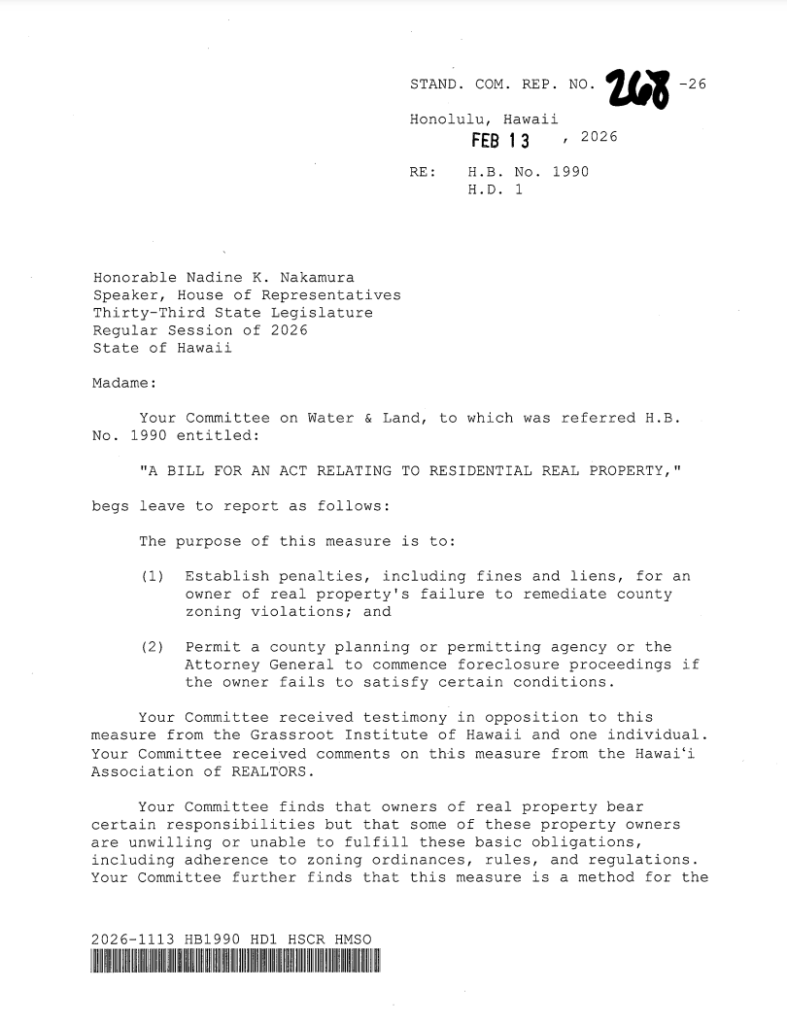
Who reads these Bills? Shouldn’t these over-reaching and tyrannical Bills be vetted first? Why did the public not know about this sea-change bills that affect them?


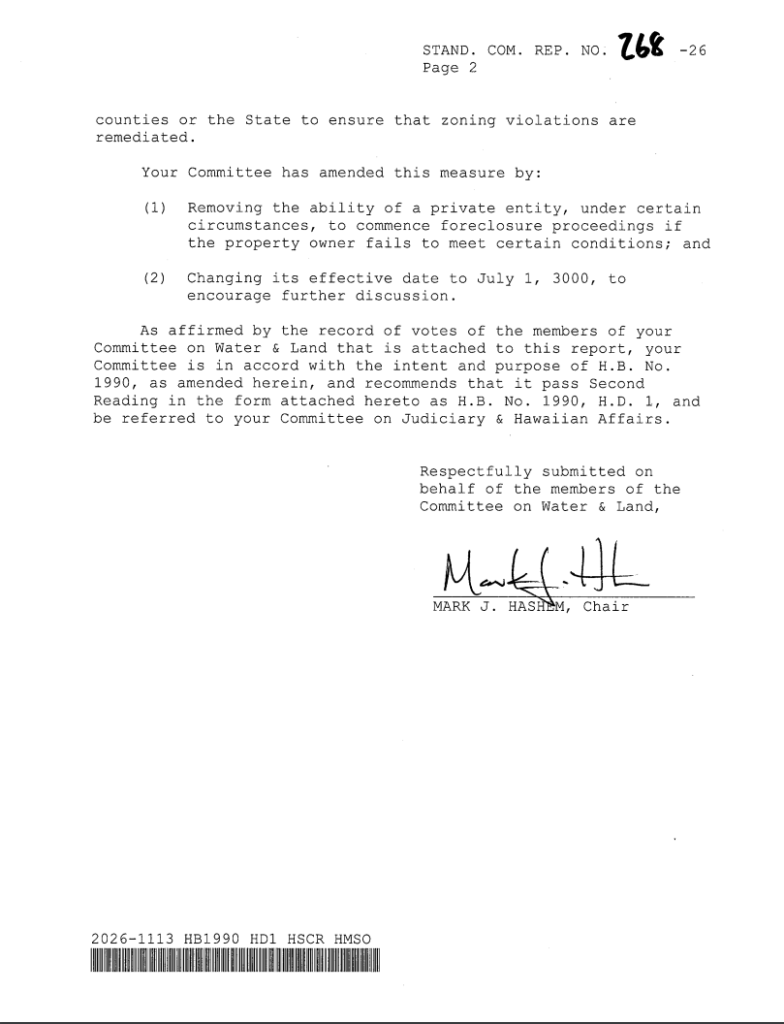
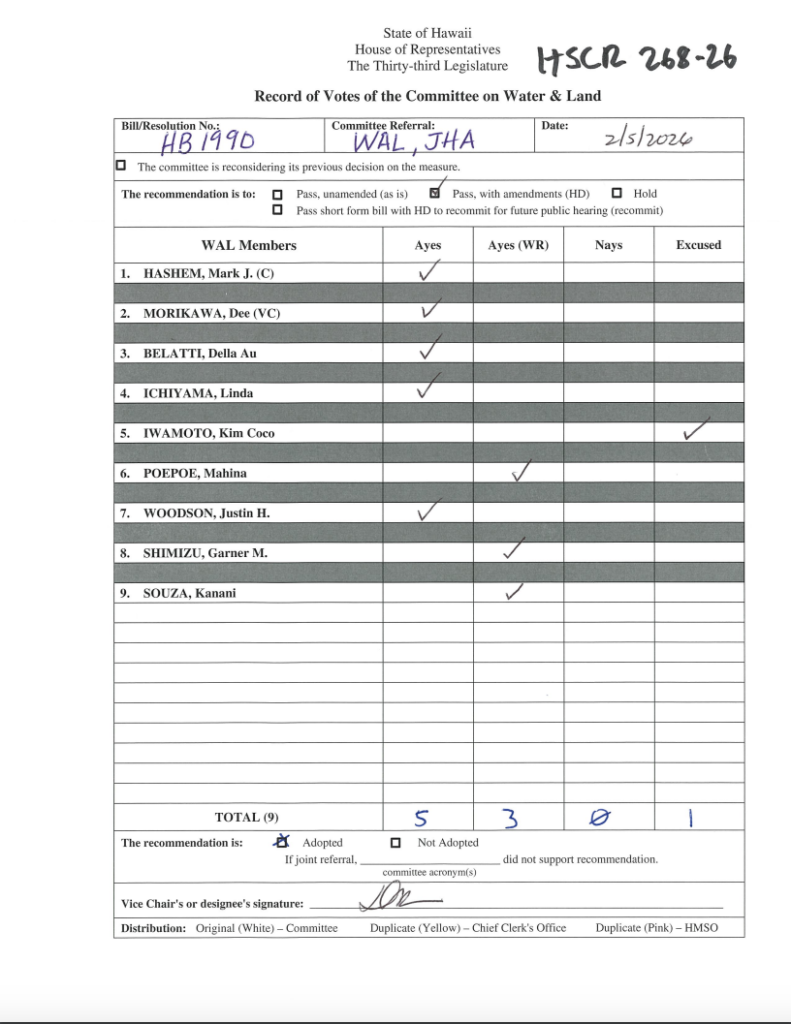
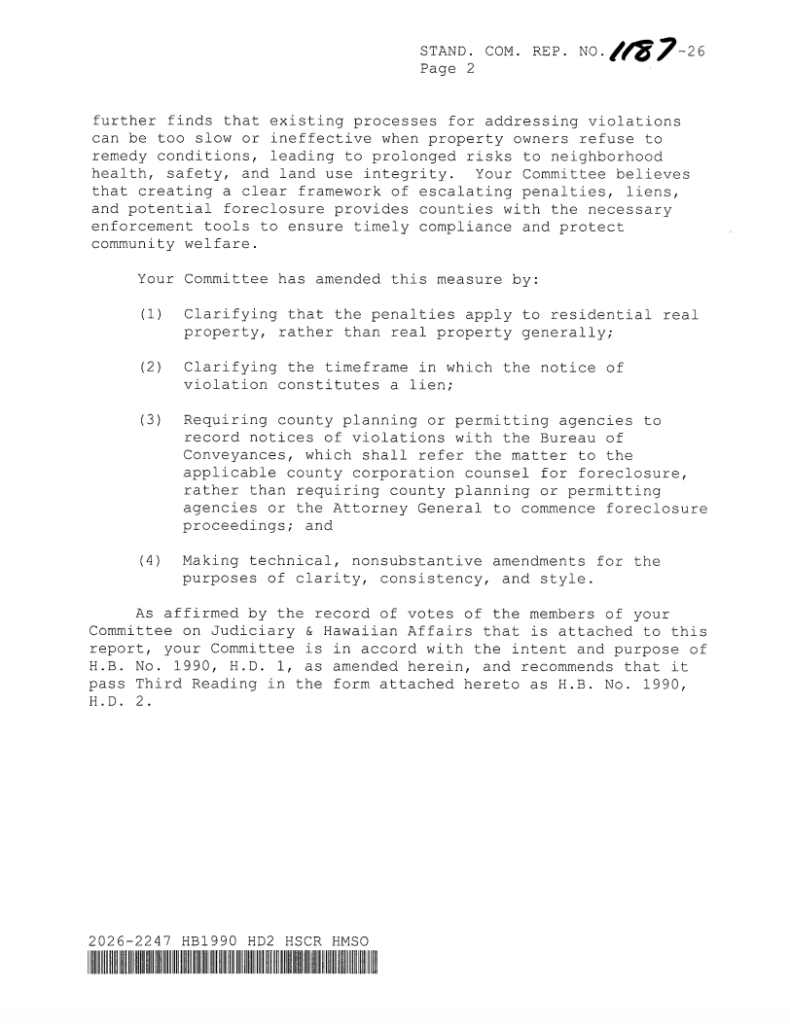
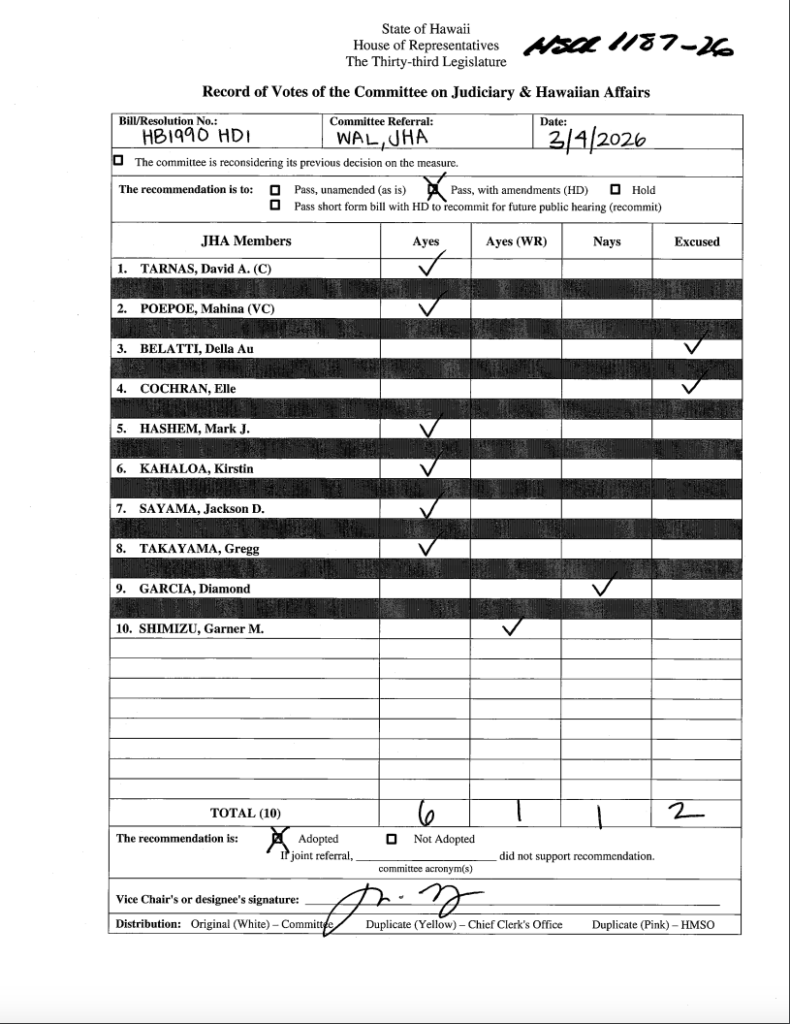
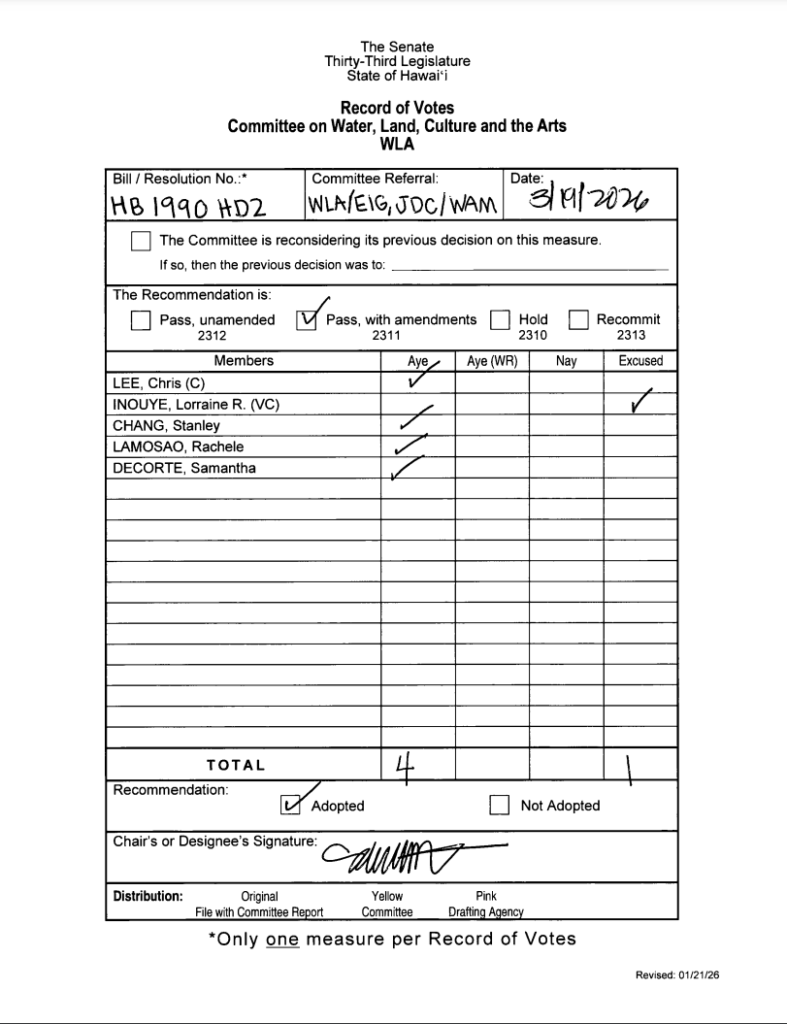
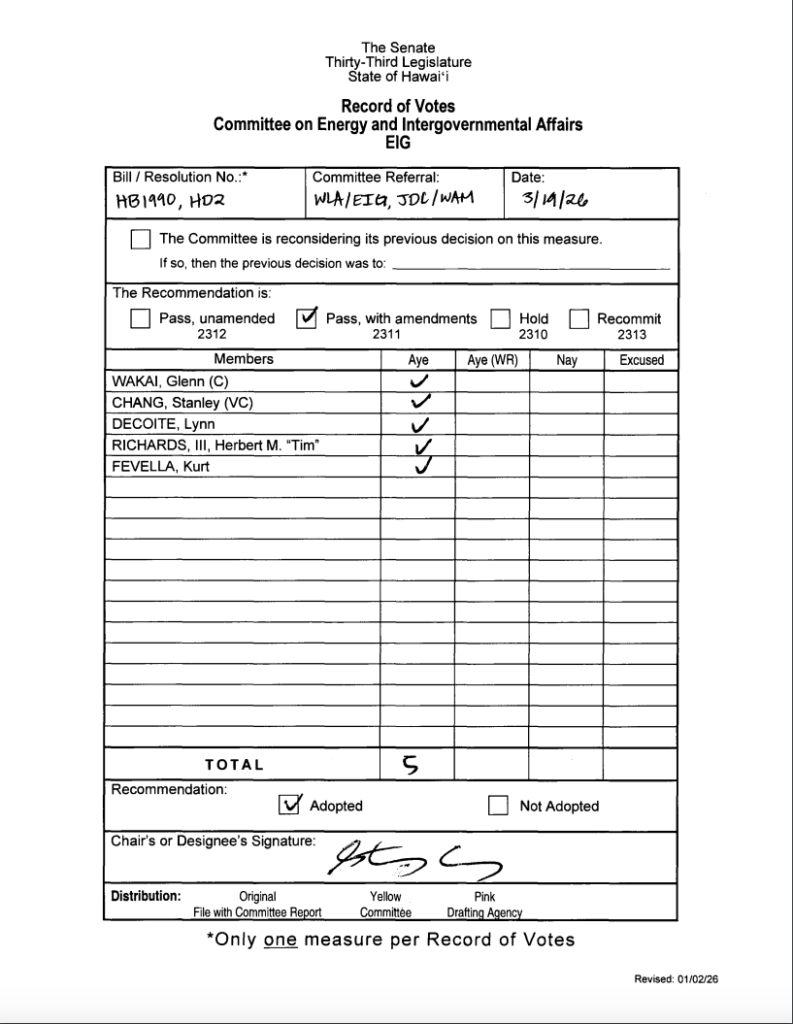
SENATE JUDICIARY and WAYS & MEANS COMMITTEES’ VOTING RECORD.
This was a very secretive Bill. While Hawaii was trying to handle the Kona Low flooding and storms, this Bill was sailing through without public knowledge until at the end.
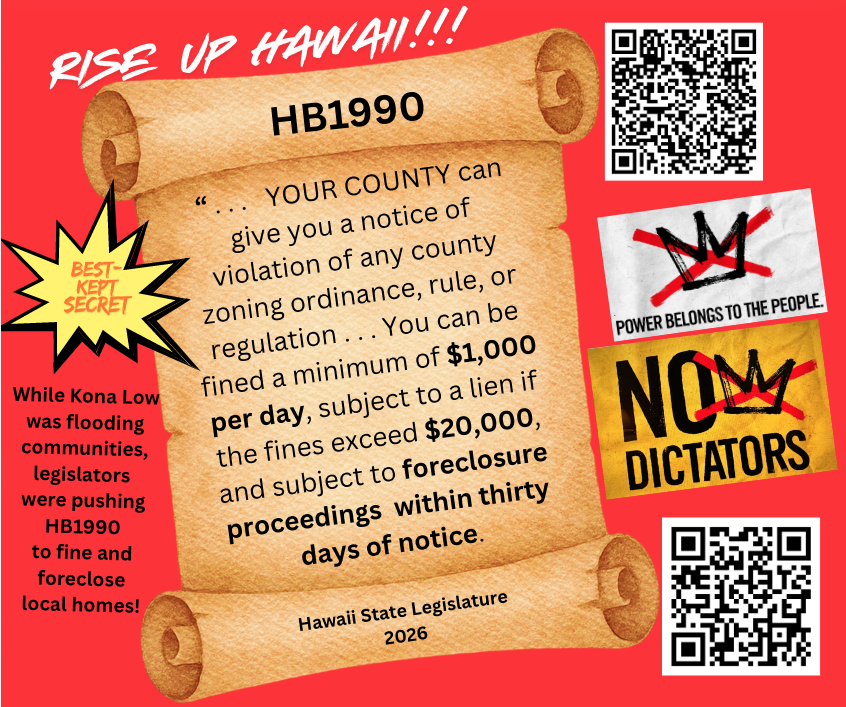
Hawaii was protesting “NO KING” “NO TYRANT” “NO DICTATOR” OUTSIDE the State Capitol while legislators INSIDE the Capitol were passing these tyrannical bills.
Typically, an ordinary person does not have the time to participate. Most people who are at these sessions are lobbyists, bureaucrats, interest groups, and corporations. The procedures are also foreign to most citizens.
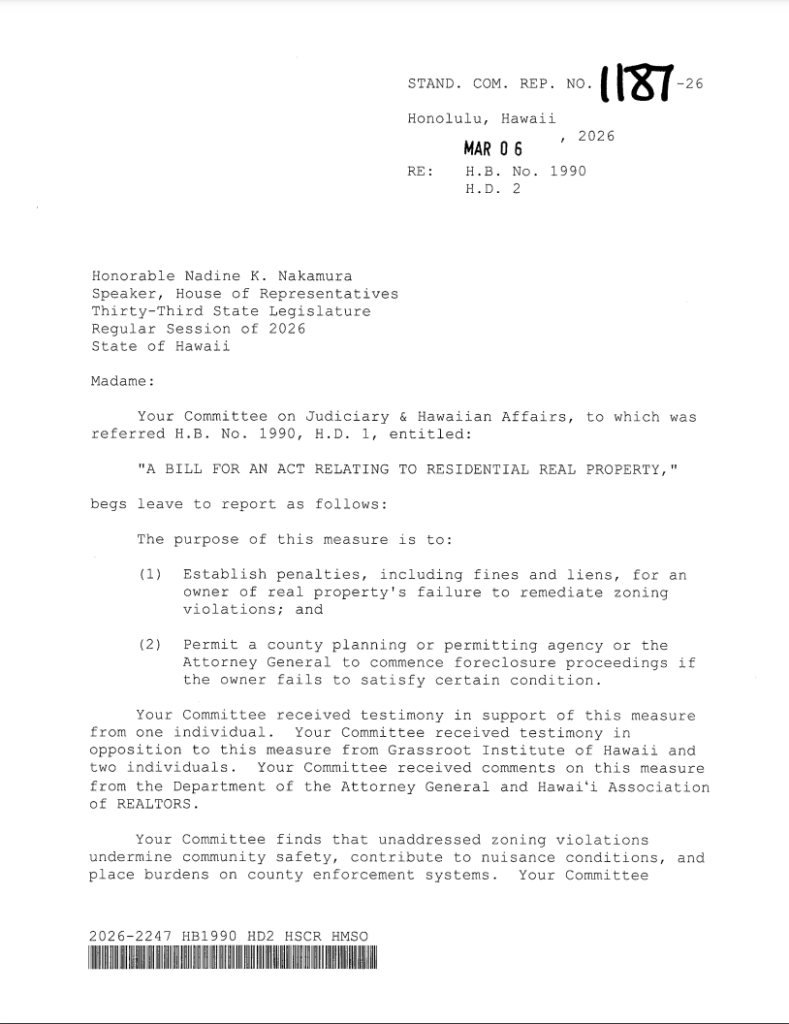
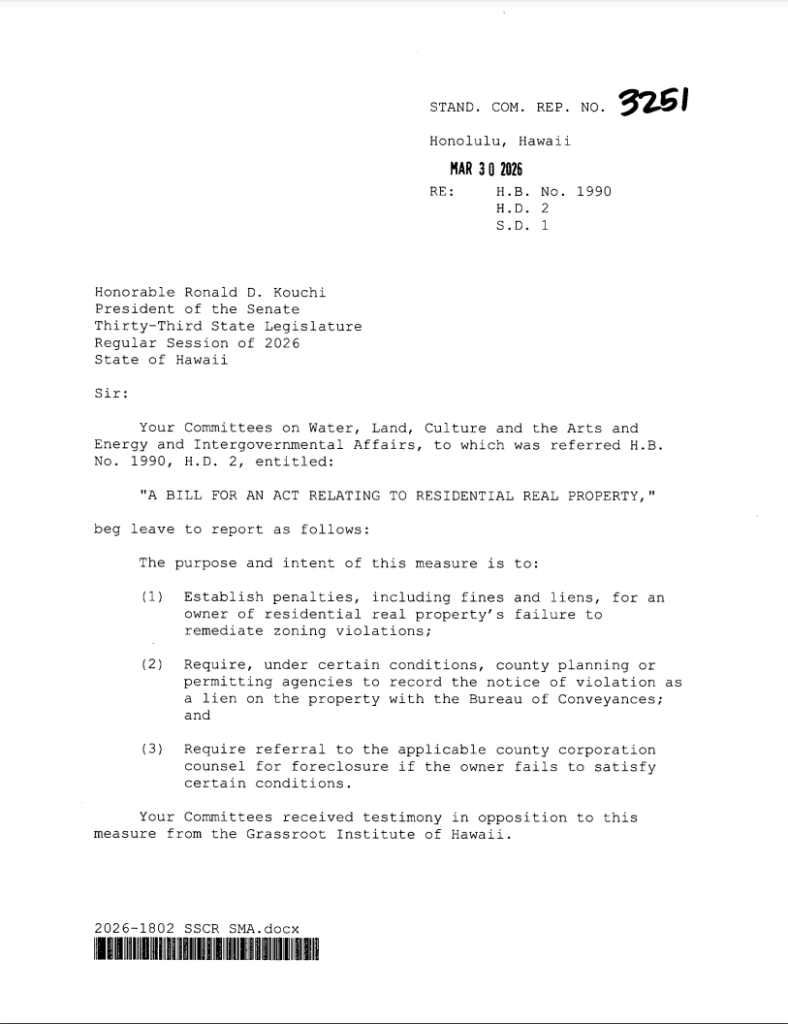
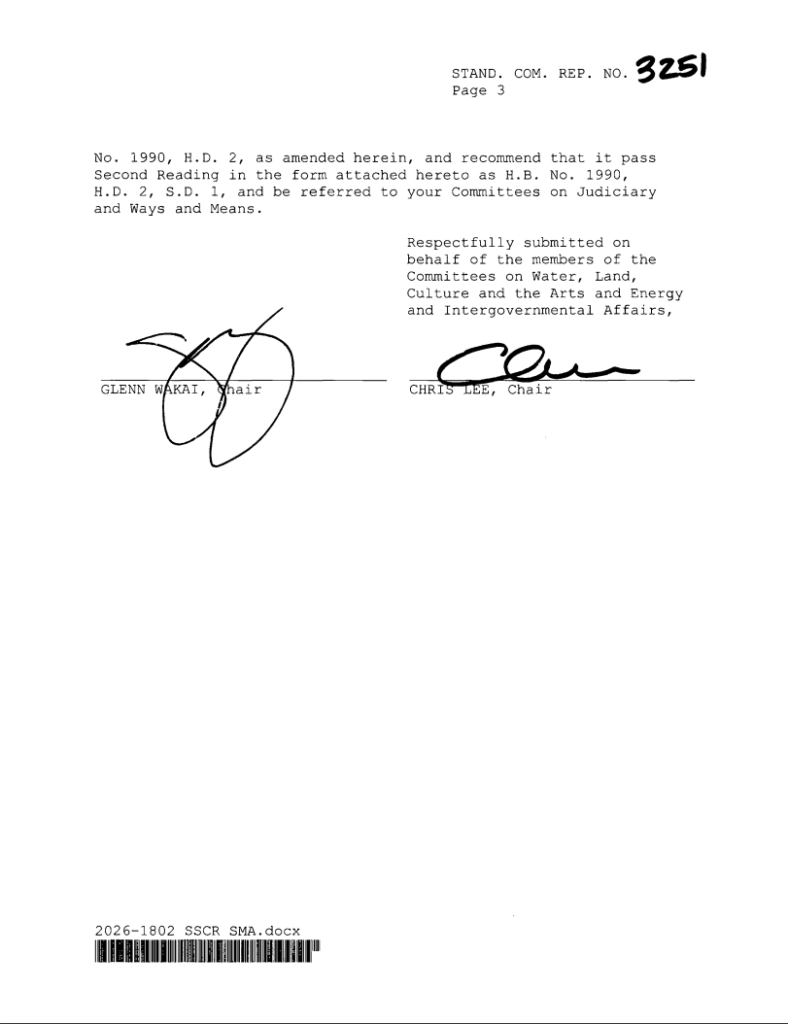
Hawaii SENATE Judiciary Committee and Ways and Mean Committee Report to the Senate President.
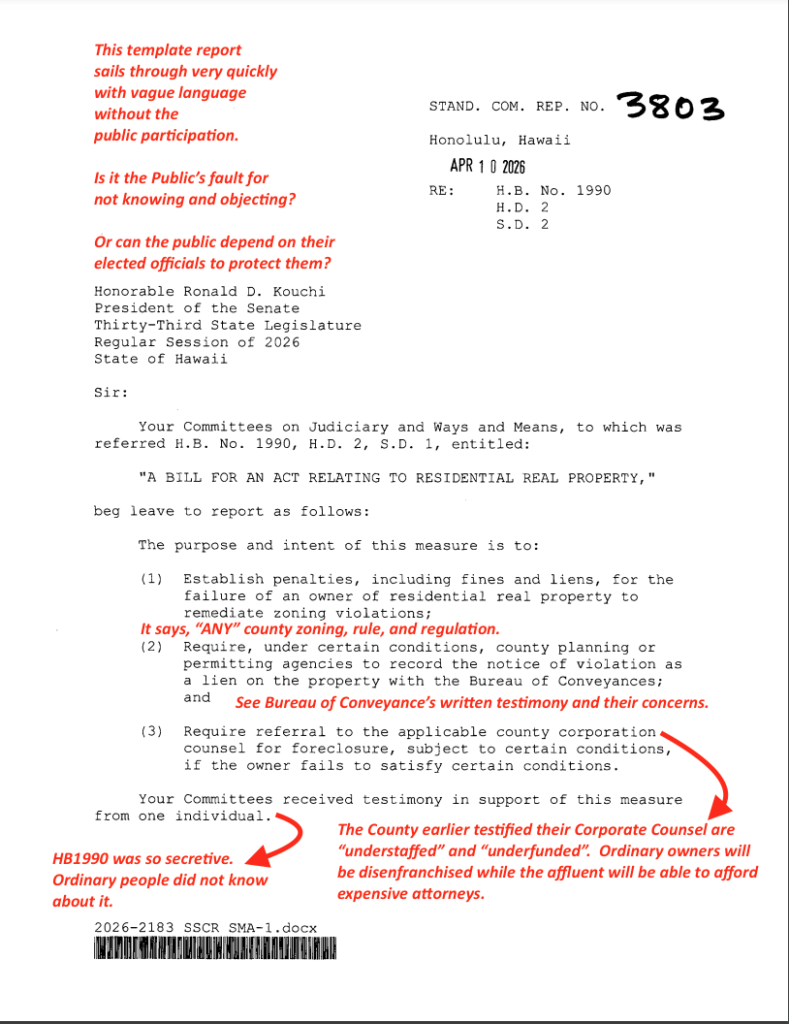

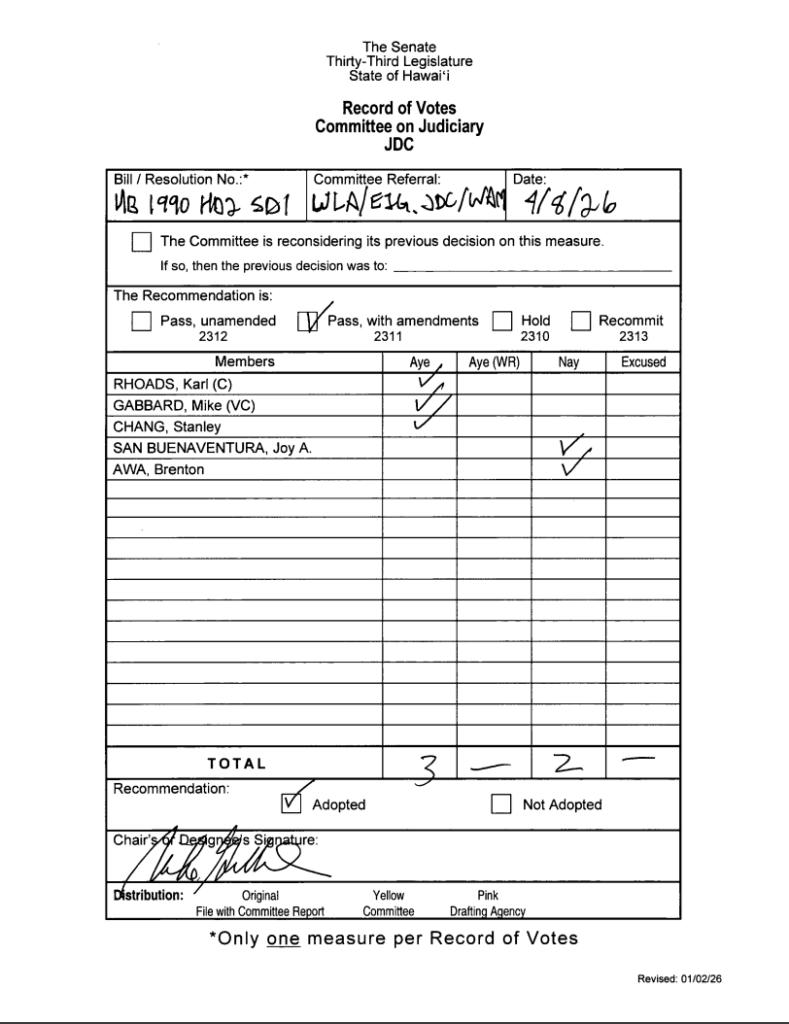
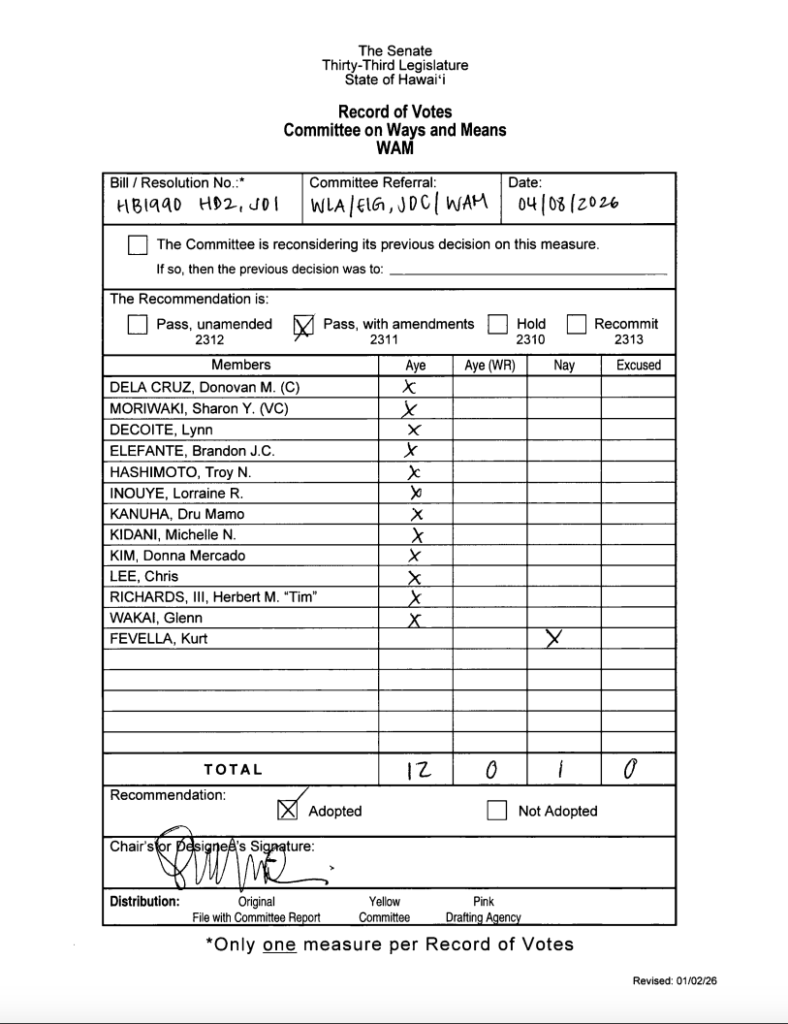
What is the intent of these quickie tyrannical Power of Sale and Foreclosure Sale?
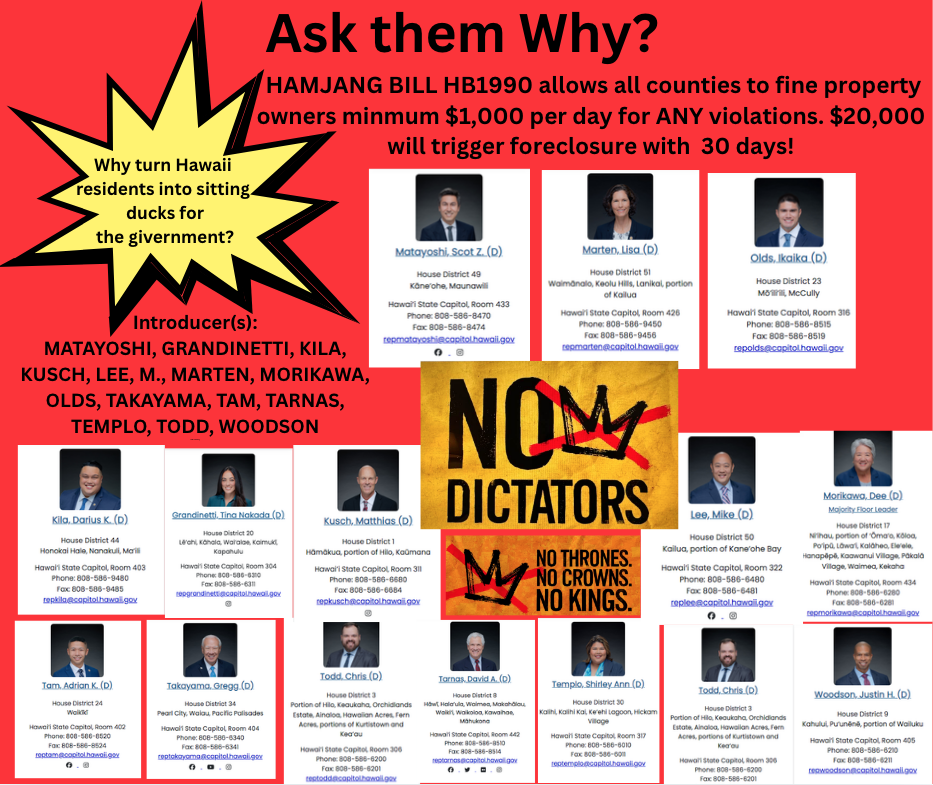

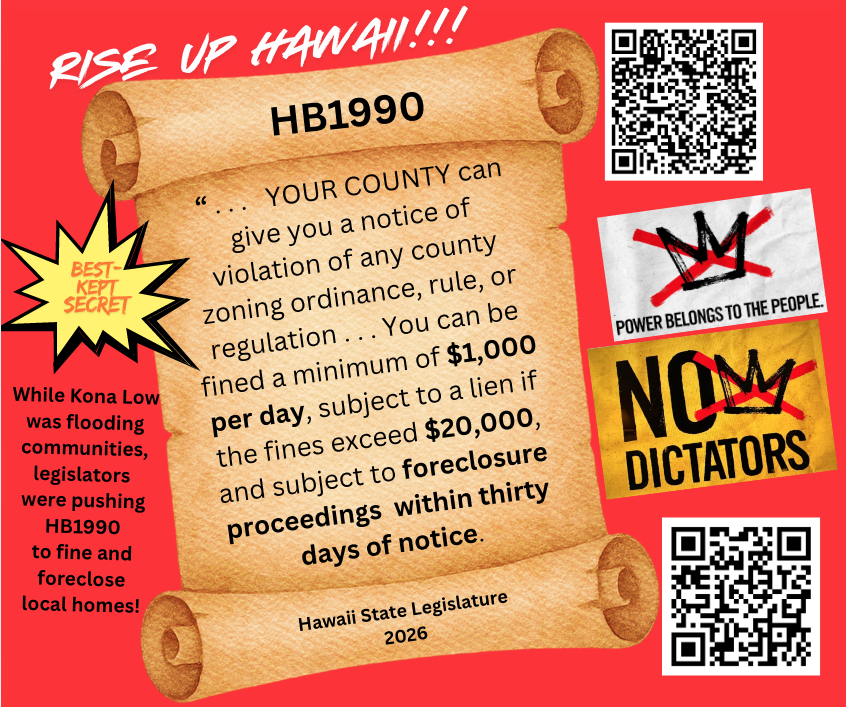
While there are vigorous protests of “NO KING”, “NO DICTATOR” “NO TYRANNY” outside the Hawaii State Capitol, tyrannical laws are being pushed through inside the Capitol
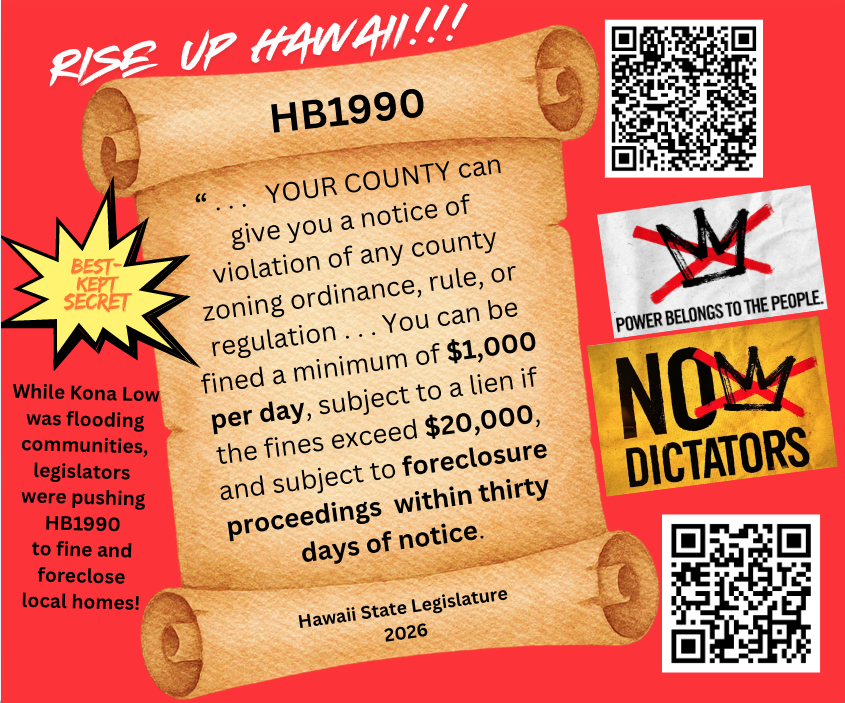
Mahalo again for giving voice AGAINST HB1990.
Keep calling the senators to Kill HB1990! They should hear from you.
The last I look, HB1990 is still recommitted to the Judicial and Ways and Means. No movement or no new amendments to it. I hope there is no Gut & Replace actions.
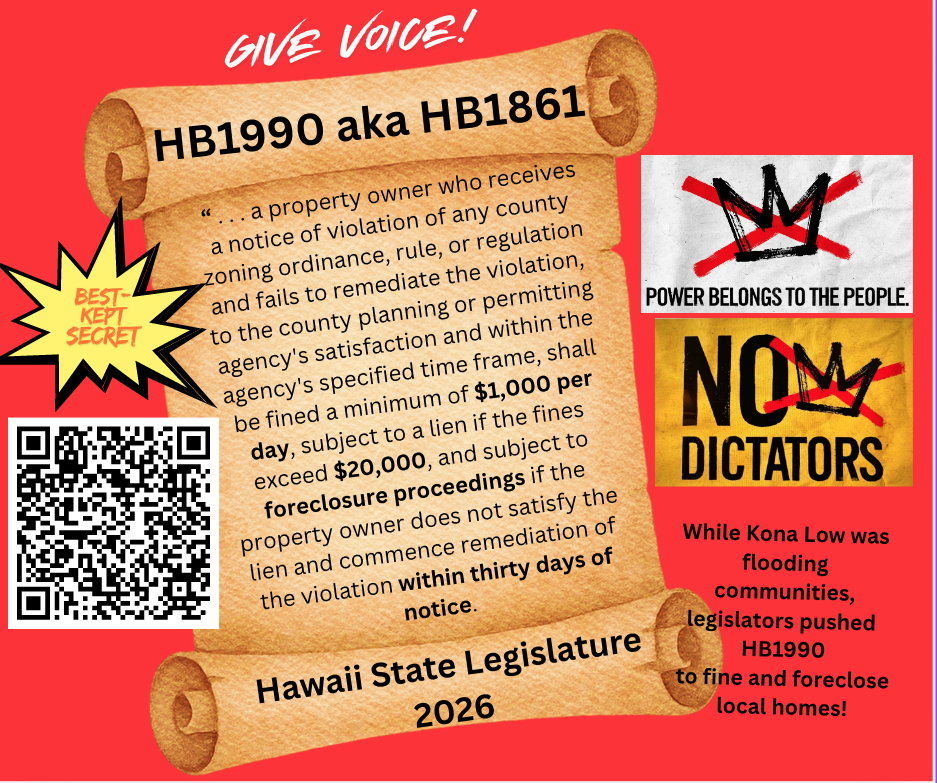
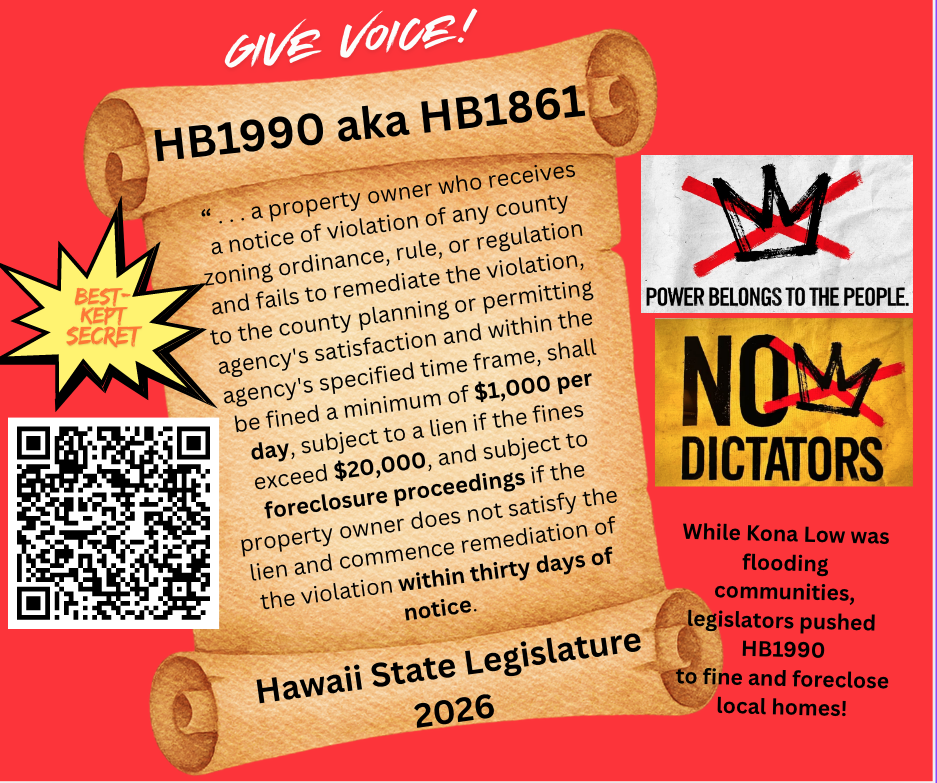
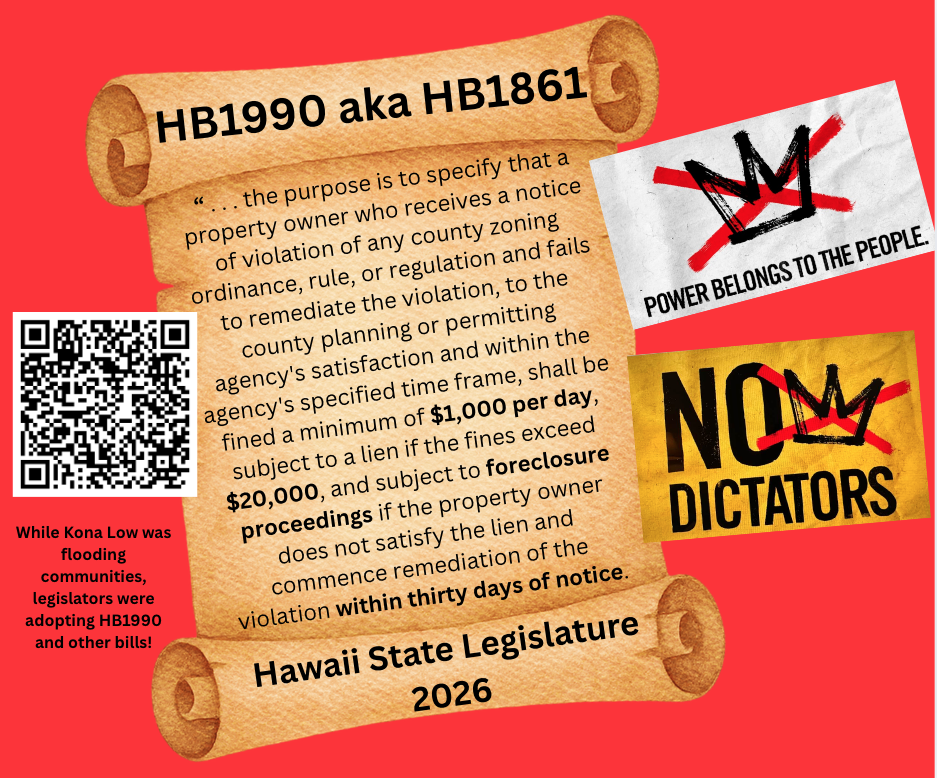
It’s never a good idea to give the government more overarching, overreaching and tyrannical powers to fine you $1,000 per day minimum. And when it reaches to $20,000, you can be slammed with a foreclosure. This is Tyranny.
The Bill language is very vague – ANY – ANY violations of county ordinances, rules, and regulations. Every owner becomes a sitting duck to the whim of the long arm of the government.
Chronology of tyranny:
This Power of Sale based on county fines first began as an annual Legislative Package to the State Legislature in 2021. All neighbor Mayors were part of this package. This covered ALL COUNTIES.

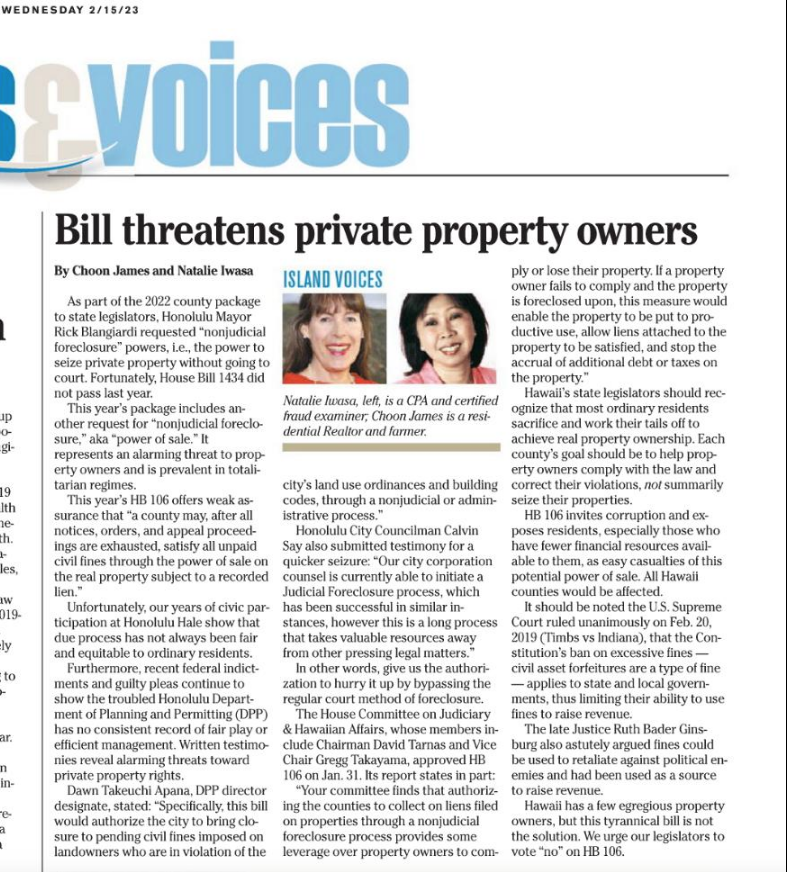
2021 – 2024 Mayor Rick Blangiardi persisted. We saw HB106 and many similar Bills with the same Agenda. But fortunately, these bills never got passed.
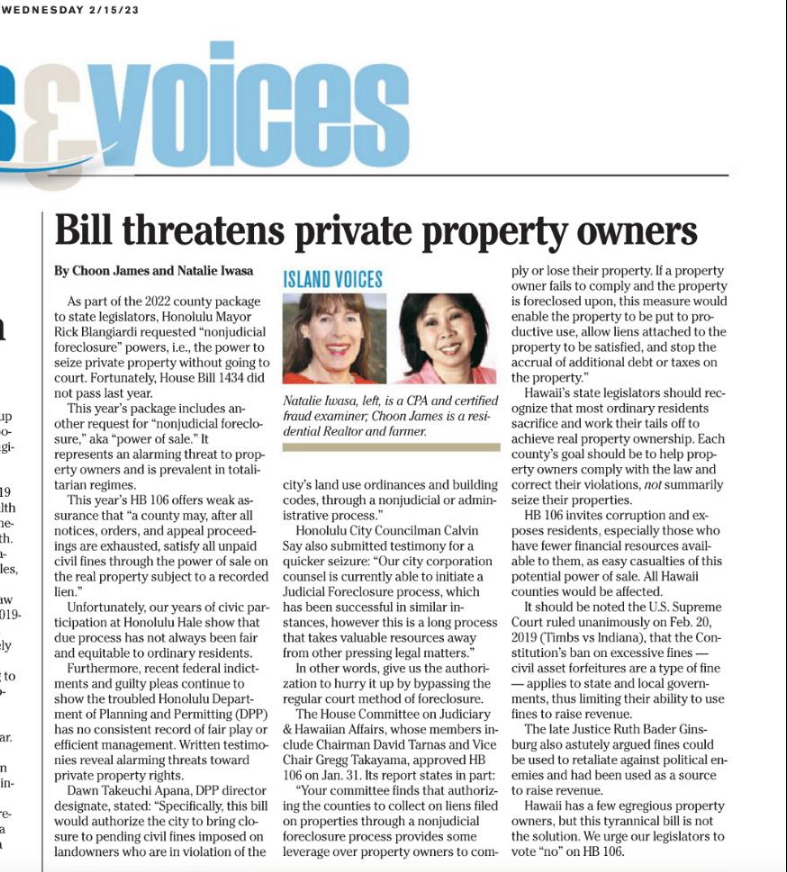
In 2025, the Honolulu Mayor distanced himself. HouseRepresentative Corey Chun from Waipahu introduced HB29. Fortunately, it was DEFERED By the Finance Committee.
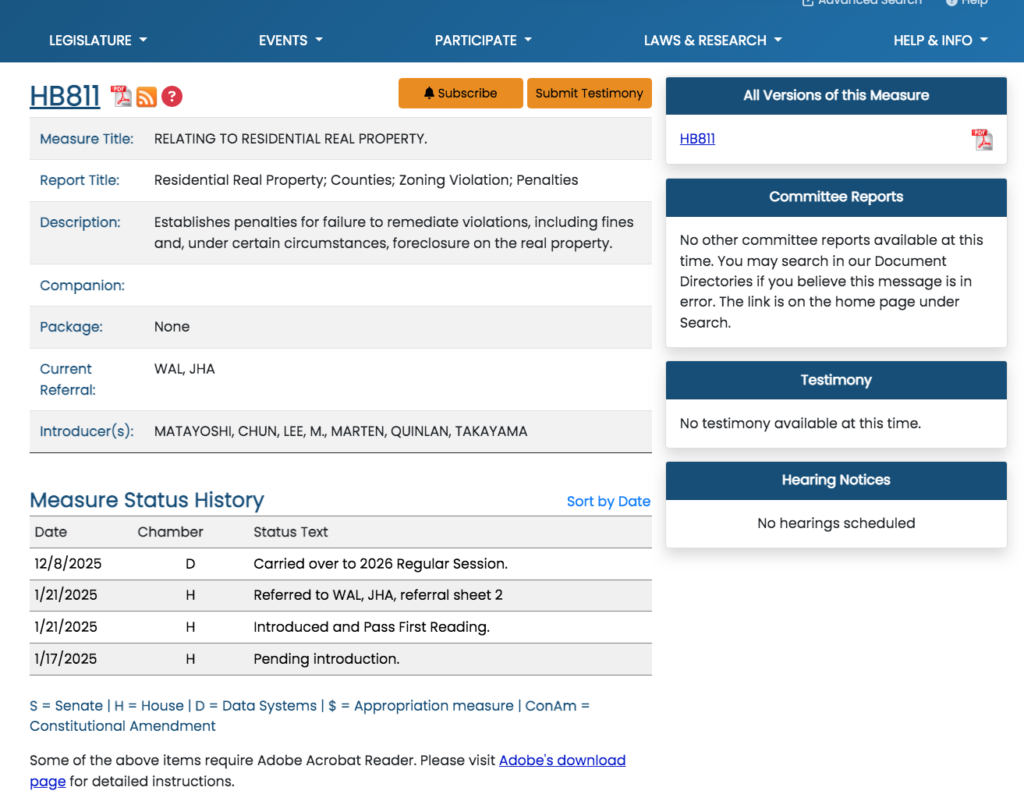
2025 also saw Bill 811 introduced by Scot Matayoshi, Corey Chun, MichaelLee . Lisa Marten, Sean Quinlan, Greg Takayama. This is a bill on steriods. Foreclosure begins when your fines reaches $5,000! It will only take 5 days when the bill wants to fine you $1,000 per day minimum. What are these politicians thinking? This Bill did not gain traction.
| Introducer(s): | MATAYOSHI, CHUN, LEE, M., MARTEN, QUINLAN, TAKAYAMA This one imposes only $5,000 instead of $20,000 for a foreclosure slam! It did not gain traction. |
2026 These Power of Sale Bills only needed 2 House Committees to pass the House. Finance Committee was bypassed. HB1861 was introduced by Quinland, Matayoshi, Marten, and Olds did not cross over this year.

Simultanteously, another Bill1990 which we did not know about till recently, quietly progressed to where we are today
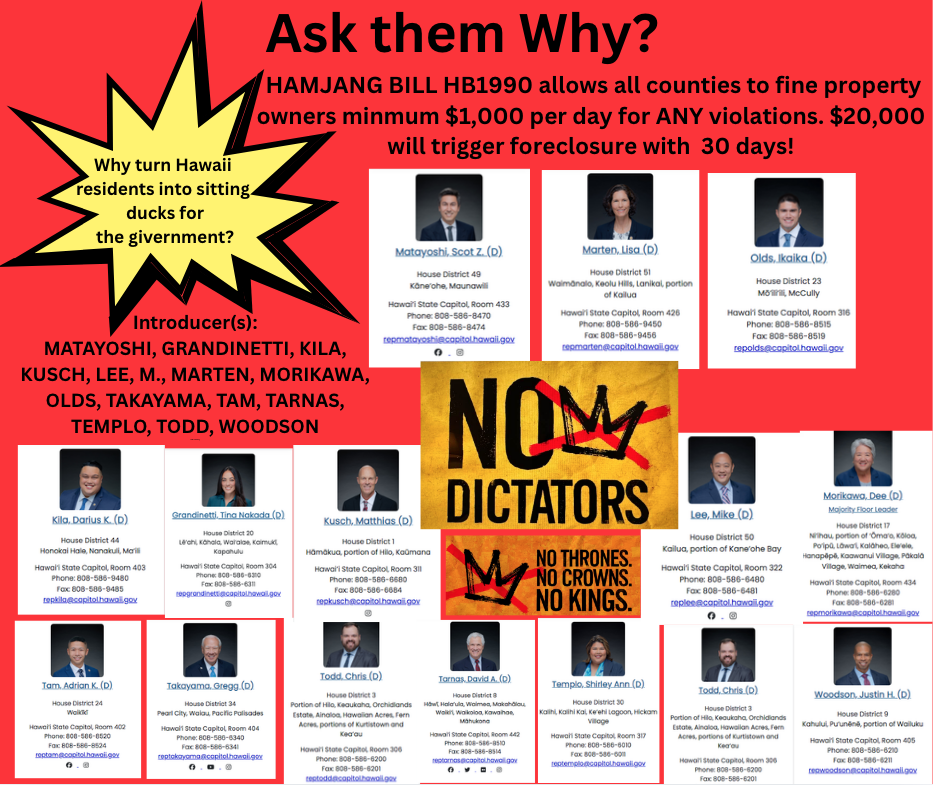
| Introducer(s): | MATAYOSHI, GRANDINETTI, KILA, KUSCH, LEE, M., MARTEN, MORIKAWA, OLDS, TAKAYAMA, TAM, TARNAS, TEMPLO, TODD, WOODSON |
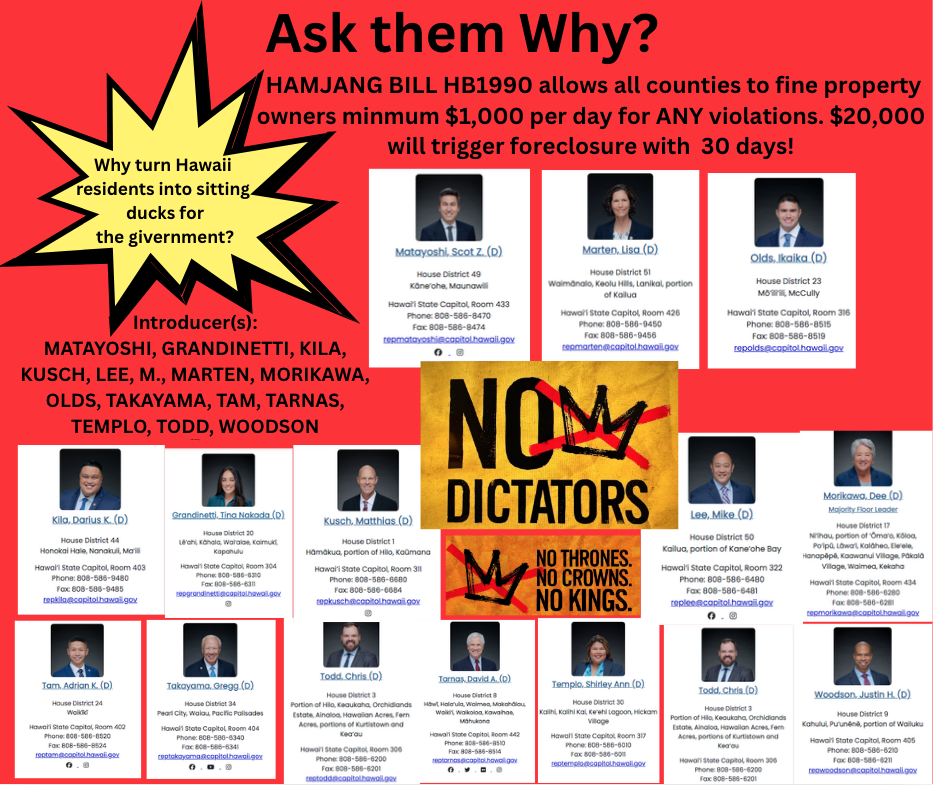
Demoracy is at stake. We cannot be protesting NO KINGS – NO TYRANTS and then impose tyranny upon Hawaii’s residents with these secretive Bills to oppress.

.
Kill HB 1990! This is a knee-jerk vindictive Bill that will create more problems to ordinary citizens.
My quick note to the Senators and Representatives, again.
Aloha!
You have over 3,000 bills this legislature session? About 20%, including this punitive and half-baked bill, have made the cross-over.
Have you gotten the chance personally to read through this Bill that has passed quickly this session?
I cannot imagine that you would expose your own communities and constituents as sitting ducks
to this far-reaching and tyrannical Bill HB1990.
Your constituents will become easy targets of complaints because most residential dwellings have violations neighbors or the government can complain about. You must be aware that counties also have systemic problems. It’s well-known knowledge. A lot of the rationale provided for this ill-thought HB1990 are off-tangent, illogical, and counter-productive that will create more problems for Hawaii. There is a latest new amendment to HB1990.
ONE EXAMPLE:
Description:
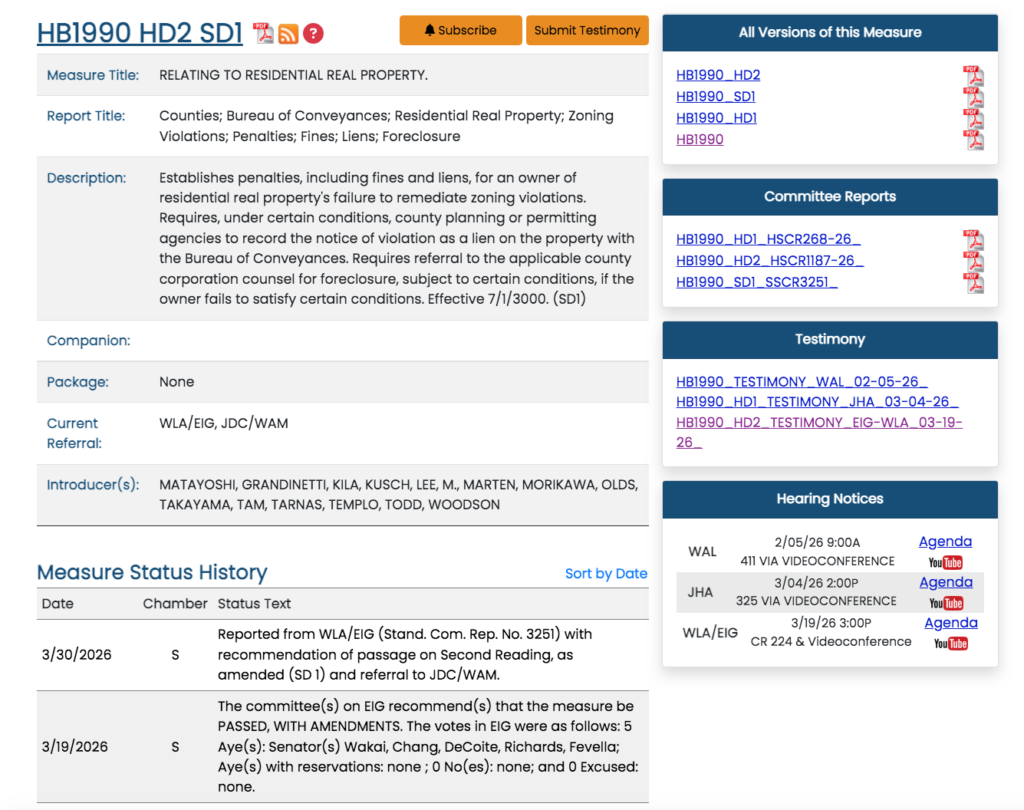
Establishes penalties, including fines and liens, for an owner of residential real property’s failure to remediate zoning violations.
Requires, under certain conditions, county planning or permitting agencies to record the notice of violation as a lien on
the property with the Bureau of Conveyances. Requires referral to the applicable county corporation counsel for foreclosure, subject to certain conditions, if the owner fails to satisfy certain conditions. Requires the applicable district or circuit court to hold a de novo review of penalties assessed for unaddressed residential real property zoning violations, including foreclosure, upon appeal by the affected residential real property owner. Effective 7/1/3000. (SD2)
Who will this new amendment disenfranchise? Local owners with no means to afford expensive legal fees.
Note also that the Honolulu County who first initiated this Power of Sale in 2021, based on new County fines had this reason for asking for more new powers:(HB 1990 aka HB1861 aka HB29 aka . . .) The amendment will only create more ” legal manpower and funding” that the county claims it does not have.
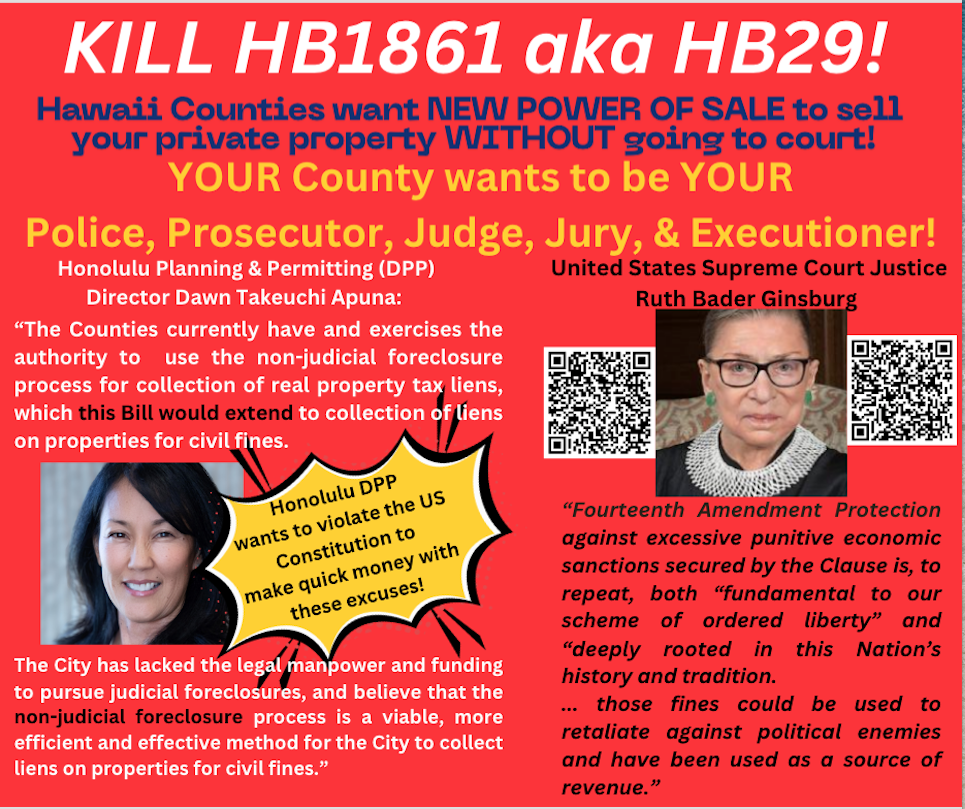
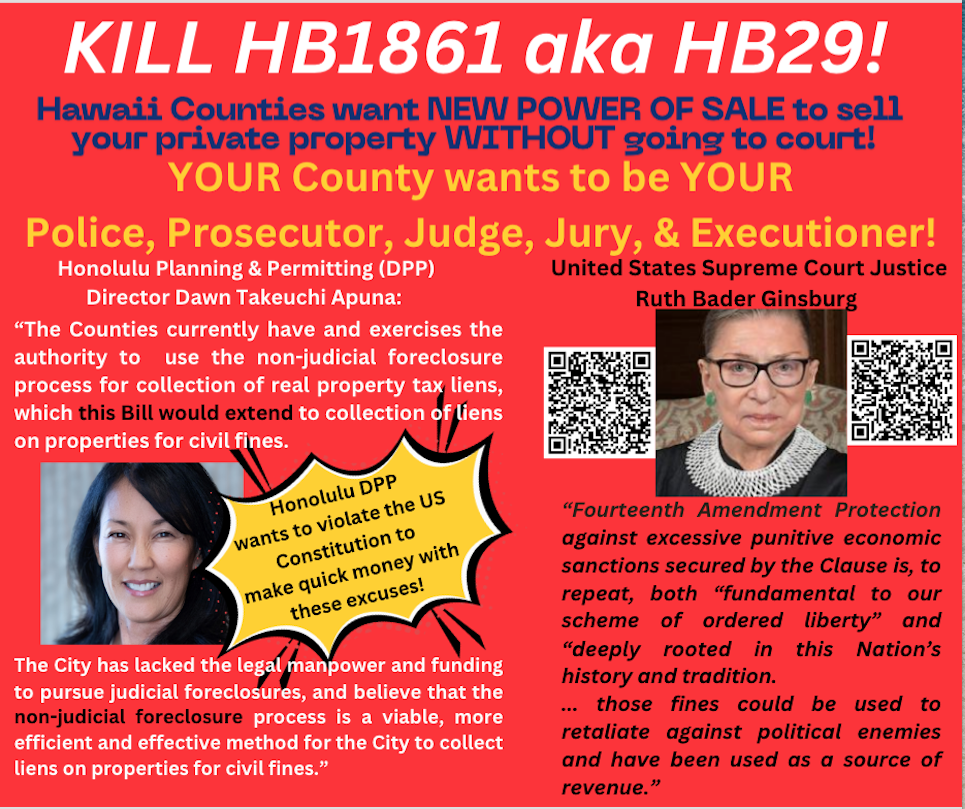
“The City has lacked the legal manpower and funding to pursue foreclosure . . .”

Did you read any of the testimonies? The most articulate written testimony is from LURF who has institutional knowledge of Hawaii’s land use issues. It’s cogent, reasonable and pono with a little aloha for the people of Hawaii.
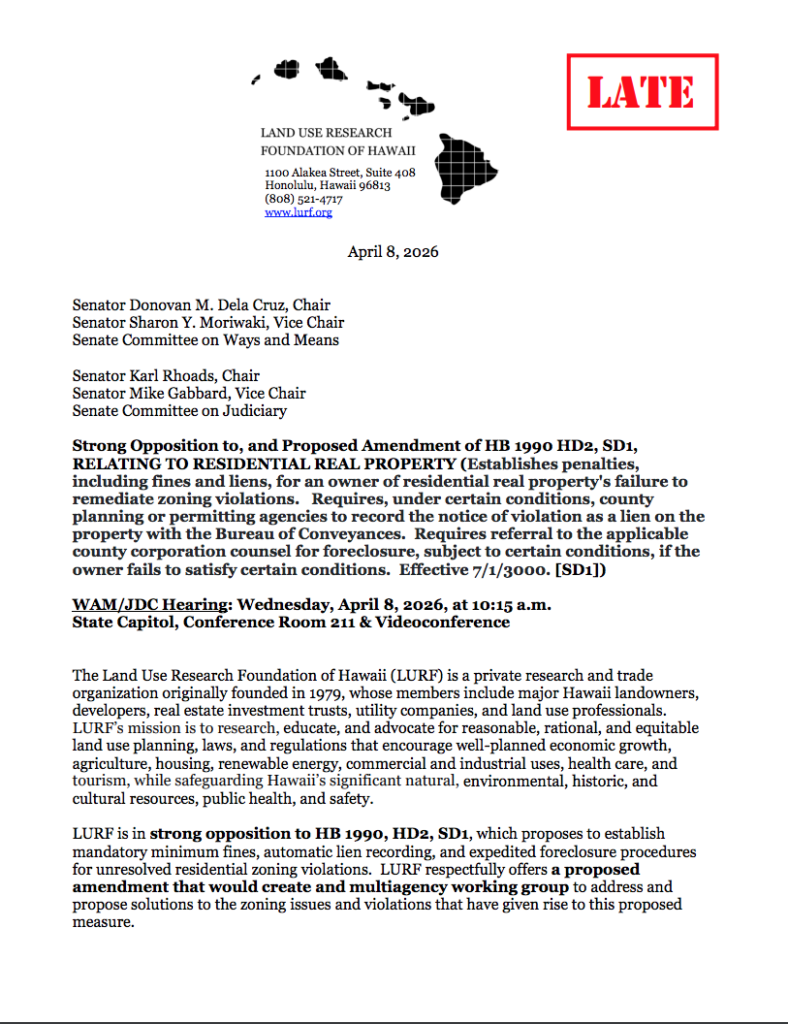
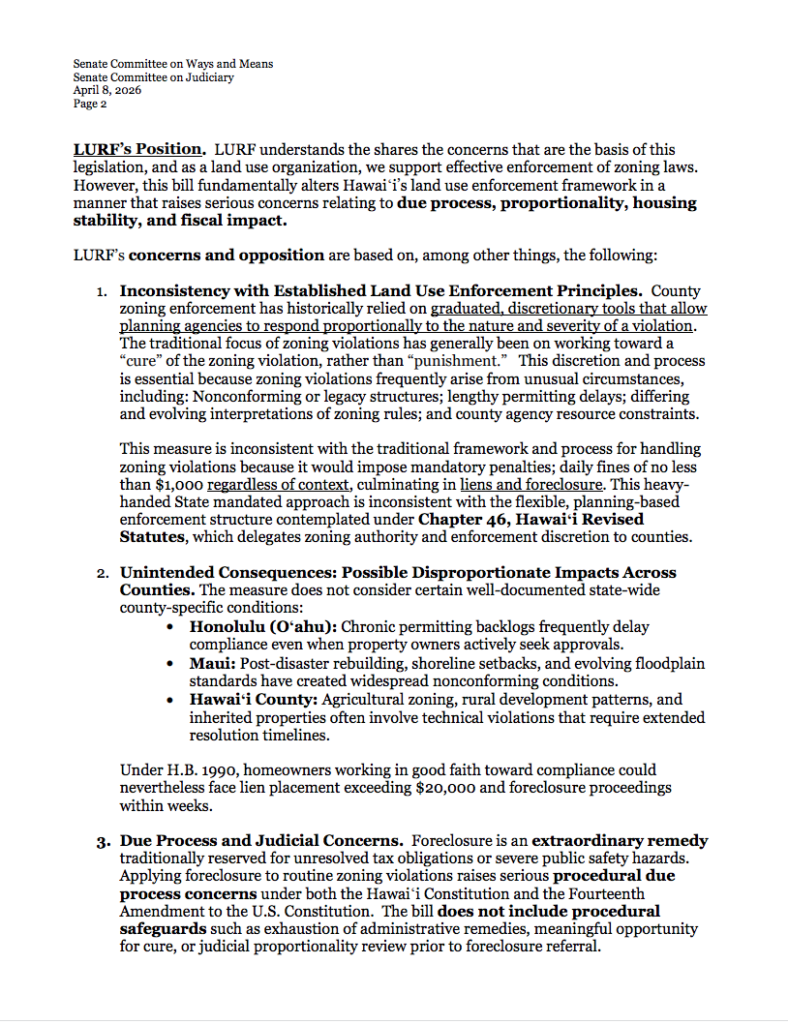
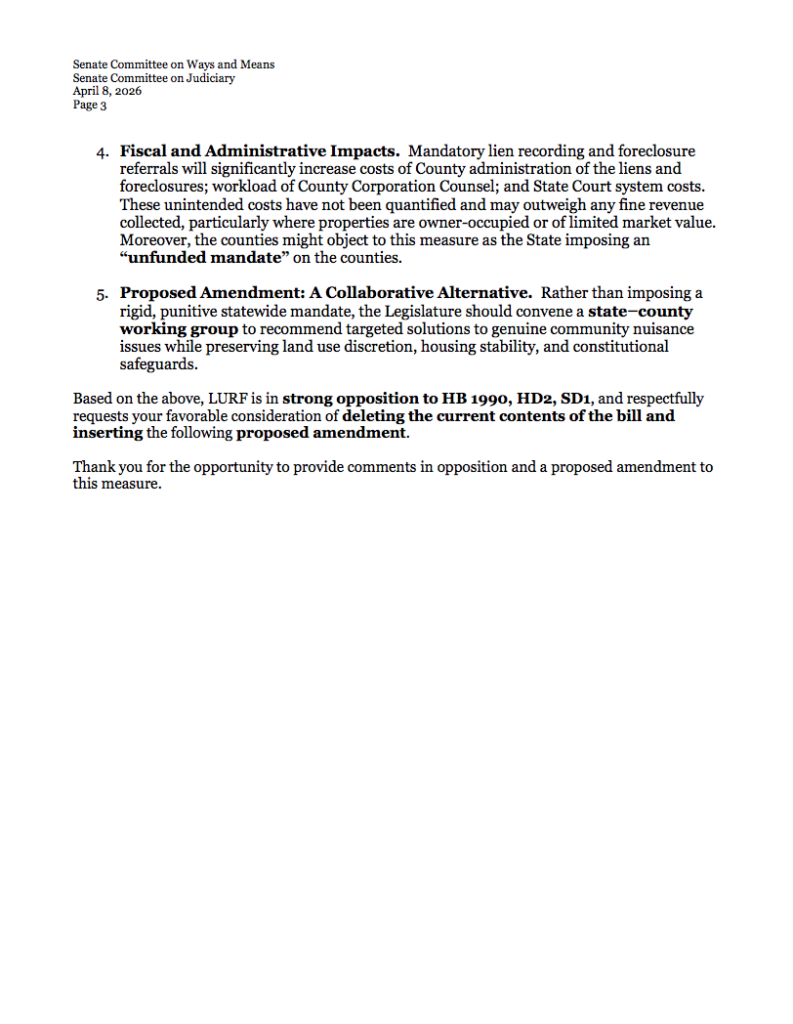
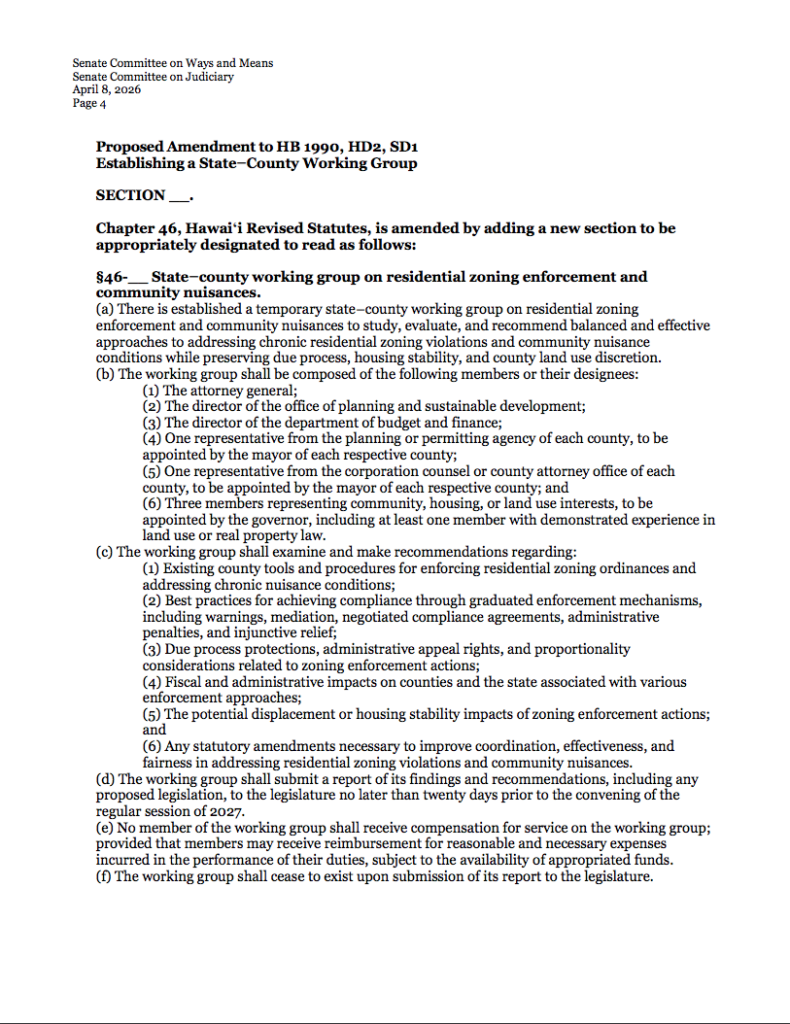
Some legislators are quietly robbing basic constitutional civil rights of their private property owners constituents!
We were informed a couple days ago that HB1990 is sailing through! This is an abusive and greedy bill – – A notice of violation of ANY county zoning ordinance, rule or regulation shall be fined . . . $1000 per day subject to a lien if the fines exceed $20,000 and subject to foreclosure within 30 days of notice.
The Bill affects ALL Counties.
Who in Oahu alone can get a quick response from the County within 30 days! There are 30 days in a month, so $20,000 is easy number to become ripe for foreclosure!
What can you do?
Email the Senators. Tell them to “KILL HB1990” and other opinions you may have. Cut and paste on your email addresses.
sens@capitol.hawaii.gov,
senihara@capitol.hawaii.gov,
senelefante@capitol.hawaii.gov,
senChang@capitol.hawaii.gov,
senkouchi@capitol.hawaii.gov,
sendelacruz@capitol.hawaii.gov,
senrichards@capitol.hawaii.gov,
senmisalucha@capitol.hawaii.gov,
sennishihara@capitol.hawaii.gov,
sendecoite@capitol.hawaii.gov,
sensshimabukuro@capitol.hawaii.gov,
senfevella@capitol.hawaii.gov,
senmoriwaki@capitol.hawaii.gov,
sengabbard@capitol.hawaii.gov,
senwakai@capitol.hawaii.gov,
senawa@capitol.hawaii.gov,
senfukunaga@capitol.hawaii.gov,
senhashimoto@capitol.hawaii.gov,
senkeohokalole@capitol.hawaii.gov,
senkidani@capitol.hawaii.gov,
senkim@capitol.hawaii.gov,
senlamosao@capitol.hawaii.gov,
senmckelvey@capitol.hawaii.gov,
senrhoads@capitol.hawaii.gov,
sensanbuenaventura@capitol.hawaii.gov,
senlee@capitol.hawaii.gov,
senkanuha@capitol.hawaii.gov,
A DEEPER DIVE:
The person who just informed us of HB1900 (2026) also shared HB811(2025).
HB811( 2025) too is very alarming and jarring. Who in their right mind think that fines of $5,000 should trigger a foreclosure within 30 days! Who knows how tedious and long it is to work with a county bureaucracy to get a permit for anything?
It’s common knowledge that any one or group can ask a Hawaii Legislator to draft a bill and sponsor it. This is a good democratic exercise for public participation.
However, there should be a litmus test to ensure that basic constitutional civil rights are not violated or infringed upon. Any proposed Bill ought to be for the public good and for the benefit for all Hawaii.
A proposed Bill can’t be appeasing one person or group to the detriment of the rest of Hawaii.
A proposed Bill cannot be a Mafia hit to a single issue because someone/group wants to. The Multiplier Impacts as well as Unintended Consequences on different levels of any proposed bill ought to analyzed and discussed intelligently BEFORE introduction.
I cannot recognize the signature of the legislative introducer. But the record shows the Introducers of HB811 as ( GANG OF SIX)
| Introducer(s): | MATAYOSHI, CHUN, LEE, M., MARTEN, QUINLAN, TAKAYAMA |
|---|
I would like to know what’s their heads? Does any one of them own property or know what it’s like to own a property? Why waste taxpayers’ money to write this type of pilau bill? Does the introducer even know a typical home in Hawaii is $1M? Most of our local families are not born with a silver spoon in their mouth. They work hard to own a house that they can call their own. Why turn their own constituents into a sitting duck for the long arm of the government? It’s never a good idea to give the long arm of the government more powers.
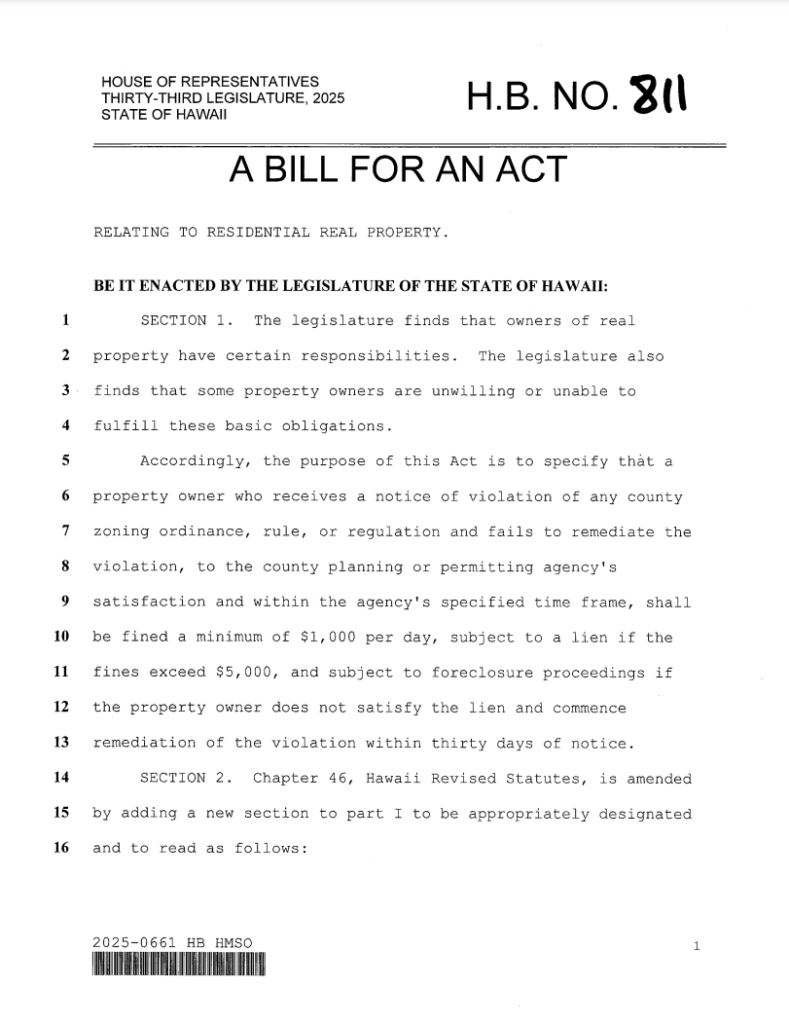
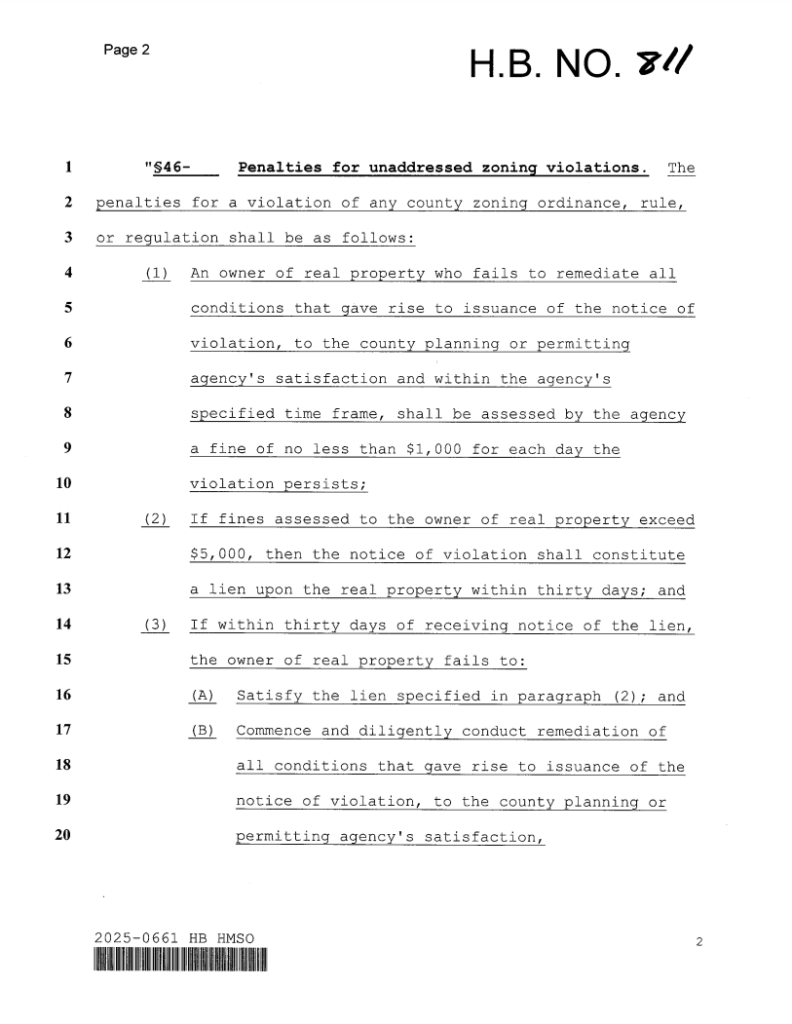
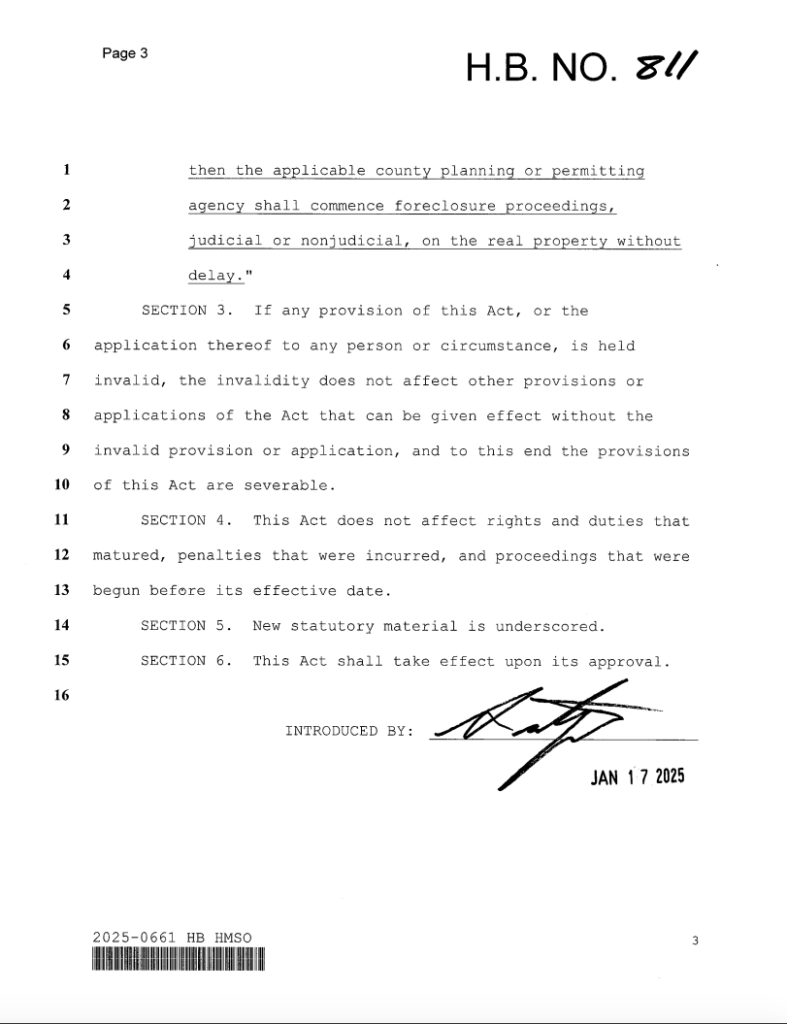
The above (2025) HB811 looks like an early draft to HB1990 (2026) which is sailing through quietly at the State Capitol as of this writing.
Note they’ve added a few more legislators to sign into it. GANG OF 14.
| Introducer(s): | MATAYOSHI, GRANDINETTI, KILA, KUSCH, LEE, M., MARTEN, MORIKAWA, OLDS, TAKAYAMA, TAM, TARNAS, TEMPLO, TODD, WOODSON |
|---|
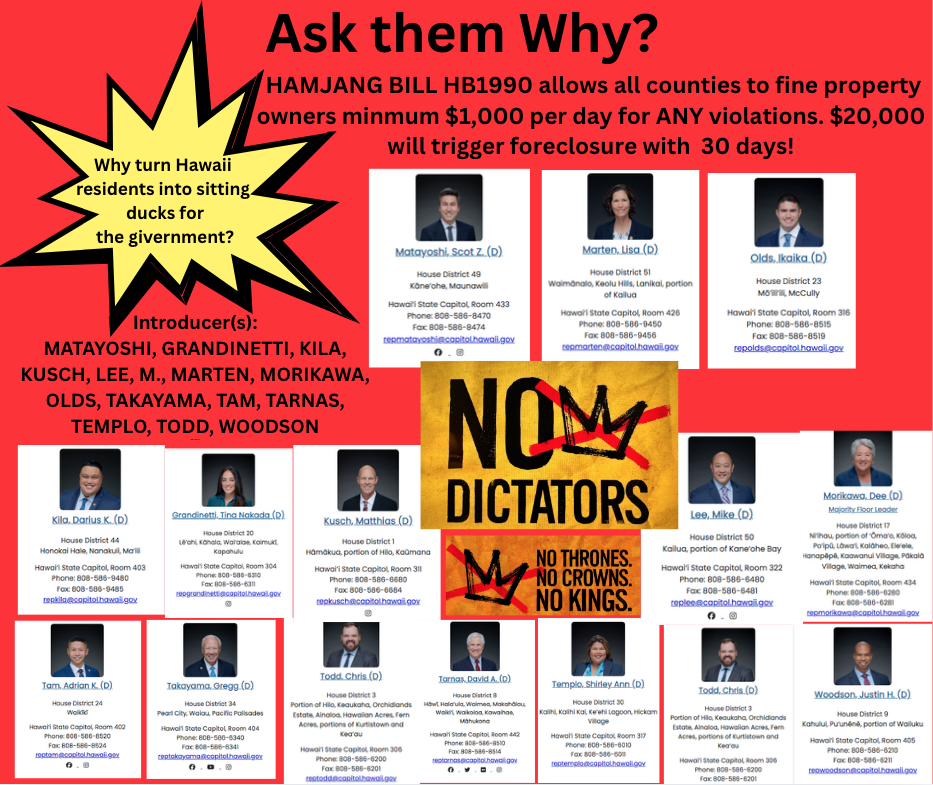
2026 also has another similar Trojan Horse in HB1861. The Introducers are recorded as (GANG OF 4)
| Introducer(s): | QUINLAN, MARTEN, MATAYOSHI, OLDS |
|---|
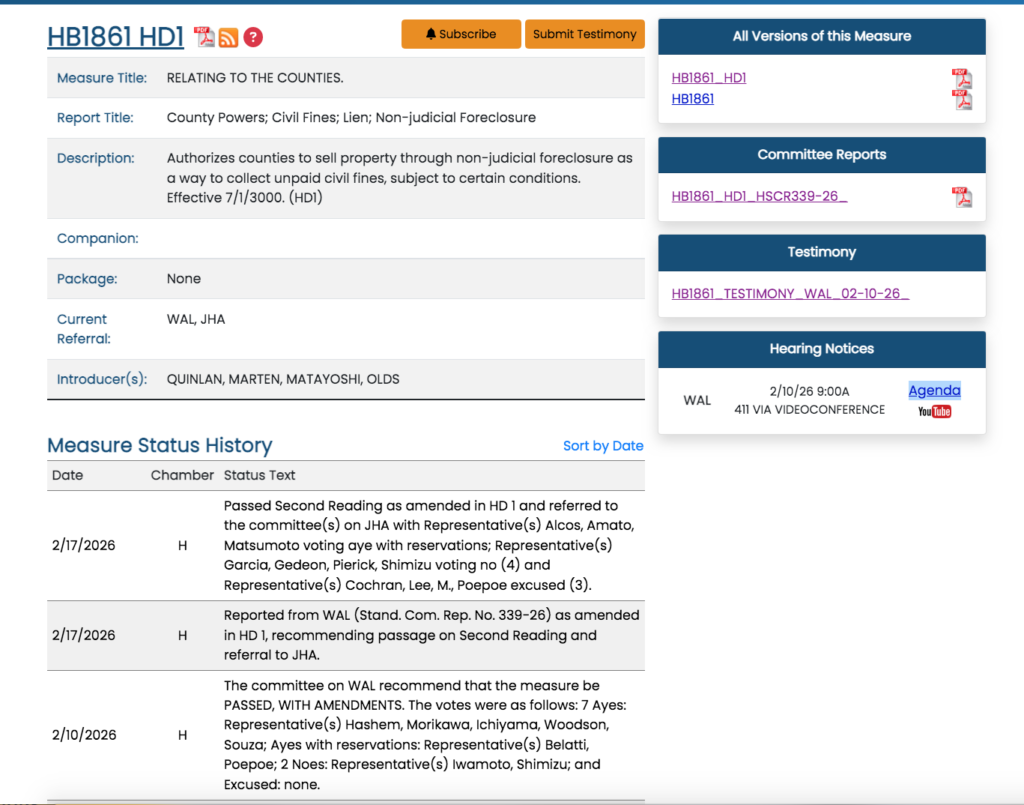

Did you legislator tell you about this possible sea-change?
Do you know what’s going on? Has any of your legislators disclose this drastic actions to you? The common denominator for repeat introducers is QUINLAN, MARTEN, MATAYOSHI, OLDS, CHUN*.
What’s just as alarming is that these Capitol Committee Chairs have the tendency to simply get along to move along to the detriment of the public. They spill out the same old illogical phrases – “This Bill deserves more conversation” or “This deserves more discussion” or “This deserves more dialogue”. They cherry-pick what they want to hear and do. They usually prepare the “amendments” before hand. So the Committee Chair will pass it out to the next chain for the sake of “more conversation”.
How can a conversation work for the constituents with a 2-minute testimony? How does a conversation work for the 99.9% public who cannot attend these hearings?
Shouldn’t these discussions/dialogue/conversations happening with the grassroots constituents first?
First, constituents need to know about these Bills. Constituents need to know about these Bills BEFORE they are introduced and put on the fast track to adopt. After-the-Fact laws is sneaky and undemocratic.

All these new civil fines and foreclosures began with Honolulu Mayor Blangiardi in 2021. He persisted each subsequent year until Representative Corey Chun of Waipahu because the sole introducer of similar agenda in 2025.
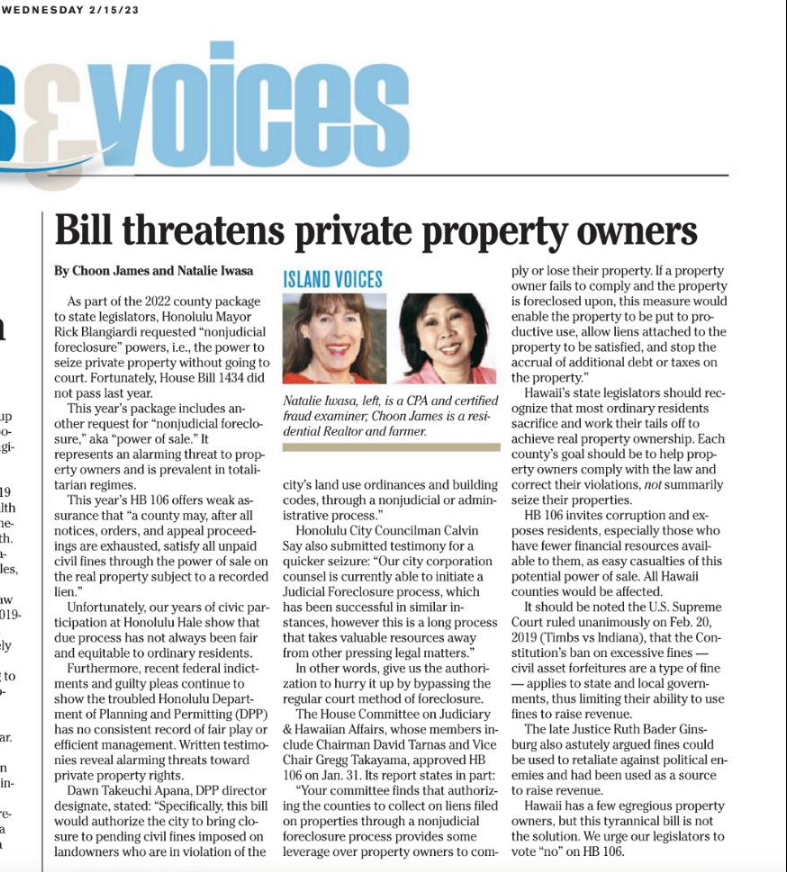
But the Hawaii State Legislature HB1990 to fine residents $1000 a day and quick foreclosure is secretly sailing through.
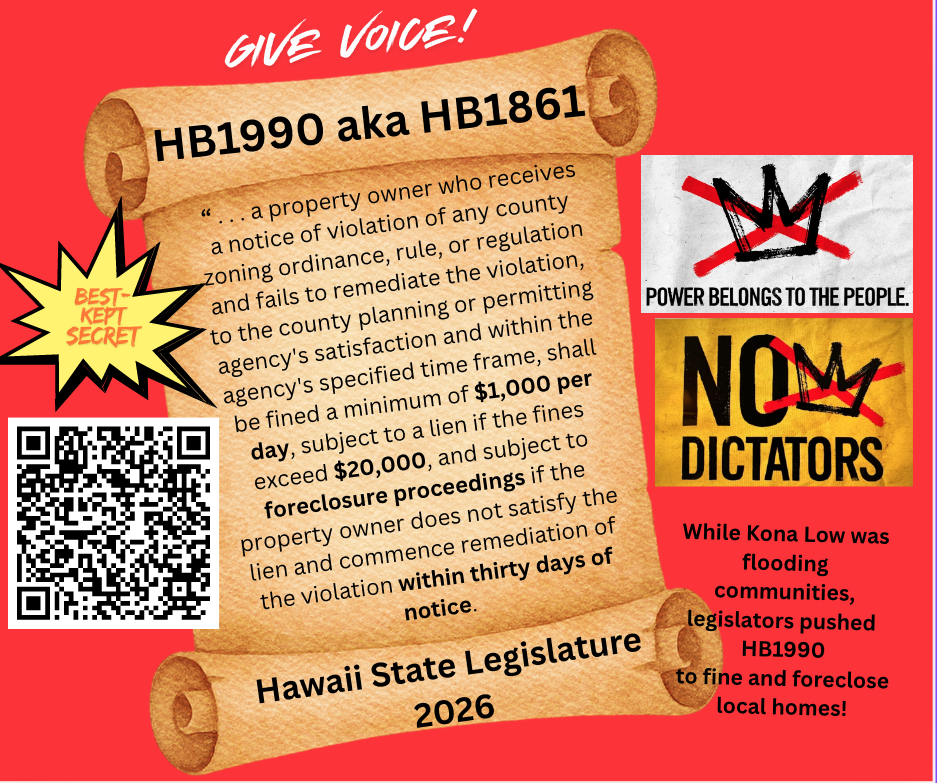
We are trying to stop HB1861 with the same agenda. But we did not know about HB1990. It feels sneaky. Why no disclosure of these significant changes that affect the lives of residents. Ordinary residents shouldn’t have to bird-dog politicians to make sure they do us no harm or just introduce hamajang Bills!

This agenda to have a new foreclosure powers through new county fines was initiated by Mayor Blangiardi in 2021. Blangiardi pushed every year. In 2025, a similar Bill 29 was introduced by House Representative Corey Chun of Waipahu.
This year, HB1861 was introduced by four (4) House Representatives – Sean Quinlan, Scott Matayoshi, Lisa Marten and Ikaika Olds.

Unfortunately, while ordinary residents were stopping HB1861, there was a concurrent BILL HB1990 sailing through. We heard about it a day ago! What a devious system! Three of the 4 Introducers for HB1861 are also introducers for HB1990 – Scott Matayoshi, Lisa Marten, and Ikaiko Olds. ( Sean Quinland’s name is no longer here.)
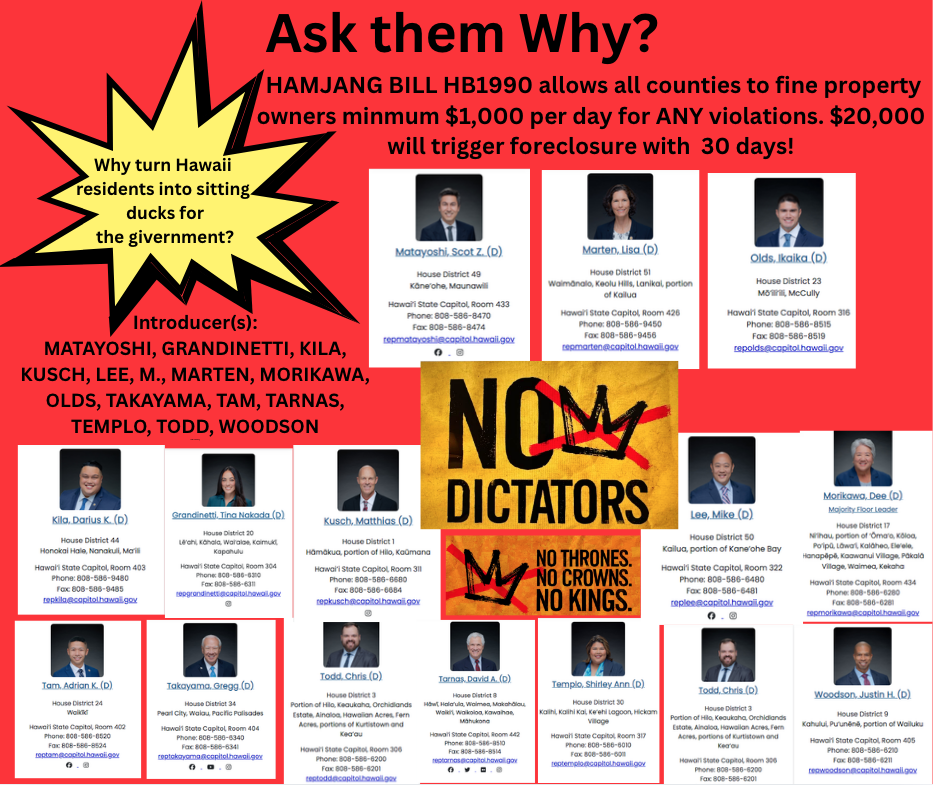
This unconstitutional agenda has been ongoing and initiated by Mayor Blangiardi since 2021. Blangiardi pushed every year. In 2025, a similar Bill 29 was introduced by House Representative Corey Chun of Waipahu. 2026 brought new and more introducers!



Or is it because we forget we live on an island and keep cementing?
Here are some comments for thoughts.

Oahu’s topography looks like this. There is not much flat land. But somehow, the powers-that-be keep thinking they can develop more and more without serious infrastructure engineering.
The uphill streams need to be maintained and cleaned. The drainages and culverts need to be cleaned out. If the County says it does not have the staff or its hard to find employees, what’s going to happen?
If the County approves a subdivision or project without an over-arching drainage system, legit traffic study, or other municipal services, what’s going to happen?
” Friday the 13th took on a deeper meaning when the winds and rains started. Kona low impacting Hawaii A subtropical system called a Kona low is passing north of Hawaii. This brings screaming southwest winds ahead of the storm’s cold front. This causes upsloping winds on the west-facing, or “Kona”, side of the mountains.“
KITV provides helpful hints as this Kona Low Disaster winds down. We were without electric for about 2 days but it was nothing like the Iniki Hurricane that lasted for about five days for us in Laie. The entire island lacked electricity and television service for an extended period. Electric companies restored only 20% of the island’s power service within four weeks of Iniki, while other areas had no power for three to four months. (AI)
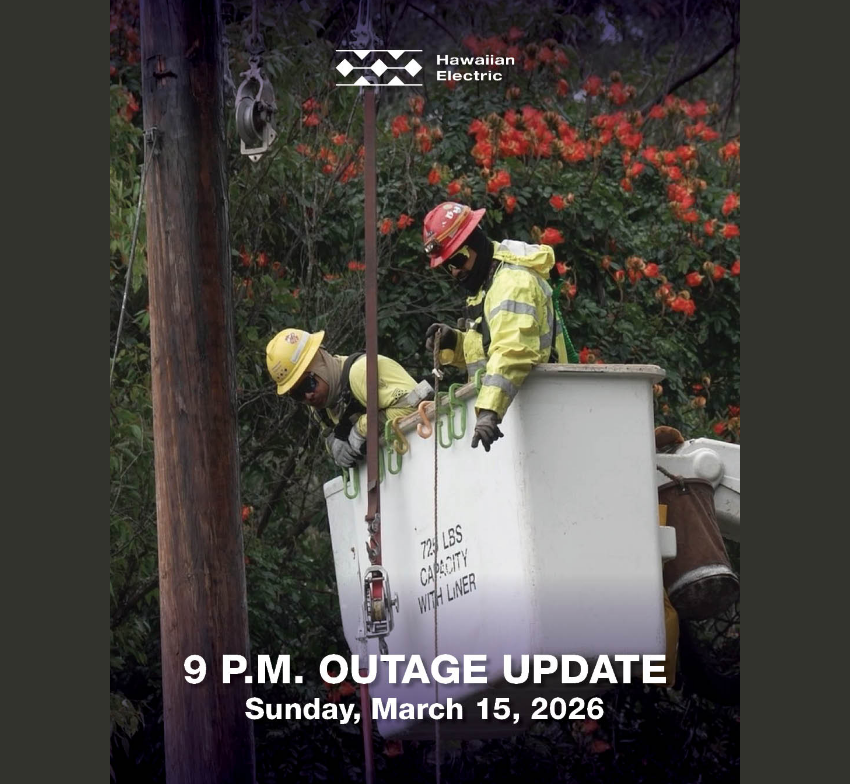
Outage update as of 9 p.m. HST on Sunday, March 15, 2026: Hundreds of our employees and contractors have been working non-stop to restore power to customers impacted by the destructive Kona Low storm. In many areas, toppled trees, branches and other debris must be cleared before damage assessments and repairs can begin. All customers are urged to stay prepared for potential extended outages.
As of 9 p.m.:
• Oahu: About 7,000 customers in areas including Nanakuli, Kaimuki, Kaneohe, and Waipio, are without power (3% of customers on island). The H-3 Freeway was reopened in both directions shortly after 6 p.m. after crews completed repairs to a major transmission line that crosses over traffic.
• Maui County: This evening, crews restored power to a majority of South Maui customers. Crews also brought back online a majority of Kula customers between the Omaopio Road area to Lower Kula Highway. About 4,600 customers (6% of customers on Maui) are currently without power, with the majority in Upcountry and East Maui.
• Hawaii Island: About 14,500 customers are without power in various areas around the island. Today, crews worked in Keaau, Kurtistown, Mountain View, Volcano, South Point, and North and South Kona. Two transmission lines also were repaired, and repairs to a third line are expected to be completed by tomorrow. Damage assessments were conducted in accessible areas in Kaloko, Holualoa, South Point, Volcano Village, Mauna Loa Estates, Royal Hawaiian Estates, and Nanawale Estates. In total, 30 damaged or broken poles were identified.
Customers can view current outages and report outages on the outage map at hawaiianelectric.com and on the mobile app. Estimated restoration times displayed on the outage maps are approximations. Inspections must be completed and any repairs made before power can be safely restored.
Customers experiencing a long duration power outage can find safety reminders and other tips in our Handbook for Emergency Preparedness available on hawaiianelectric.com/prepare.
HOW WE RESTORE FOLLOWING A STORM:
We don’t restore power based on when customers report an outage, where customers live or the status of accounts. Rather, we begin with multiple locations and follow an overall plan that calls for restoring power to the largest number of customers safely and as quickly as possible.
• We start by repairing any damage to our power plants and the power lines that carry electricity from our plants to the local substations.
• We prioritize restoring power to critical facilities such as hospitals, water pumping sites, wastewater plants, military facilities, and airports.
• At the same time, we work to return service to the largest number of customers in the shortest amount of time.
• From here, we repair the infrastructure serving smaller groups and neighborhoods, converging on the hardest hit areas until every customer’s power is restored.
For more information on our power restoration steps, visit hawaiianelectric.com/restorationprocess
This is a reprint from The Honolulu Advertiser for educational purposes. ( We added extra links from other publications for more information.)
By Dan Nakaso and Andrew Gomes
March 6, 2026

STAR-ADVERTISER / JAN. 8, 2018
U.S. Rep. Colleen Hanabusa formally announces she is running for governor during a gathering on the east lawn of the State Capitol building with dozens of her supporters in 2018.
Colleen Hanabusa, a formidable Hawaii politician and prominent labor lawyer from Waianae who served in Congress but failed to become Hawaii’s governor and Honolulu’s mayor, died early Friday morning at the age of 74.
Hanabusa had been hospitalized for five months with cancer, her family said.
Gov. Josh Green ordered the U.S. and Hawaiian flags be flown at half-staff at the state Capitol, all state offices and agencies, and all Hawaii National Guard facilities in honor of Hanabusa, a former U.S. representative and president of the state Senate who more recently chaired the board of the Honolulu Authority for Rapid Transportation.
“Colleen Opens in a new tab Hanabusa dedicated her life to serving the people of Hawaii Opens in a new tab — from the Waianae Coast she proudly called home, to the halls of the Hawaii State Capitol and the United States Congress,” Green said in a news release. “She broke barriers as the first woman to serve as President of the Hawaii State Senate and spent decades advocating for her community with strength, determination and heart. Her legacy of leadership and public service will continue to inspire generations to come.”
Honolulu Mayor Rick Blangiardi, who appointed Hanabusa to the HART chair, said in a statement, “Hawaii has lost a remarkable leader, and we all have lost a friend. Managing Director Mike Formby and I had a close relationship with Colleen, and she dedicated her life to serving the people of Hawaii with intelligence, determination, and an unwavering sense of purpose.”
City & County of Honolulu flags also will be lowered today through Sunday to honor her.
Hanabusa ended her political career at HART after she, Blangiardi and Lori Kahikina — HART’s executive director and CEO — proposed truncating the route to regain the confidence of the Federal Transit Authority, got long-awaited federal dollars flowing back to the project and opened the first leg of the Skyline system in June 2023.
Asked why Hanabusa would agree to serve as an unpaid volunteer while the rail project faced intense criticism at home and in Washington, D.C., Blangiardi told the Honolulu Star-Advertiser on Friday that “It speaks volumes about her. What it says is that she put Hawaii first.”
Kahikina said, “On behalf of myself and the entire HART Ohana, we are deeply saddened by the news of Colleen Hanabusa’s passing. My deepest sympathy goes out to the Hanabusa ohana. I greatly appreciate her contributions to the Honolulu rail project, and respect and admire her work as a tireless advocate and public servant. HART extends its sincere condolences to all who had the privilege of knowing Colleen.”
Hanabusa was born May 4, 1951, and raised in Waianae where her great-grandparents worked on a sugar plantation and her family later established a service station, Hanabusa Service, in 1948.
Because her parents, June and Isao, devoted so much time to the family business, Hanabusa was raised largely by her maternal grandmother.
After graduating from St. Andrew’s Priory in 1969, Hanabusa earned a bachelor’s degree in sociology and economics from the University of Hawaii in 1973, and followed it with a master’s degree in sociology in 1975 and then a law degree in 1977 also from UH.
As a labor lawyer during the 1980s and early 1990s under her married name at the time, Colleen Sakurai, Hanabusa represented some high-profile clients who were politically powerful and others who were politicians or intersected with politics.
Clients from that time included the Hawaii Teamsters Union in a legal fight to represent state corrections officers, and the Hotel Employees and Restaurant Employees Local 5 union in a dispute over picketing during a statewide hotel strike.
Hanabusa also represented Honolulu City Council members in a 1993 legal skirmish with then-Mayor Frank Fasi to stop him from using Oahu Neighborhood Board elections as an “advisory referendum” on tax funding for a $2 billion Fasi rail transit plan.
One of those Council members, Arnold Morgado, ran for mayor in 1994cq special election and 1996 with Hanabusa as a campaign strategist and attorney. Morgado lost both times to Jeremy Harris.
In 1998, Hanabusa sought political office herself. She ran for a state Senate seat against Sen. James Aki, the Democratic incumbent who a year earlier had been granted deferred acceptance of a no-contest plea to two felony gambling charges. Hanabusa won the primary and went on to win the general election to represent Nanakuli, Waianae and Makaha.
As a first-term lawmaker, Hanabusa quickly made a name for herself by helping organize the rejection of Margery Bronster as then-Gov. Ben Cayetano’s nominee for attorney general.
Then in 2001, she spearheaded efforts to reform state civil service laws, an action that stirred up politically powerful public worker unions.
“While the effort won quick public praise, it immediately drew the opposition of public employee unions, and Hanabusa, although being a labor lawyer, was never a favorite daughter of the public unions,” Honolulu Star-Bulletin reporter and political columnist Richard Borreca wrote in a column a few years later.
Hanabusa caught some heat and tangled with Cayetano again a few years later over legislation she introduced to provide Jeff Stone, developer of Ko Olina Resort & Marina, with $75 million in state tax credits to build a “world class” aquarium to enhance the resort.
The Legislature passed the bill in 2002, but Cayetano vetoed it. In response, Hanabusa sued Cayetano and reintroduced the bill in 2003 after Republican Linda Lingle beat then-Lt. Gov. Mazie Hirono to succeed Cayetano. The bill passed again and was signed by Lingle.
A year later, Hanabusa drew flack after it became publicly known that the home she shared at Ko Olina with her fiancee at the time, state Sheriff John F. Souza III, was sold to Souza by Stone, and that Souza also rented an office from Stone that Hanabusa rented from Souza for her law practice. Souza, a friend of Stone’s, had a trucking company that helped build homes at the resort.
Hanabusa, Souza and Stone said at the time that the real estate deals were at market prices and unrelated to the tax-credit legislation. Hanabusa shortly thereafter married Souza. Later, the aquarium project fizzled.
Higher power
While serving in the Legislature, Hanabusa pursued ambitions for higher office that resulted in two unsuccessful runs for Congress that didn’t put at risk her position in the state Senate.
Hanabusa’s first attempt in 2003 was to fill a vacancy representing urban Honolulu created by the death of U.S. Rep. Patsy Mink. Ed Case won the special election featuring 43 candidates. Hanabusa placed third.
Three years later, Hanabusa challenged Hirono to replace Case, who gave up his U.S. House seat representing rural parts of the state in an unsuccessful bid to unseat U.S. Sen. Daniel Akaka.
Touting her deep westside roots, Hanabusa announced her campaign in front of her family’s service station. “I believe I’ve been a loud voice for the people of the Waianae Coast,” she said. “I hope that the rest of the 2nd Congressional (District) will want to see a Waianae girl there.”
The primary election drew nine Democratic competitors. Hanabusa placed second to Hirono, who was born in Japan and moved to Hawaii when she was 8.
As an unrelated sort of consolation prize, Hanabusa was named Senate president in 2007 and became the first woman to lead the Senate or House of Representatives in Hawaii’s Legislature.
Hanabusa had angled for the Senate’s top position for several years, and succeeded despite early negative feedback.
Local historian Bob Dye wrote in a 2001 Honolulu Advertiser column that Hanabusa was told her goal was unattainable in part because she was a freshman at the time but also because she was a woman and had a “take no prisoners” political style.
Hanabusa’s time in the Legislature and as Senate president lasted until 2010 when then-U.S. Rep. Neil Abercrombie resigned to take office as Hawaii’s governor.
Abercrombie’s vacancy in Congress resulted in a special election that was won by Republican Charles Djou due to Hanabusa and Case splitting many Democratic votes, but Hanabusa defeated Djou with 53% of the vote in a regular election five months later to represent urban Honolulu.
Spurn and return
When Hawaii’s revered U.S. Sen. Daniel Inouye died in late 2012 at age 88, Hanabusa as his political protege saw a good opportunity to fill the seat, especially because Inouye before death conveyed his “last wish” for her to succeed him.
Abercrombie, however, as governor would pick Inouye’s interim successor, and named his lieutenant governor at the time, Brian Schatz, to fill out the last two years of Inouye’s term.
Two years later, Hanabusa did not seek reelection to her House seat and instead challenged Schatz for his Senate seat, in what became an intense and bruising showdown.
Some Schatz supporters and Hanabusa critics made a case that Schatz, then 41, was positioned to establish longer-term seniority in Congress compared with Hanabusa, then 63.
Hanabusa discounted the notion, telling the Washington Post, “It’s almost like saying that somebody would be anointed for 40 years.”
Schatz won the 2014 primary election by a narrow margin, and Hanabusa returned to Honolulu to practice law.
Honolulu’s mayor at the time, Kirk Caldwell, quickly appointed Hanabusa to the board of directors of the Honolulu Authority for Rapid Transportation overseeing the city’s overdue and over-budget rail project.
UH also selected Hanabusa to teach a course on civil liberties in times of crisis in 2016 as a visiting scholar funded by the Daniel K. Inouye Institute.
Hanabusa was HART’s board chair until 2016 when she returned to Capitol Hill after easily winning an election to succeed then-U.S. Rep. Mark Takai, who decided not to seek reelection due to cancer that led to his death soon after.
Back to HART
Just a year later, in 2017, Hanabusa declared that she wouldn’t seek reelection to the U.S. House so that she could to run for governor in a bid to prevent then-Gov. David Ige from being elected in 2018 to a second four-year term.
During a televised debate, Hanabusa criticized Ige for his handling of a January 2018 false missile alert from the Hawaii Emergency Management Agency, calling the incident that generated widespread public panic “a systemic failure of leadership” by Ige’s administration.
“You had no plan to begin with, and you didn’t know when something went wrong,” Hanabusa said. “Will you finally take personal responsibility for the missile fiasco?”
Ige won the primary contest, and Hanabusa finished out her congressional term in January 2019.
Out of office once again, Hanabusa mounted a campaign in 2020 to succeed term-limited Caldwell as mayor amid a crowded nonpartisan field of 15 candidates who included former Honolulu Mayor Mufi Hannemann, then-City Council member Kym Pine, former state high school athletics chief Keith Amemiya and former local television station general manager Rick Blangiardi.
Hanabusa finished third in the primary behind Amemiya and Blangiardi, who won the general election. Blangiardi in 2021 reappointed Hanabusa to HART’s board.
On Sept. 23, Hanabusa offered her letter of resignation to Blangiardi, effective Sept. 30, following her absence from the August HART board meeting. In the letter she said she could no longer effectively serve on the board where her term was to have run through June 30, 2026.
“Colleen and I once stood on opposite sides of a mayoral race, but what grew from that experience was a relationship built on mutual respect and friendship,” the mayor said Friday. “I came to appreciate her insight, her honesty, and her deep commitment to this community. I was grateful when she agreed to serve as Chair of the Honolulu Authority for Rapid Transportation Board. Her leadership and steady guidance were instrumental during an important time for the Skyline project.”
Hanabusa is survived by her husband John Souza.
Star-Advertiser reporter Peter Boylan contributed to this report.
Hawaii Legislators want to remove DUE PROCESS from Private Property Rights through HB1861 aka HB29. New NON-Judicial Power of Sale to seize private properties based on county fines. No court. Just Non-Judicial Foreclosure.
On the other hand, Democratic Party affiliated protesters organized nation-wide civic resistance – “No Dictators” protests against the Trump administration’s policies relating to civil rights, Due Process and democracy in October, 2025.
Such rallies were held the Hawaii State Capitol and neighbor islands including Hilo, Waimea, Kona, and Kahului.

I
n January 2026, these four Hawaii Legislators (below) want to remove DUE PROCESS from private property owners through HB1861 aka HB29.


This unconstitutional Tyranny agenda began with Honolulu City County in 2021. The Blangiardi Administration introduced NON-Judicial Power of Sale as a County Legislative Package in 2021. The Department of Planning and Permitting (DPP) gets to issue violations, to place fines and to seize property without no Due Process of going to court.
Who wants to give more powers to the long arm of the government? Who wants DPP to be the Police, Prosecutor, Judge, Jury, and Executioner?

Private Property owners will be stripped of Due Process if these non-judicial Power of Sale Bills are adopted by the Hawaii State Legislature this year.
It’s ironic that the Unhoused now has more rights than ordinary private property owners and renters if non-judicial Power of Sale based on county civil fines is adopted through HB1861 aka HB29.

Below excerpt is for educational purposes.
The Unhoused is guaranteed an expanded Due Process Rights while private property owners will be denied Due Process in court.
Due Process in Hawaii is fundamentally guaranteed by Article I, Section 5 of the Hawaii Constitution, protecting life, liberty, and property from arbitrary government action. It ensures fair legal proceedings, including the right to counsel in specific cases, and has been recently applied to protect the property rights of unhoused individuals and the rights of parents in child protective proceedings.

Wookie Kim is the legal director of the ACLU of Hawaiʻi, which represented the plaintiffs in Davis v. Bissen.
On September 20, 2021, a group of unhoused people living near Kanahā Beach Park in central Maui were awakened by police officers and other Maui County workers armed with forklifts, dump trucks, and other heavy machinery. Wielding the threat of arrest and prosecution for criminal trespass, they forced everyone living in the park to leave immediately — with or without their personal belongings.
The county seized everything that was left behind. All told, the county impounded dozens of vehicles and immediately destroyed tons of property, including tents, clothes, pots and pans, child car seats, strollers, and water tanks.
Earlier this year, the Hawaii Supreme Court unanimously ruled in Davis v. Bissen that the county’s actions violated the due process rights of the people whose property was seized.
In an opinion authored by Justice Sabrina McKenna, the court held that “unabandoned possessions of houseless persons” were a “classic form” of property protected by Article I, Section 5, of the state constitution, even if such property was in a public space. The private interest at stake was “significant,” the court said, and the county’s “unchecked decision to seize and destroy the plaintiffs’ personal property posed a high risk of erroneous deprivation of property.”
Moreover, the court held, because “the county’s plan was to destroy (instead of store) seized property,” it could not carry out the sweep without first conducting a “contested case” hearing under the Hawaii Administrative Procedure Act. A contested case hearing is a proceeding before the relevant agency (here, Maui County) in which the agency considers evidence, hears testimony, allows for cross-examination of witnesses, holds oral arguments, and renders a decision about the legality of a planned action, much like a court proceeding.
Here, the plaintiffs had formally requested such a hearing before the sweep occurred, but Maui County ignored those requests. As later court filings would reveal, the county’s stance was that it did not need to hold any hearings. Why? Because, it maintained, unhoused people’s property was “on government property without permission and in violation of trespassing laws” and, therefore, was not protected by due process in the first instance. But, as the court’s decision confirms, one does not forfeit due process protections simply by leaving property in a public space.
The ruling paves the way for a potential first: the holding of a contested case hearing before a local government conducts a sweep of a houseless encampment. While such a hearing would be routine for, say, a landowner challenging the state’s decision to bulldoze a home erected on her property, to my knowledge no municipality in the country has ever held or been required to hold such a robust hearing before destroying the property of unhoused people. While the plaintiffs in this case may only get a post-deprivation hearing on remand, going forward unhoused people in Hawaii may be entitled to a full-blown contested case hearing before a planned sweep.
This could have significant practical effect on the lives of an immense number of people in Hawaii: As of 2023, there were 6,223 houseless people in in the state. Native Hawaiian women, including two of the four plaintiffs, are disproportionally impacted by Hawaii’s housing crisis. Maui County uses sweeps to force — or, as Honolulu officials euphemistically describe it, “gently coerce” — unhoused people into pulling themselves up by their bootstraps. (Never mind that many unhoused people in Hawaii are employed, including all but one of the plaintiffs in this case, who work in service jobs tailored to Maui’s tourism industry.) Rather than helping people get off the streets, sweeps only perpetuate the homeless crisis.
Beyond its practical impact, a state supreme court win squarely vindicating the due process rights of unhoused people also carries symbolic weight. Our legal system structurally disfavors unhoused people: as scholar Wayne Wagner has written, “homeless persons possess fewer and lesser legal rights” than those who live in houses or apartments. Many of our constitutional rights — including those relating to privacy and autonomy — are predicated on owning or having possession of real property, a place to which one can retreat from governmental interference. Further, in lacking access to conventional housing, unhoused people are more likely to be politically disempowered because of difficulties in proving identity or residence when registering to vote. The Hawaii Supreme Court’s declaration that government actors are bound to respect due process for everyone, unhoused or not, at all times, is a victory for the principle of equality under the law.
Finally, the court’s decision is notable not only for its holding but for the way it got there. The court applied what it calls the “state-constitution-first approach” to constitutional interpretation. Under that approach, the court “interpret[s] the Hawaii constitutional provision before its federal analogue.” The court adopted this approach less than a month earlier in State v. Wilson — a case construing the Hawaii Constitution’s analogue to the Second Amendment — to govern how it would resolve cases in which a party “invokes both the Hawaii and United States Constitutions.”
In choosing to interpret and rely exclusively on the state constitution in its Davis decision, the Hawaii Supreme Court has highlighted the “distinct role [of state constitutions] under our nation’s system of federalism” and reminded us, once again, that state constitutions can be as important a source of rights as the U.S. Constitution.
Suggested Citation: Wookie Kim, Hawaii Expands Due Process Rights of Unhoused People, Sᴛᴀᴛᴇ Cᴏᴜʀᴛ Rᴇᴘᴏʀᴛ (Jun. 11, 2024), https://statecourtreport.org/our-work/analysis-opinion/hawaii-expands-due-process-rights-unhoused-people.
More information about HB1861 aka HB28