Tag Archives: Honolulu

Witty!

Social media can’t be all that bad. this is funny. Potholes are every where here in Hawaii.

It’s a mystery why we spend millions of dollars each year and we continue to have such problems. Mind you, we don’t even have to deal with snow or de-icing.

It I have my rathers, I would insist that there are warranties to these jobs. Companies must be confident enough of their work to provide a 5-year warranty. If there are potholes, the company has to fix their work within a week at its own expense.

City Employee expresses his personal views against windowless units as a private citizen in Bill 21

Bill 21, authored by City Councilman Tyler Dos Santos-Tam, asks for changes to the City County Housing Code to be consistent with the International Building Code (IBC) that allows windowless (no natural light and ventilation) housing units.

Santos-Tam, a construction industry lobbyist, said that the county needs to build 25,000 housing units and thus “optionality” is necessary in housing development. The statement begs many questions as to who these units are for and do we want Oahu to follow other countries’ values and standards. Is this about helping developers or is this about meeting the needs of our local residents?

Below is an excellent example of a local government worker with lots of expertise and experience standing up for the public good, rather than developers. Michael O Silva, speaking as a private citizen, should be commended for speaking up. His testimony is free from self-interests but filled with common sense and aloha for the ordinary local residents. Read the testimonies here.

Listen to Bill 21 here. It starts around the 1:46 mark.

Hawaii Legislature: HB 538 dismisses the US Constitution

Did a group of politicians woke up one morning and decided to attack the US Constitution or something?

Read HB 538 in the context that the Honolulu Department of Planning and Permitting (DPP) is struggling. It has been mired with corruption and mismanagement for years.

At Honolulu Mayor Rick’s Blangiardi’s City Address on March 15, 2023, he stated that the average time for a permit approval was 300 days. Three hundred (300) days is actually on the fast track.

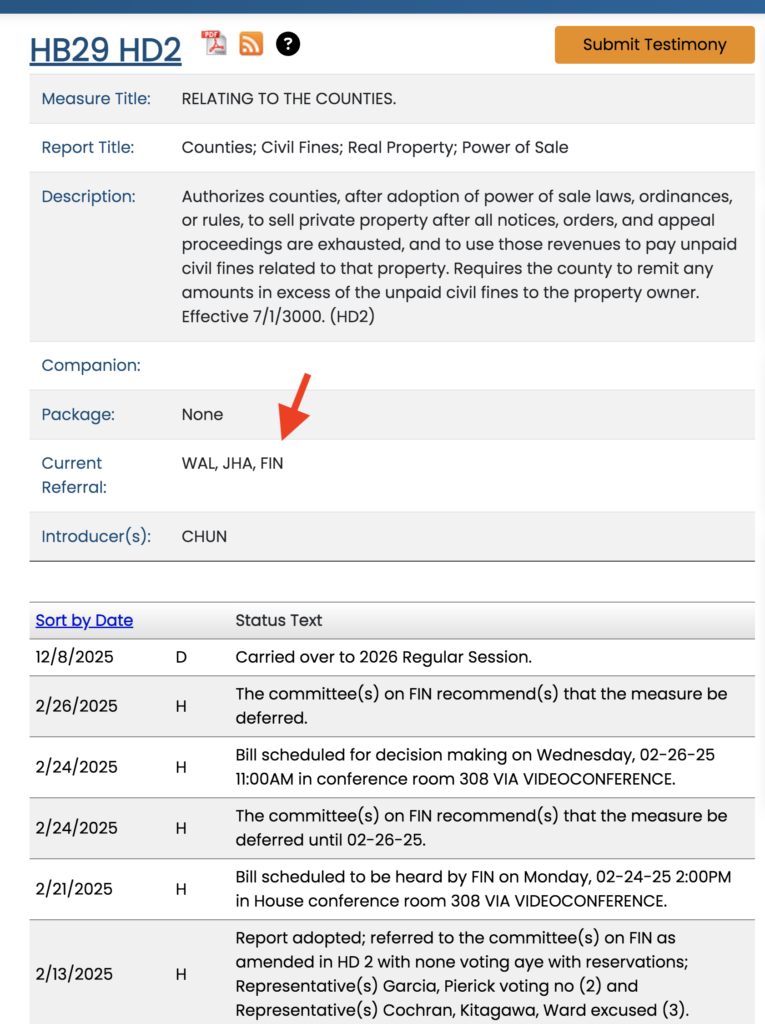
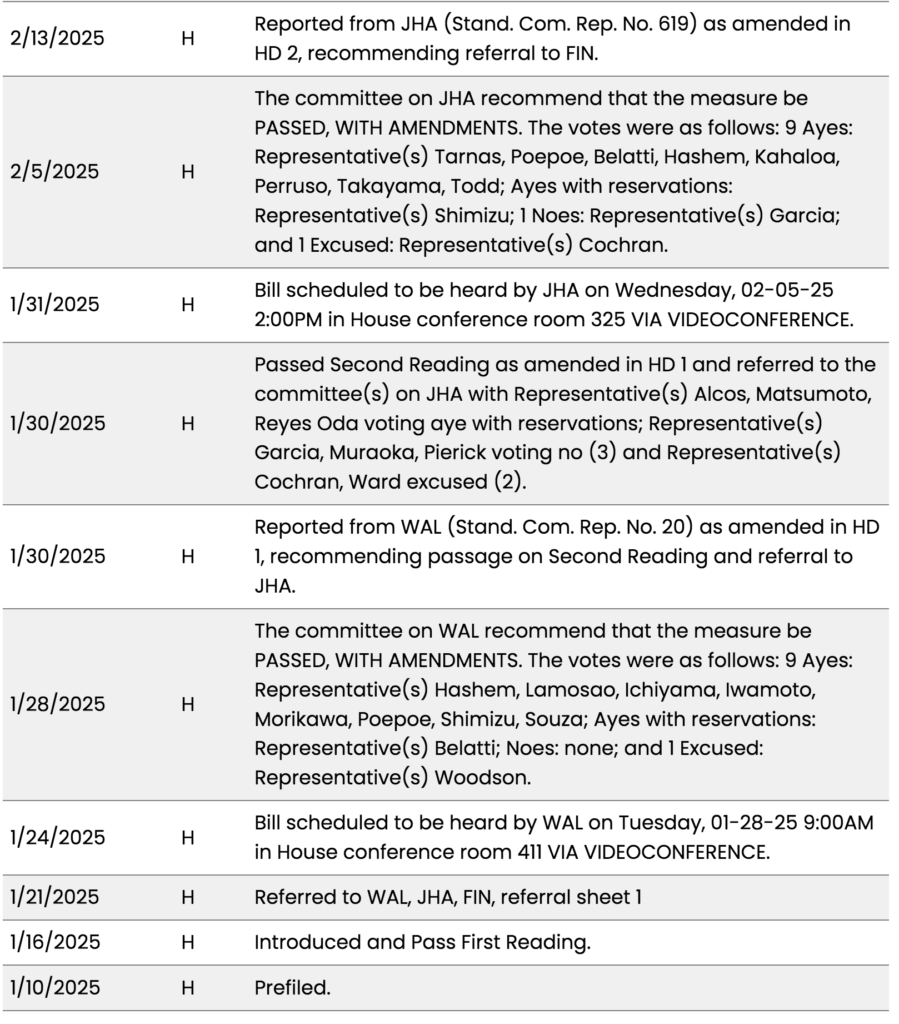
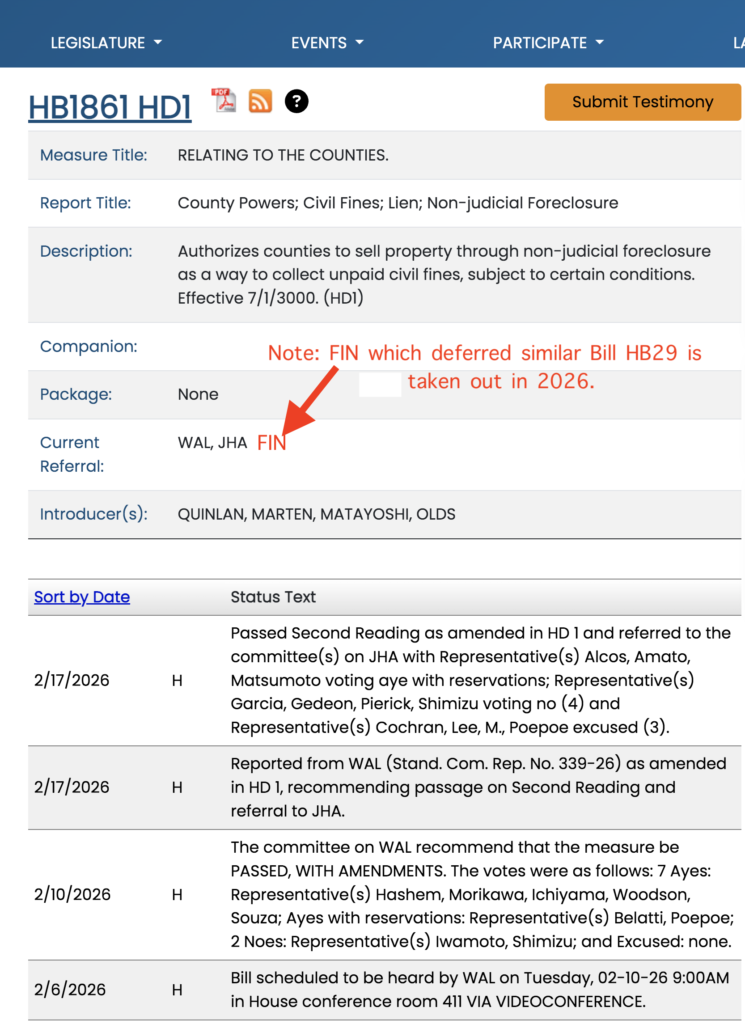
HB 538 states ” then the applicable county planning or permitting agency shall commence foreclosure proceedings, judicial or nonjudicial, on the real property without delay.” Guess which type of foreclosure the county is going to choose?

HB 538 first started with wanting entry into homes without consent. (Interestingly, another bill SB 1468 asks for surveyors entry into any property too.)

Page 2 of HB 538 proposes:

46-A Authority to enter private property; zoning
violation. (a) Notwithstanding chapter 322, a county planning
or permitting agency may enter privately owned residential real property, without the consent or cooperation of the owner or
occupant of the real property, for the purpose of investigating
any condition on the premises that the officer reasonably
believes may constitute a violation of any county zoning
ordinance, rule, or regulation that:

On Page 4, it continues:

§46-B Penalties for unaddressed zoning violations. The
penalties for a violation of any county zoning ordinance, rule,
or regulation shall be as follows, regardless of whether a
county planning or permitting agency’s investigation was
conducted without the owner’s or occupant’s consent or
cooperation pursuant to section 46-A(a) or by other means:

(1) An owner of real property who fails to remediate all
conditions that gave rise to issuance of the notice of
violation, to the agency’s satisfaction and within the
agency’s specified time frame, shall be assessed by
the agency a fine of not less than $1,000 for each day
the violation persists;

(2) If fines assessed to the owner of real property exceed
$5,000, then the notice of violation shall constitute
a lien upon the real property within thirty days; and

(3) If within thirty days of receiving notice of the lien,
the owner of real property fails to:
(A) Satisfy the lien specified in paragraph (2); and (B) Commence and diligently conduct remediation of
all conditions that gave rise to issuance of the
notice of violation, to the agency’s
satisfaction, then the applicable county planning or permitting
agency shall commence foreclosure proceedings,
judicial or nonjudicial, on the real property without
delay.”

Hawaii Legislative Bills must uphold the US Constitution

Good public policies are vetted carefully in an over-arching manner. They must be rooted within the parameters of the US Constitution that have served us well for 235 years.

There are some very troublesome bills – SB875, HB15. HB538, HB106, SB216, HB 498 that are introduced this 2023 session.

The language may vary in these Bills but the core violation is the taking of private property based on civil fines, without providing the judicial court process. It’s not about the market value or the balance of the sold property loot.

I get it that certain politicians are hoping for easier and quicker penalties like non-judicial foreclosures. But to think that the counties can seize private property based on civil fines is misguided. We can’t have knee-jerk legislation just because we want to punish some “egregious” private property owners or to create a new source of income revenues.

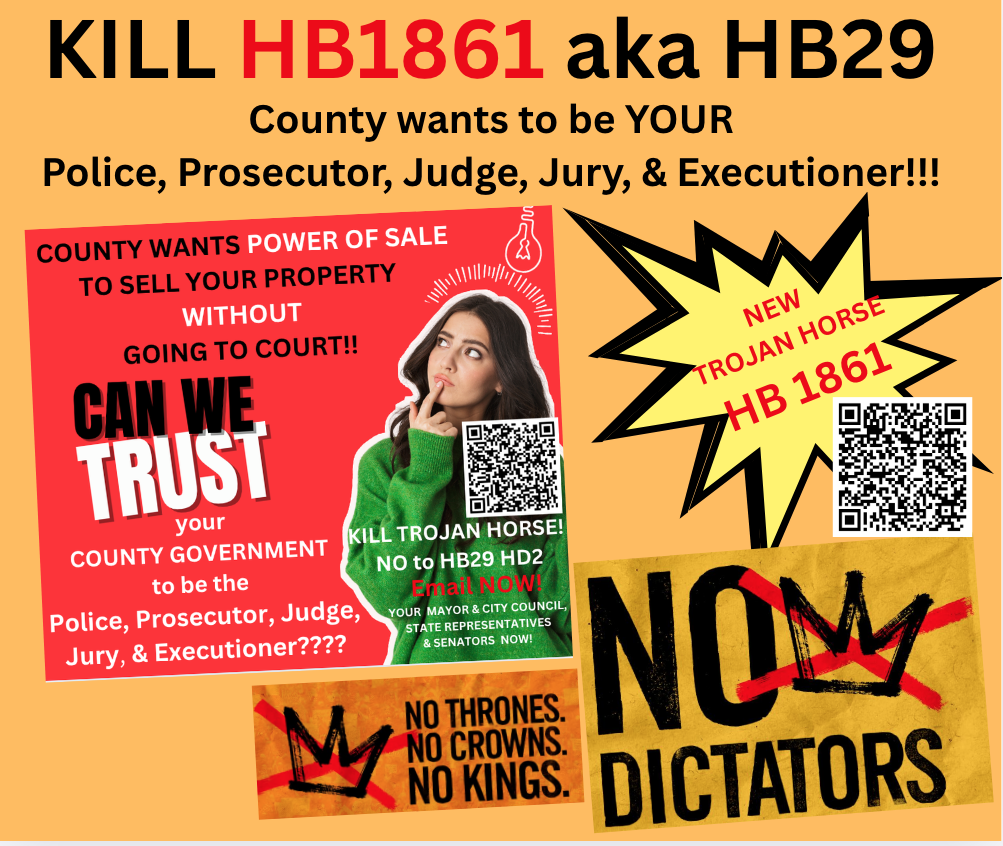
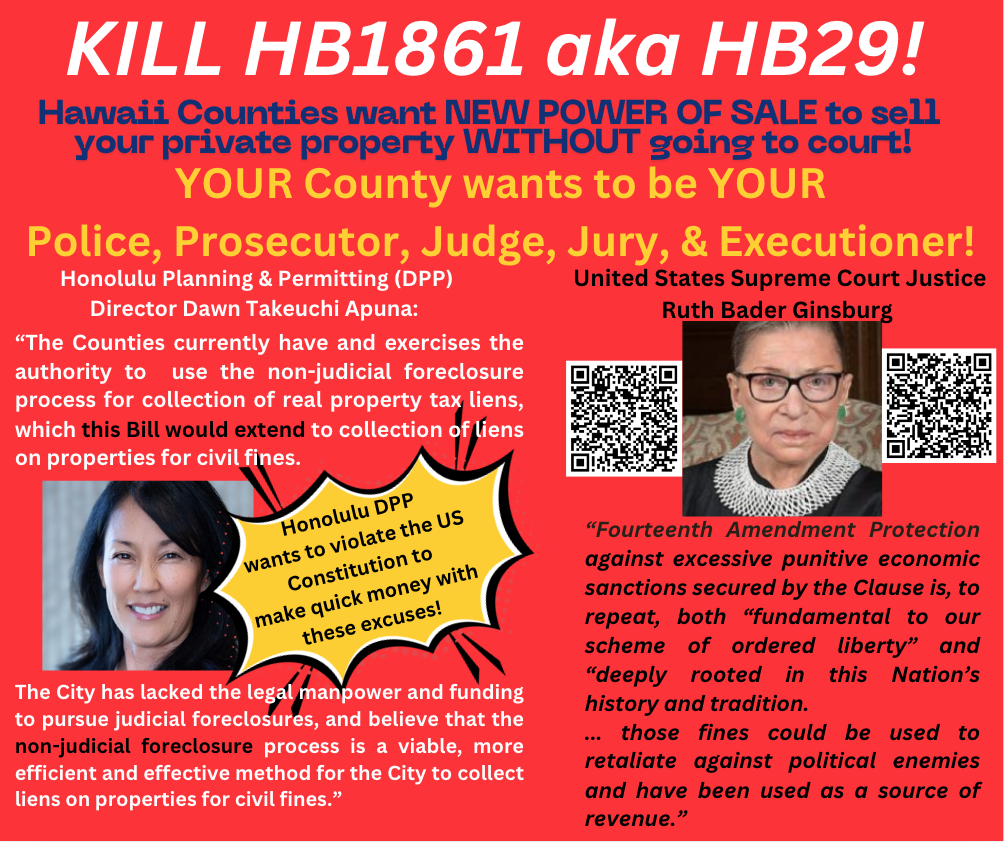
Counties cannot become the in-house Police, Prosecutor, Jury, Judge, and Executioner.

The late Justice Ruth Bader Ginsburg said it best in one of her last Opinions for the US Supreme Court in Timbs vs Indiana relating to excessive CIVIL fines and Due Process. Below are some of jurist RBG’s excerpts to all of us from the grave:


This Court has held that the Fourteenth Amendment’s Due Process Clause incorporates the protections contained in the Bill of Rights, rendering them applicable to the States.”  

For good reason, the protection against excessive fines has been a constant shield throughout Anglo-American history: Exorbitant tolls undermine other constitutional liberties. Excessive fines can be used, for example, to retaliate against or chill the speech of political enemies, as the Stuarts’ critics learned several centuries ago.”

” Protection against excessive fines has been a constant shield throughout Anglo-American history for good reason: Such fines undermine other liberties. They can be used, e.g., to retaliate against or chill the speech of political enemies. They can also be employed, not in service of penal purposes, but as a source of revenue. The historical and logical case for concluding that the Fourteenth Amendment incorporates the Excessive Fines Clause is indeed overwhelming.”

“Even absent a political motive, fines may be employed “in a measure out of accord with the penal goals of retribution and deterrence,” for “fines are a source of revenue,”

” In short, the historical and logical case for concluding that the Fourteenth Amendment incorporates the Excessive Fines Clause is overwhelming. Protection against excessive punitive economic sanctions secured by the Clause is, to repeat, both “fundamental to our scheme of ordered liberty” and “deeply rooted in this Nation’s history and tradition.”       

Who’s behind these non-judicial Power of Sale bills?

UPDATE: SB 875 & HB 15 are speeding on. ( HB 538 is quite similar.)

Keep in mind the counties already have “Judicial Foreclosure” and “Eminent Domain” powers in place. But the justification is that these processes take too long.

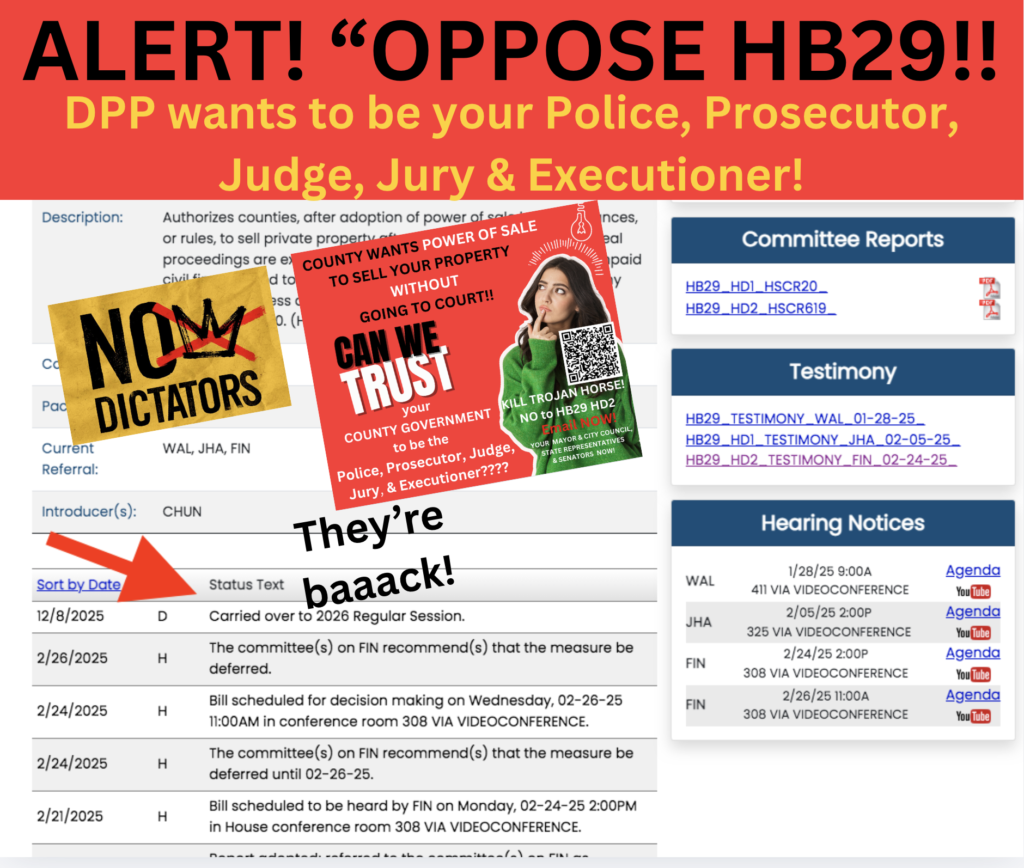
In other words, these bills will allow the counties to be the Police, Prosecutor, Jury, Judge, and Executioner. The Judicial Due Process will be cut off.

We’re asked who started these non-judicial foreclosure bills to forced sale of a private property, based on the Honolulu Department of Planning and Permitting (DPP) fines, without going to court.

Here are some quick answers:

It originated in 2022 as HB 1434 with Honolulu Mayor Rick Blangiardi. Keep it mind that this Power of Sale requests applied to ALL Counties in Hawaii. Based on my observations of him, it’s unlikely that this non-judicial Power of Sale idea originated from Blangiardi unless he’s hoping for a new stream of revenues from fines and sale of properties.

If I have to take a guess, it would be his Managing Director Mike Formby, formerly with the Pacific Resource Partnership (PRP) or former Department of Planning and Permitting (DPP) Director Dean Uchida.

Five (5) City Council members, known as the Gang of 5, also submitted testimony – Chair Tommy Waters, Esther Kia’iana, Brandon Elefante, Calvin Say, and Radiant Cordera.

What were the underlying motives?

Fortunately, Bill 1434 failed to pass last year.

I was in the same Mayoral campaign with Rick Blangiardi in 2020. Based on my observations and
his words, he had very shallow understanding about Honolulu City Hall workings.

This year 2023, Mayor Blangiardi is back with HB 106 and SB 216 by request to Senate President Ron Kouchi and House Speaker Scott Saiki.

However, presto! The tactics have changed a bit this year. There are five (5) clone bills with the same agenda speeding through.

Google Searches show no county mayors, state legislators or city council members appear to have warned Hawaii about this draconian assault on private properties.

Here are the rest of the three (3) bills.

SB875 is introduced by Senators Stanley Chang, Donovan Dela Cruz and Sharon Moriwaki. This bill is alive and has crossed over on March 7, 2023.

This time around, written testimonies come from only Honolulu City Council former Budget Chair Calvin Say and DPP Director Dawn Takeuchi Apuna.

Companion Bill HB498 is introduced by Representative Jackson Sayama.

HB 15 is introduced by Representative David Tarnas (D) It has no senate companion bill but it has crossed over on March 7, 2023.

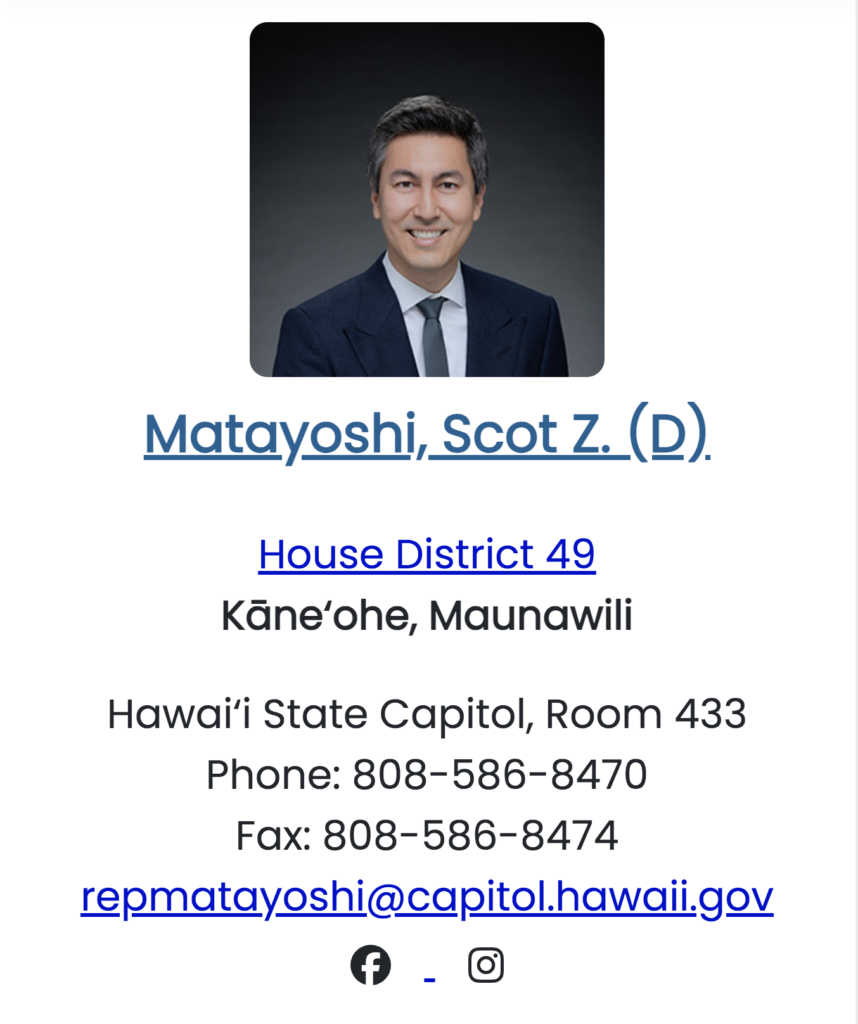
HB538 is another similar one that includes judicial or non-judicial foreclosure. It is introduced by MATAYOSHI, BELATTI, HASHIMOTO, HOLT, KILA, KITAGAWA, LAMOSAO, MARTEN, NISHIMOTO, TAKENOUCHI, TARNAS, Chun.

The time line provided in this bill is too unrealistic. It assumes that DPP is 100% efficient. In actual fact, it takes a very long time to get a permit. Some permits take a much longer time because it may need a shoreline certified shoreline. This could easily take six months to complete.

Bill 106 threatens private property owners

This is a reprint from the Star Advertiser published February 15, 2023. The limit for Star Advertiser was 600 words. For educational purposes, we’re adding more info through links and photos.

EDITORIAL | ISLAND VOICES

Column: Bill threatens private property owners

  • By Choon James and Natalie Iwasa
  • Today 
  • Updated 7:19 pm

As part of the 2022 county package to state legislators, Honolulu Mayor Rick Blangiardi requested “nonjudicial foreclosure” powers, i.e., the power to seize private property without going to court. Fortunately, House Bill 1434 did not pass last year.

This year’s package includes another request for “nonjudicial foreclosure,” aka “power of sale.” 2023 HB 106 BELOW represents an alarming threat to property owners and is prevalent in totalitarian regimes.

This year’s HB 106 offers weak assurance that “a county may, after all notices, orders, and appeal proceedings are exhausted, satisfy all unpaid civil fines through the power of sale on the real property subject to a recorded lien.”

Unfortunately, our years of civic participation at Honolulu Hale show that due process has not always been fair and equitable to ordinary residents.

Furthermore, recent federal indictments and guilty pleas continue to show the troubled Honolulu Department of Planning and Permitting (DPP) has no consistent record of fair play or efficient management. Written testimonies reveal alarming threats toward private property rights.

Dawn Takeuchi Apana, DPP director designate, stated: “Specifically, this bill would authorize the city to bring closure to pending civil fines imposed on landowners who are in violation of the city’s land use ordinances and building codes, through a nonjudicial or administrative process.”

Honolulu City Councilman Calvin Say also submitted testimony for a quicker seizure: “Our city corporation counsel is currently able to initiate a Judicial Foreclosure process, which has been successful in similar instances, however this is a long process that takes valuable resources away from other pressing legal matters.”

In other words, give us the authorization to hurry it up by bypassing the regular court method of foreclosure.

The House Committee on Judiciary & Hawaiian Affairs, whose members include Chairman David Tarnas and Vice Chair Gregg Takayama, approved HB 106 on Jan. 31. Its report states in part:

“Your committee finds that authorizing the counties to collect on liens filed on properties through a nonjudicial foreclosure process provides some leverage over property owners to comply or lose their property. If a property owner fails to comply and the property is foreclosed upon, this measure would enable the property to be put to productive use, allow liens attached to the property to be satisfied, and stop the accrual of additional debt or taxes on the property.”

Chairman David Tarnas and Vice Chair Gregg Takayama, approved HB 106 on Jan. 31. 2023

Hawaii’s state legislators should recognize that most ordinary residents sacrifice and work their tails off to achieve real property ownership. Each county’s goal should be to help property owners comply with the law and correct their violations, not summarily seize their properties.

HB 106 invites corruption and exposes residents, especially those who have fewer financial resources available to them, as easy casualties of this potential power of sale. All Hawaii counties would be affected.

It should be noted the U.S. Supreme Court ruled unanimously on Feb. 20, 2019 (Timbs vs Indiana), that the Constitution’s ban on excessive fines — civil asset forfeitures are a type of fine — applies to state and local governments, thus limiting their ability to use fines to raise revenue.

The late Justice Ruth Bader Ginsburg also astutely argued fines could be used to retaliate against political enemies and had been used as a source to raise revenue.

RBG was a tireless and resolute champion of justice.

Hawaii has a few egregious property owners, but this tyrannical bill is not the solution. We urge our legislators to vote “no” on HB 106.

###


AUTHORS: Natalie Iwasa is a CPA and certified fraud examiner; Choon James is a residential Realtor and farmer. They have spent combined decades of civic participation at Honolulu Hale as community advocates for good governance.

Bill 10: Council Chair Tommy Waters told public to pay more attention

At the end of the October 20, 2022 Planning and Zoning Committee, Chair Tommy Waters told the public to pay more attention saying that the Bill 10 was introduced on February 3, 2022.

OUCH!

Funny thing I was just thinking that even the single – vacation rental – issue took years to reach a conclusion.

With the vacation rental issue alone, after years of acrimony during the Caldwell Administration, the new Blangiardi overhauled Bill 89 and came up with a new Bill 41 aka Ordinance 22-7. Presently, there is a District Court Preliminary Injunction Order on October 3, 2022.

Why would the public be so alarmed with Bill 10 at this stage?

Could it possibly be that the City Council members did not provide sufficient disclosure, education and outreach on this very sweeping and significant Bill that overhauls Oahu’s land use ordinance?

Seriously, how many city council members have read through the entire 239 pages approved and submitted to them by the Honolulu Planning Commission?

After the Second Reading of Bill 10 on September 26, 2022, two city council members felt the need to host informational town hall meetings for this Bill.

District 1 Andria Tupola hosted an hour Zoom meeting on October 19, 2022. It could have gone on for another two hours to work out amendments in the Ramseyer format.

District 3 Esther Kia’aina said she would host a town hall meeting on November 10. But it would be only on the Agricultural section.

If we watch the Bill 10 proceedings video here, we will note that ONLY amendments that were submitted by ONLY the City Council members were accepted or not accepted by the Council Planning Chair. Other various suggestions and concerns by the public appear to be lost in the pile of oral and written testimonies.

Inevitably, there is a whole lot of reading. Contrary to what the Chair may say, there are a lot of substantial changes to the Land Use Ordinances (LUO). It’s not just an update.

Add to this commotion is the public mistrust that this omnibus Bill is so huge that there may be changes slipped into the documents. The contents are also complicated and technical. This is not a bill to ban fireworks. This is a bill on how the city will control and regulate the lifestyle and communities of Oahu. The public is wary that does not have the time or resources to comb through it line by line.

Here is the reading list.

Approved Versions

Proposed Drafts

Related Communications

  •  CC-230(22) – ELEFANTE – Bill 10 (2022) Relating to Use Regulations.
  •  CC-237(22) – TUPOLA – Proposed Amendments to Bill 10 (2022), CD1.
  •  CC-241(22) – WATERS – Proposed amendments to Bill 10 (2022), CD1.
  •  CC-249(22) – ELEFANTE – Proposed additional amendments to Bill 10 (2022).
  •  CC-250(22) – ELEFANTE – Disclosure of Interest Statement for Bill 10 (2022). FILE
  •  CC-268(22) – ELEFANTE – Bill 10 CD1 (2022), Relating to Use Regulations.
  •  CC-273(22) – TUPOLA – Proposed amendments to Bill 10 (2022), CD1.
  •  CC-274(22) – KIAʻĀINA – Bill 10 CD2 (2022), Relating to Use Regulations.
  •  CC-275(22) – WATERS – Proposed Amendments to Bill 10 (2022), CD1.
  •  CC-276(22) – CORDERO – Proposed Amendments to Bill 10 (2022), CD1.
  •  CC-280(22) – TSUNEYOSHI – Proposed amendments to Bill 10 (2022), CD1.
  •  CC-281(22) – WATERS – Proposed Amendments to Bill 10 (2022), CD1.
  •  CC-286(22) – ELEFANTE – Proposed Amendments to Bill 10 (2022), CD1.
  •  CC-295(22) – SAY – Proposed Amendments to Bill 10 (2022), CD1.
  •  CC-296(22) – ELEFANTE – Proposed additional amendments to Bill 10, CD1 (2022).
  •  CC-297(22) – ELEFANTE – Disclosure of Interest Statement on Bill 10 (22), CD1. File
  •  CC-298(22) – ELEFANTE – Disclosure of Interest Statement on Bill 10 (22), CD1. File
  •  CC-305(22) – ELEFANTE – Bill 10 CD2 (2022), Relating to Use Regulations.
  •  CC-309(22) – WATERS – Proposed Amendments to Bill 10 (2022), CD2.
  •  CC-310(22) – TUPOLA – Proposed amendments to Bill 10 (2022), CD2.
  •  CC-311(22) – ELEFANTE – Proposed Additional Amendments to BILL 10, CD1 (2022).
  •  CC-313(22) – WATERS – Proposed Amendments to Bill 10 (2022), CD2
  •  CC-314(22) – ELEFANTE – Disclosure of Interest Statement for Bill 10 (22), CD1. FILE
  •  CC-315(22) – ELEFANTE – Disclosure of Interest Statement for Bill 10 (22), CD1. FILE
  •  CC-316(22) – ELEFANTE – Zoning and Planning Chair’s Recommendations on Proposed Additional Amendments to BILL 10, CD2 (2022).
  •  CC-319(22) – TUPOLA – United States Court of Appeals Opinion 47.
  •  CC-320(22) – ELEFANTE – Disclosure of Interest Statement for Bill 10 (2022). FILE
  •  CC-321(22) – ELEFANTE – Disclosure of Interest Statement for Bill 10 (2022). FILE
  •  D-0074(22) – PLANNING COMMISSION – Draft Bill to Request Amendments to Chapter 21, Revised Ordinances of Honolulu (ROH), 1990 Land Use Ordinance (LUO), Relating to Use Regulations.
  •  D-0127(22) – PLANNING AND PERMITTING – Request for Extension of Time for Processing Bill 10 (2022) Relating to Use Regulations.
  •  D-0130(22) – PLANNING AND PERMITTING – Testimony in Support of Bill 10 (2022) Relating to Use Regulations.
  •  D-0269(22) – PLANNING AND PERMITTING – Additional summary information for Bill 10 (2022).
  •  D-0273(22) – Presentation on Bill 10 (2022) for 04/21/22 Zoning and Planning meeting.
  •  D-0532(22) – KAILUA NEIGHBORHOOD BOARD NO. 31 – Recommendations Pertaining to the Proposed Land Use Ordinance (LUO) Chapter 21 Changes Proposed by Bill 10 (2022) for the July 14, 2022 @ 09:00 AM ZONING AND PLANNING Meeting..
  •  D-0576(22) – PLANNING AND PERMITTING – Departmental Response to Proposed Amendments in Bill 10, CD1 (2022) Relating to Use Regulations Chapter 21, Revised Ordinances of Honolulu Land Use Ordinance (LUO).
  •  D-0583(22) – PLANNING AND PERMITTING – Departmental Response to Councilmember Questions Bill 10, CD1 (2022) Relating to Use Regulations In the B-1 and B-2 Business Districts, Chapter 21, Revised Ordinances of Honolulu – Land Use Ordinance (LUO)
  •  D-0622(22) – PLANNING AND PERMITTING – Presentation on briefing item #10 for the August 25, 2022 @ 09:00 AM Zoning And Planning meeting.
  •  D-0658(22) – PLANNING AND PERMITTING – Request for Second Extension of Time for Processing Bill 10 (2022) Relating to Use Regulations.
  •  D-0699(22) – PLANNING AND PERMITTING – Response to questions from the Committee on Zoning and Planning Special Meeting on September 26, 2022.
  •  MM-162(22) – CLIMATE CHANGE, SUSTAINABILITY AND RESILIENCY – Bill 10 (2022), CD1 Relating to Use Regulations.
  •  M-0058(22) Testimony on BILL010(22) for Feb 23, 2022 @ 10:00 AM Council Meeting.
  •  M-0069(22) Testimony on BILL010(22) for March 3, 2022 @ 09:00 AM Zoning and Planning Meeting.
  •  M-0156(22) Testimony on BILL010(22) for Apr 21, 2022 @ 09:00 AM ZONING AND PLANNING Meeting.
  •  M-0280(22) Testimony on BILL010(22) for Jul 14, 2022 @ 09:00 AM ZONING AND PLANNING Meeting.
  •  M-0286(22) Testimony on BILL010(22) for Jul 14, 2022 @ 09:00 AM ZONING AND PLANNING Meeting.
  •  M-0324(22)  Testimony on BILL010(22) for Aug 25, 2022 @ 09:00 AM ZONING AND PLANNING Meeting.
  •  M-0339(22) – HAWAII STATE ENERGY OFFICE – Testimony on BILL010(22) for August 25, 2022@ 09:00 AM Zoning and Planning Meeting.
  •  M-0346(22) Testimony on BILL010(22) for August 25, 2022@ 09:00 AM Zoning and Planning Meeting.
  •  M-0351(22) Testimony on Bill 10 (2022) for 08/25/22 @ 9:00 AM Zoning and Planning meeting.
  •  M-0370(22) Testimony on BILL010(22) for September 7, 2022 @ 10:00 AM Council Meeting.
  •  M-0373(22) Testimony on BILL010(22) for September 7, 2022 @ 10:00 AM COUNCIL Meeting.
  •  M-0387(22) Testimony on Bill 10 (2022), CD1 for September 26, 2022 @ 9:00 AM Zoning and Planning Special Meeting
  •  M-0411(22) Testimony on Bill 10 (2022), CD1 for September 26, 2022 @ 9:00 AM Zoning and Planning Special Meeting.
  •  M-0417(22) Testimony on BILL010(22) for Sep 26, 2022 @ 09:00 AM ZONING AND PLANNING Meeting.
  •  M-0450(22) Testimony on BILL010(22) for Oct 20, 2022 @ 09:00 AM ZONING AND PLANNING Meeting.
  •  M-0460(22) Testimony on BILL010(22) for Oct 20, 2022 @ 09:00 AM ZONING AND PLANNING Meeting.

Honolulu City Ordinance 22-7 Vacation Rental Rules faces Preliminary Injunction from US District Court

It has been nearly six months since Mayor Rick Blangiardi signed Bill 41 that was adopted by the Honolulu City Council on April 13, 2022.

The Blangiardi Administration is supposed to lay out the new Rules and Regulations from Bill 41, now known as Ordinance 22-7, on October 23, 2022.

This October 13, 2022 Preliminary Injunction, triggered by Hawaii Short-Term Legal Rentals Alliance (HSTLA) lawsuit in April 2022, forces the city to reconsider its core premises.

At the core of the lawsuit is the 30-day being lengthened to 89-day by the city to control illegal vacation rentals. Note, on the other hand, it’s a known fact that many vacation rental operators were using the 30-day “facade”. Operators were renting to different parties within the 30-day frame. An average vacation rental stay is around 8 days.

There are lots of questions and conversations to be had on this. The first three sentences of US District Judge’s Preliminary Injunction below say it all.

Residential property owners on O‘ahu have long been able to lawfully rent
their properties to tenants for a minimum of 30 days. That much is undisputed.

But what about operators who rent to multiple parties during that 30-day duration.You can read the entire Order here.

Despite this Preliminary Injunction, there are still other rules in this new Ordinance 22-7 that the city can enforce. Residents can report violations here.

Singapore is World’s #1 for best roads

Read the excerpt below and my personal story while in Singapore.

” By now, it should not come as a surprise that Singapore typically crushes the competition in many world rankings.

And so it did, in a recent list of best roads around the world, where Singapore came in — you guessed it — first.

Iscored 9.44 over 10 points in terms of its road quality in a global study by Zutobi, which also took into account the number of road deaths and the relative size of the road network.”

I was visiting Singapore for about a month. My father’s grave was being reinterred from the Choa Chu Kang Cemetery that was supposedly for the expansion of the Tengah Airbase.

I had left Singapore in 1975 and felt like I needed to show support to my family who had always taken care of family affairs.

During the entire month that I was in Singapore, I travelled all over the island. We travelled on roads, highways, alley ways, and side streets.

There was not a single pothole encountered during my stay in Singapore.

We finally landed home in Oahu. As the airplane was taxi-ing to the terminal at the Honolulu International airport, the announcement came from the pilot came on:

Ladies and Gentlemen, we apologize. There will be a 2-minute delay as there is a pot-hole in front of us. The plane is being towed to the terminal.”

My husband and I looked at each other and laughed upon hearing that announcement.

Welcome back to Hawaii!

Land of the potholes, even on the airport grounds.

Elections 2022: Honolulu City Charter Amendments

Here they are. What do you think? What are the multiplier impacts of these changes? Will it improve the issue? Who will it benefit? Is it needed? How much would it cost?

Charter Question #1. Shall the Revised City Charter be amended to increase the mandatory percentage of the City’s estimated real property tax revenues to be appropriated annually for deposit into the Affordable Housing Fund from one-half of one percent to one percent?

Charter Question #2. Shall the Revised City Charter be amended to require that the Planning Commission have at least one member with substantial experience or expertise in one of the following categories of disciplines, that each of the categories be represented by a different member, and that all of the categories are represented on the commission:

Charter Question #3. Shall the Revised City Charter be amended to expand the permitted use of funds in the Clean Water and Natural Lands Fund to include funding for costs related to the operation, maintenance, and management of lands acquired by way of this Fund that are necessary to protect, maintain, or restore resources at risk on these lands, such as infrastructure, environmental remediation, or improvements to provide for public access and use?

Charter Question #4. Shall the Revised City Charter be amended to update the provisions pertaining to the Office of Council Services (“OCS”), the research and drafting arm of the Council, to reflect its current functions; consolidate various provisions relating to the OCS in a separate Chapter of the Revised Charter like its fellow Legislative Branch agencies, the Office of the City Clerk and Office of the City Auditor, provide for the appointment, salary, and duties of the OCS director; and expressly recognize the authority of the licensed attorneys in the OCS to provide legal advice to the City Council and its members?

The full text of these amendments are available for review. Visit honoluluelections.us.