Knowledge is Power

Repost: This is a good reminder that we can all learn to obtain knowledge and continue to learn. There is no age limit.

Nearly 700 people were injured and 214 missing due to the Indian Ocean earthquake that trigger the tsunami in 2004 in Phuket, Thailand.

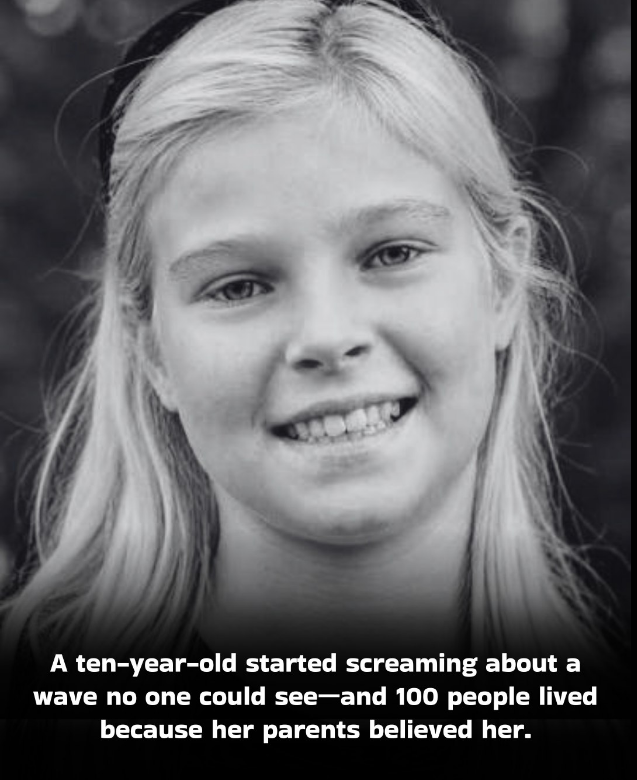
A ten-year-old started screaming about a wave no one could see—and 100 people lived because her parents believed her.

December 26, 2004. Mai Khao Beach, Phuket, Thailand. Christmas holiday. Perfect weather. The Smith family walked along the sand on their first overseas vacation together.

Then Tilly noticed something wrong.

The water wasn’t behaving normally. “It wasn’t calm and it wasn’t going in and then out,” she later recalled. “It was just coming in and in and in.”

The sea had turned frothy—”like you get on a beer,” she said. “It was sort of sizzling.”

Any other ten-year-old might have thought it strange. Tilly knew exactly what it meant.

Two weeks earlier, her geography teacher Andrew Kearney had shown the class footage of the 1946 tsunami that devastated Hawaii. He taught them the warning signs: sea receding unusually far, frothy bubbling water, ocean behaving strangely.

Tilly was watching those exact warning signs unfold in front of her.

She started screaming at her parents. “There’s going to be a tsunami!”

They didn’t believe her. They couldn’t see any wave. The sky was clear. The beach was calm.

But Tilly wouldn’t stop. She became more insistent, more frantic.

“I’m going,” she finally said. “I’m definitely going. There is definitely going to be a tsunami.”

Her father Colin heard the urgency in her voice. He decided to trust his daughter.

By coincidence, a Japanese man nearby overheard Tilly use the word “tsunami.” He’d just heard news of an earthquake in Sumatra. “I think your daughter’s right,” he said.

Colin alerted hotel staff. They began evacuating immediately.

Tilly’s mother Penny was one of the last to leave. She had to sprint as the water began rushing in behind her. “I ran,” she recalled, “and then I thought I was going to die.”

They made it to the second floor with seconds to spare.

Then the wave hit. Thirty feet tall.

Everything on the beach—beds, palm trees, debris—was swept into the pool and beyond. “Even if you hadn’t drowned,” Penny later said, “you would have been hit by something.”

The 2004 Indian Ocean tsunami killed over 230,000 people across 14 countries. Entire beaches in Phuket were wiped out.

But at Mai Khao Beach, not a single person died.

Because a ten-year-old girl paid attention in geography class.

Tilly was hailed as the “Angel of the Beach.” She received awards, spoke at the United Nations, met Bill Clinton. Her story is now taught in schools worldwide.

Her father Colin still thinks about what could have happened. “If she hadn’t told us, we would have just kept on walking,” he said. “I’m convinced we would have died.”

Tilly still credits her teacher. “If it wasn’t for Mr. Kearney,” she told the UN, “I’d probably be dead and so would my family.”

Two weeks. One lesson. One hundred lives.

That’s the power of education.

NOTE: AI – In the 2004 Indian Ocean tsunami, approximately 250 to 279 people died in Phuket. While Phuket saw significant localized devastation, the neighboring mainland province of Phang Nga (particularly the tourist area of Khao Lak) was much harder hit, suffering over 4,000 fatalities.

Don’t mess with the US Constitution

Reprint: Hawaii State Legislature 2022

Choon James

onSeptdorst0brc 1317a6i2708ue40237y2686ra4u58f7fga1F2a54,2l  ·

Shared with Public

Public

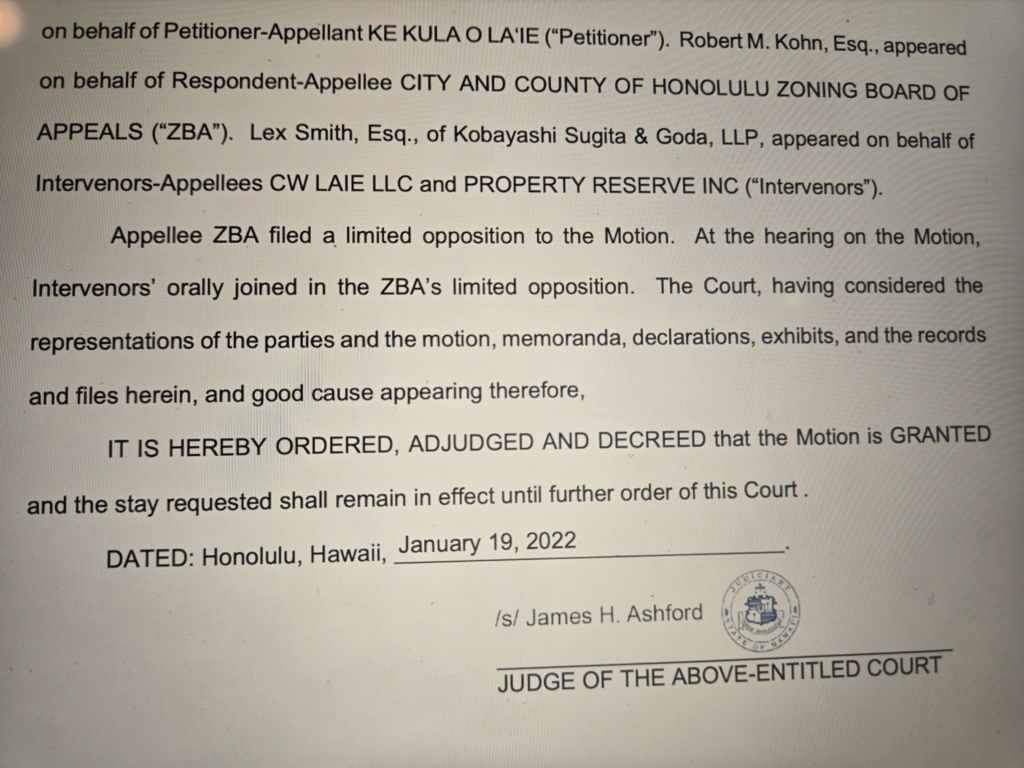
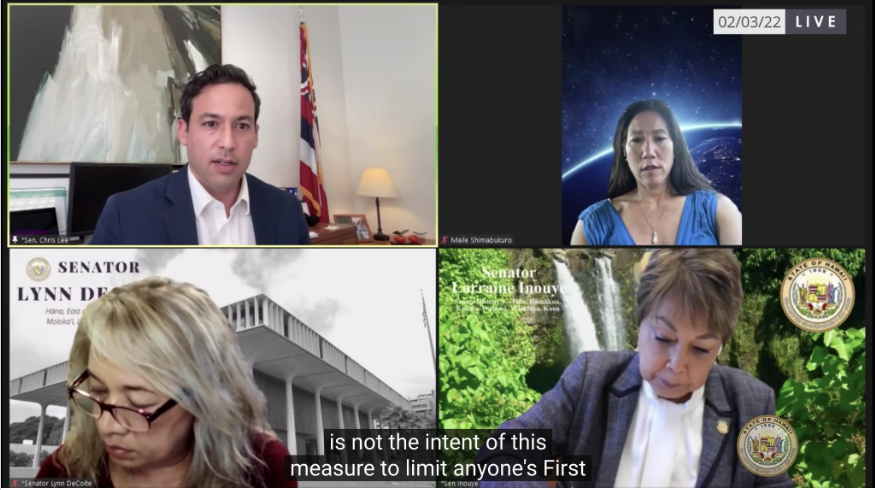
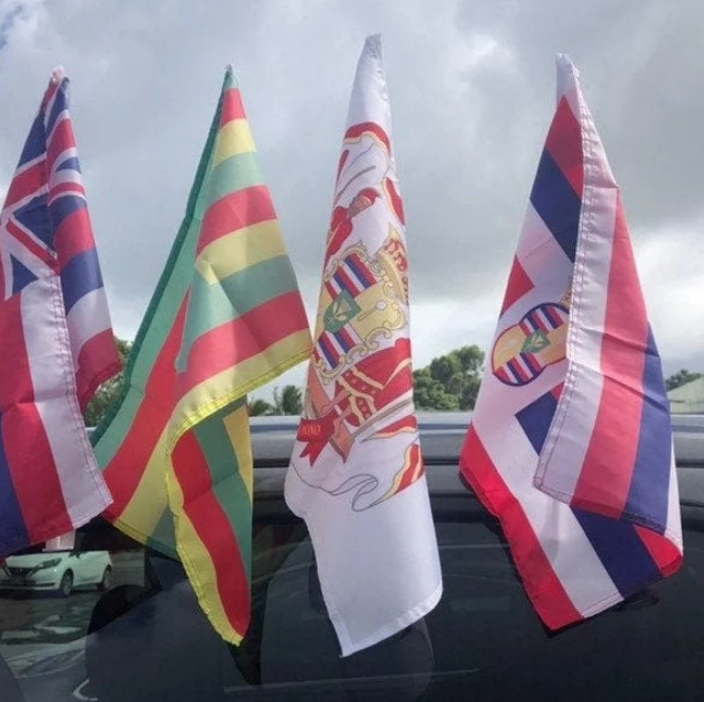
DEFERRED to Tuesday 2-8 3:05PM AGENDA. SB 1357 to prohibit flags display on vehicles on roads, etc. SCROLL TO 1:30 for status: https://www.youtube.com/watch?v=Y_Puas70MFA

We can’t have government shutting down Free Speech.

SECTION 1. The legislature finds that flags flown from vehicles being operated or moved on streets cause distractions and create unsafe driving conditions. The purpose of this Act is to discourage unsafe practices.

—————————————————————-

We must protect Free Speech at all costs.

There are lots of distractions and unsafe driving conditions on the road – Loose dogs. Drunk driving. Driving in opposite directions. Tourist trolleys. Huge vehicles blocking our view planes. Sign Waving. Display of huge banners on buildings along roads.

The item that is most distracting is the POTHOLES!!

We’re forced to keep our eyes down on the road to avoid the potholes which are EVERYWHERE. Our tires blow out. Cars try to miss the potholes on busy streets. The underbelly of the vehicles are damaged.

POTHOLES are the most dangerous and most distracting.

Hundreds of millions of dollars are spent but our roads have become more and more dangerous. We would like the Hawaii Senate to focus on this huge distraction …. require a warranty on the road roadwork and so on to promote road safety. It’s ridiculous that every time it rains, more potholes appear. There is no reason why the state cannot expect basic workmanship for the hundreds of millions that are spent annually.

Please terminate SB 1357 – It’s treacherous to free speech and an open democracy.

#2022 #HawaiiStateCapitol #FreeSpeech #FirstAmendment

Ah Quon McElrath – The International Longshore and Warehouse Union (ILWU) Activist.

“AQ” was not a personal friend. I wish she was. But someone told me a funny story about her. I remember her roaming the State Capitol in her senior years the few times I was there. The Honolulu Hale is my familiar space, not the State Capitol. That person said she would roam the halls of the Hawaii State Capitol. She was fearless. It came to a point where politicians would see her coming and evade her.

She was known to tell a politician in her or his face and asked, “What’s wrong with you?”.

We need more Ah Quons!

The following excerpt is copied for educational purposes:

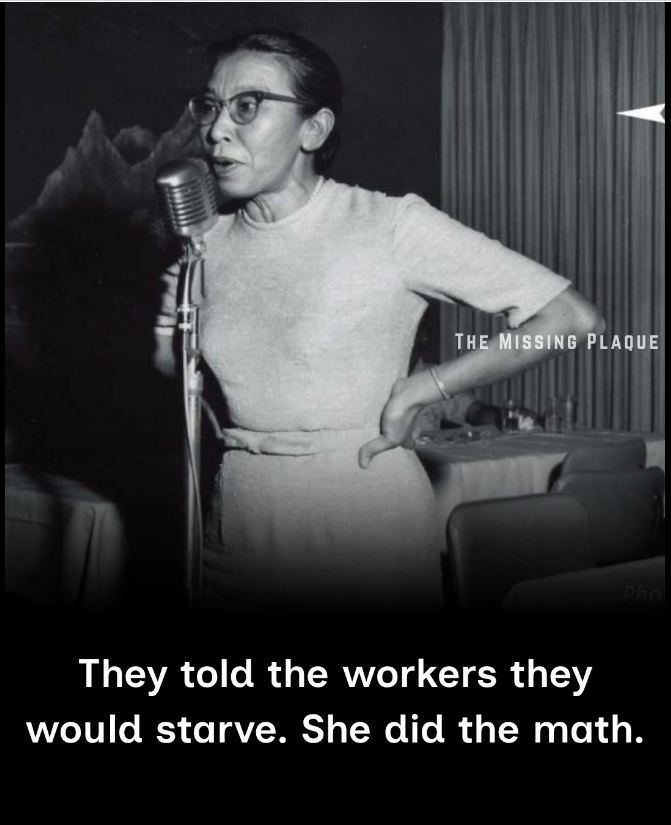
The Missing Plaque

ornSpdstoeu2g32tPg2tg3my1 a1i  3f12a2 1:62g00tlltaMM1c88mmgu ·

In 1946, Hawaiian sugar plantation workers made 24 cents an hour. The five corporations that owned the islands also owned the houses, the hospitals, the water lines, and the grocery stores. They were known simply as the Big Five. If a worker complained about the heat, the twelve-hour shifts, or the cane dust coating their lungs, they were evicted. If they struck, they starved.

Ah Quon McElrath knew exactly how the math of poverty worked. She was born directly into it. The daughter of Chinese immigrants, she grew up in the shadow of the Iwilei canneries and the massive sugar estates. Her father died when she was just a child. She watched her mother take in laundry, washing heavy work clothes by hand over a wooden board to keep the family from eviction. The territory in the decades before statehood was not the tourist paradise advertised in mainland magazines. It was an industrial fiefdom.

Five massive sugar agencies. Castle & Cooke. Alexander & Baldwin. C. Brewer. American Factors. Theo H. Davies. They controlled ninety percent of the economy. They dictated the price of land. They owned the shipping routes. They wrote the laws in the territorial legislature. They set the daily wages of the men who swung the machetes in the fields.

Ah Quon had managed to secure a university degree in sociology, but she remained rooted in the world of the laborers. She walked with a slight physical limp from a severe childhood burn, moving deliberately through the dirt roads of the camps, carrying notebooks filled with grocery prices, medical costs, and the true cost of living.

On September 1, 1946, the plantations went completely silent. The International Longshore and Warehouse Union (ILWU) called a territory-wide strike. Seventy-nine thousand workers and their dependents walked out of the fields. The cane stopped moving to the mills. The harvesting machines sat idle in the sun.

The Big Five responded exactly as expected. They locked the heavy wooden doors to the company-owned plantation stores. They cut off all lines of credit for rice and flour. They drafted eviction notices for the company-owned shacks. The plantation managers assumed the workers would return in a matter of days. A man might risk his own job, the corporate logic went, but he would not let his children go hungry. The isolation of the islands meant no outside help could arrive by train or truck. The workers were geographically trapped.

Records show the Big Five deliberately imported laborers from different countries over the decades—Japan, the Philippines, Portugal, Korea, China. The companies housed them in strictly segregated camps and paid them different wages based entirely on their ethnicity. At the time, the prevailing corporate strategy documented in management ledgers assumed that groups who could not speak the same language, worship in the same way, or eat the same food could never organize a unified strike. The division was not accidental. It was a highly calibrated structural mechanism of control.

The system the companies relied on was known formally as the perquisite system. Under this arrangement, housing, medical care, and fuel were not purchased by the workers with their own money. They were provided directly by the plantation as part of their compensation. It looked like benevolence on paper. In practice, it meant the company held absolute authority over a family’s daily survival.

When the strike began, the companies immediately weaponized the perquisites. Plantation doctors were instructed to turn away striking families. Water lines to the camps were threatened with shutoffs. The message was delivered without emotion or fanfare: the company owned the infrastructure of life, and the company was shutting it down.

During the second week of the strike, the eviction warnings appeared. Small, typed pieces of paper pinned to the wooden doors of the camp houses. The workers had no savings to rent apartments in Honolulu. They had no vehicles to leave the rural estates. There was literally nowhere else to go.

Ah Quon McElrath did not speak five languages. She spoke arithmetic. The ILWU named her its first social worker. Her job was not to stand on a soapbox and deliver speeches about the dignity of labor. Her job was to keep 79,000 people alive long enough to break the monopoly.

She started with rice. She calculated exactly how many calories a human body needed to survive without working in the fields. She organized massive hunting and fishing committees, sending men into the mountains for wild pigs and to the ocean for daily catch. She bypassed the company stores entirely, negotiating directly with independent farmers for vegetables that the Big Five did not control. One of the independent farmers who sold them cabbage asked to remain anonymous on the receipts. He still lost his land lease two years later.

When the plantation doctors locked their doors, she set up parallel dispensaries. She recruited sympathetic physicians from the city and gathered donated medical supplies. It was not glamorous work. She kept the union’s emergency medical fund in a battered cardboard box under her bed because she did not trust the local banks. The banks, like the shipping lines and the stores, belonged to the sugar companies.

Every morning, she updated her ledgers. She tracked which families had infants needing milk, which camps had pregnant women requiring care, and which locations were running low on staple grains. The strike stretched into October. Then November. The companies waited for the hunger to fracture the picket lines along the old ethnic boundaries. The hunger never came. The massive soup kitchens ran on her schedules, feeding Japanese, Filipino, Chinese, and Portuguese workers from the very same pots.

The companies divided them by language. She organized them by arithmetic.

On November 18, after 79 days of total paralysis, the Big Five broke. The strike ended. The workers secured a 19-cent-per-hour raise, a guaranteed 48-hour work week, and an absolute end to the perquisite system. The companies were forced to convert housing and medical care into cash wages. The mechanism of control was permanently dismantled.

Ah Quon McElrath spent the next fifty years auditing pension plans, enforcing safety regulations, and negotiating healthcare benefits for the laborers. She never sought fame. She kept her office in the union hall, surrounded by filing cabinets.

The sugar plantations are mostly gone now. The vast fields where the laborers walked out have been paved over for luxury resorts, residential subdivisions, and golf courses. The company stores are closed. The ledgers she filled with the exact price of rice and milk in the autumn of 1946 are boxed away in the University of Hawaii archives. The numbers on the pages are still perfectly legible.

Ah Quon McElrath: the woman who outcalculated an empire.

Source: Center for Labor Education and Research, University of Hawaii.

Verified via: The ILWU Archives, Densho Digital Repository.

(Some details summarized for brevity.)

Hamajang HB1990 – Chronology of a Dictator’s Bill to fine $1000 minimum per day for ANY violations of County Ordinance, Rule, and Regulation. $20,000 fine TOTAL will face foreclosure!

Why? Why does the public not know about this?

AYES (WR) With Reservations is still a “YES” vote.

Hamajang HB1990 (2026) – Chronology of a Dictator’s Bill to fine $1000 minimum per day for ANY violations of County Ordinance, Rule, and Regulation. $20,000 fine TOTAL will face foreclosure!

HOUSE REPORT FROM THE Judiciary & Hawaiian Affairs Committee:

All these Bills have the same agenda = HB1990, HB1861, HB811, HB106, HB29 for the last five years.

Hamajang HB1990 – Chronology of a Dictator’s Bill to fine $1000 minimum per day for ANY violations of County Ordinance, Rule, and Regulation. $20,000 fine TOTAL will face foreclosure!

SENATE JUDICIARY and WAYS & MEANS COMMITTEES’ VOTING RECORD.

This was a very secretive Bill. While Hawaii was trying to handle the Kona Low flooding and storms, this Bill was sailing through without public knowledge until at the end.

Hawaii was protesting “NO KING” “NO TYRANT” “NO DICTATOR” OUTSIDE the State Capitol while legislators INSIDE the Capitol were passing these tyrannical bills.

Typically, an ordinary person does not have the time to participate. Most people who are at these sessions are lobbyists, bureaucrats, interest groups, and corporations. The procedures are also foreign to most citizens.

Hawaii SENATE Judiciary Committee and Ways and Mean Committee Report to the Senate President.

What is the intent of these quickie tyrannical Power of Sale and Foreclosure Sale?

Hawaii: Bipolar legislation in 2026

While there are vigorous protests of “NO KING”, “NO DICTATOR” “NO TYRANNY” outside the Hawaii State Capitol, tyrannical laws are being pushed through inside the Capitol

Mahalo again for giving voice AGAINST HB1990.

Keep calling the senators to Kill HB1990! They should hear from you.

The last I look, HB1990 is still recommitted to the Judicial and Ways and Means. No movement or no new amendments to it. I hope there is no Gut & Replace actions.

It’s never a good idea to give the government more overarching, overreaching and tyrannical powers to fine you $1,000 per day minimum. And when it reaches to $20,000, you can be slammed with a foreclosure. This is Tyranny.

The Bill language  is very vague – ANY – ANY violations of county ordinances, rules, and regulations. Every owner becomes a sitting duck to the whim of the long arm of the government.    

Chronology of tyranny:

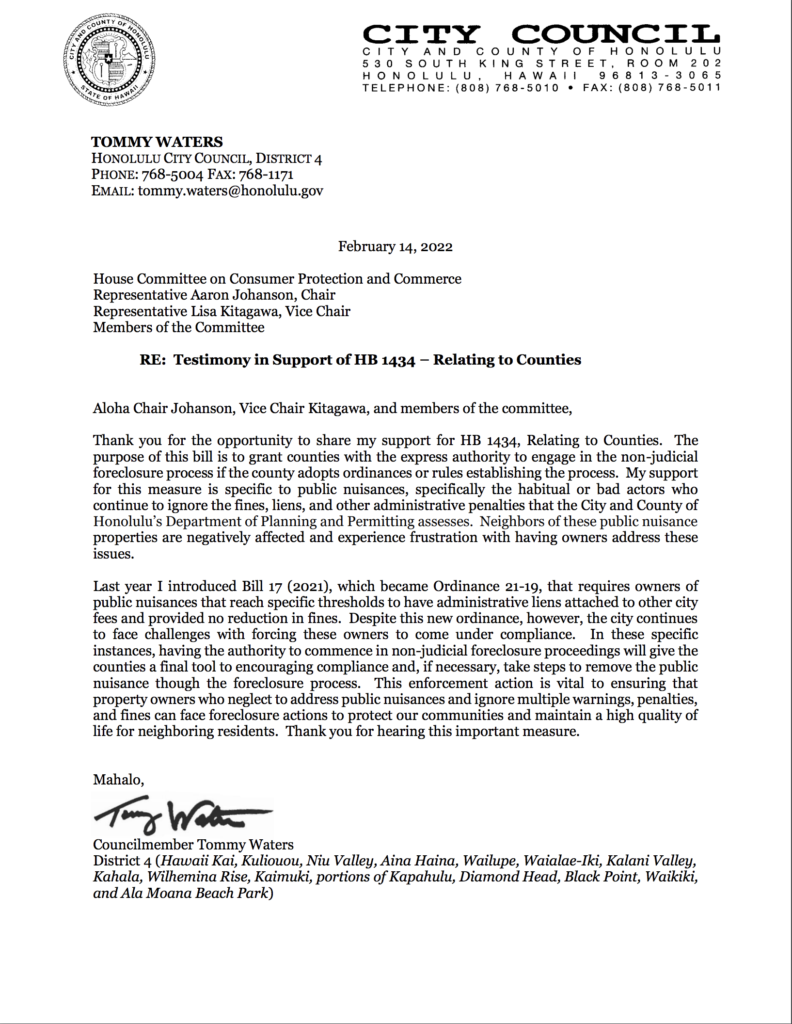
This Power of Sale based on county fines first began as an annual Legislative Package to the State Legislature in 2021. All neighbor Mayors were part of this package.  This covered ALL COUNTIES.

2021 – 2024  Mayor Rick Blangiardi persisted. We saw HB106 and many similar Bills with the same Agenda. But fortunately, these bills never got passed.

In 2025, the Honolulu Mayor distanced himself. HouseRepresentative Corey Chun from Waipahu introduced HB29. Fortunately, it was DEFERED By the Finance Committee.  

2025 also saw   Bill 811 introduced by Scot Matayoshi, Corey Chun, MichaelLee . Lisa Marten, Sean Quinlan, Greg Takayama. This is a bill on steriods. Foreclosure begins when your fines reaches $5,000! It will only take 5 days when the bill wants to fine you $1,000 per day minimum. What are these politicians thinking? This Bill did not gain traction.

Introducer(s):MATAYOSHI, CHUN, LEE, M., MARTEN, QUINLAN, TAKAYAMA This one imposes only $5,000 instead of $20,000 for a foreclosure slam! It did not gain traction.

2026  These Power of Sale Bills only needed 2 House Committees  to pass the House. Finance Committee was bypassed.   HB1861 was introduced by Quinland, Matayoshi, Marten, and Olds did not cross over this year.

Simultanteously,  another Bill1990 which we did not know about till recently, quietly progressed to where we are today  

Introducer(s):MATAYOSHI, GRANDINETTI, KILA, KUSCH, LEE, M., MARTEN, MORIKAWA, OLDS, TAKAYAMA, TAM, TARNAS, TEMPLO, TODD, WOODSON

Demoracy is at stake. We cannot be protesting NO KINGS – NO TYRANTS and then impose tyranny upon Hawaii’s residents with these secretive Bills to oppress. 

Hawaii HB1990 Hamajang Bill sailing ahead amidst over 3,000 bills this legislative session!

Kill HB 1990! This is a knee-jerk vindictive Bill that will create more problems to ordinary citizens.

My quick note to the Senators and Representatives, again.

Aloha!

You have over 3,000 bills this legislature session?  About 20%, including this punitive and half-baked bill, have made the cross-over.

Have you gotten the chance personally to read through this Bill that has passed quickly this session?

I cannot imagine that you would  expose your own communities and constituents as sitting ducks
to this far-reaching and tyrannical Bill HB1990. 

Your constituents will become easy targets of complaints because most residential dwellings have violations neighbors or the government can complain about. You must be aware that counties also have systemic problems. It’s well-known knowledge. A lot of the rationale provided for this ill-thought HB1990 are off-tangent, illogical, and counter-productive that will create more problems for Hawaii. There is a latest new amendment to HB1990.

ONE EXAMPLE:

Description:

Establishes penalties, including fines and liens, for an owner of residential real property’s failure to remediate zoning violations.  

Requires, under certain conditions, county planning or permitting agencies to record the notice of violation as a lien on 

the property with the Bureau of Conveyances.  Requires referral to the applicable county corporation counsel for foreclosure, subject to certain conditions, if the owner fails to satisfy certain conditions.  Requires the applicable district or circuit court to hold a de novo review of penalties assessed for unaddressed residential real property zoning violations, including foreclosure, upon appeal by the affected residential real property owner.  Effective 7/1/3000.  (SD2)

Who will this new amendment disenfranchise? Local owners with no means to afford expensive legal fees.

Note also that the Honolulu County who first initiated this Power of Sale in 2021, based on new County fines had this reason for asking for more new powers:(HB 1990 aka HB1861 aka HB29 aka . . .) The amendment will only create more ” legal manpower and funding” that the county claims it does not have.

The City has lacked the legal manpower and funding to pursue foreclosure . . .”

Did you read any of the testimonies? The most articulate written testimony is from LURF who has institutional knowledge of Hawaii’s land use issues. It’s cogent, reasonable and pono with a little aloha for the people of Hawaii.

Hawaii Legislative Fines and Knee-jerk Quickie Foreclosures

Some legislators are quietly robbing basic constitutional civil rights of their private property owners constituents!

We were informed a couple days ago that HB1990 is sailing through! This is an abusive and greedy bill – – A notice of violation of ANY county zoning ordinance, rule or regulation shall be fined . . . $1000 per day subject to a lien if the fines exceed $20,000 and subject to foreclosure within 30 days of notice.

The Bill affects ALL Counties.

Who in Oahu alone can get a quick response from the County within 30 days! There are 30 days in a month, so $20,000 is easy number to become ripe for foreclosure!

What can you do?

Email the Senators. Tell them to “KILL HB1990” and other opinions you may have. Cut and paste on your email addresses.

sens@capitol.hawaii.gov,
 senihara@capitol.hawaii.gov,
senelefante@capitol.hawaii.gov,
senChang@capitol.hawaii.gov,
senkouchi@capitol.hawaii.gov,
sendelacruz@capitol.hawaii.gov,
senrichards@capitol.hawaii.gov,
senmisalucha@capitol.hawaii.gov,
sennishihara@capitol.hawaii.gov,
sendecoite@capitol.hawaii.gov,
sensshimabukuro@capitol.hawaii.gov,
senfevella@capitol.hawaii.gov,
senmoriwaki@capitol.hawaii.gov,
sengabbard@capitol.hawaii.gov,
senwakai@capitol.hawaii.gov,
senawa@capitol.hawaii.gov,
senfukunaga@capitol.hawaii.gov,
senhashimoto@capitol.hawaii.gov,
senkeohokalole@capitol.hawaii.gov,
senkidani@capitol.hawaii.gov,
senkim@capitol.hawaii.gov,
senlamosao@capitol.hawaii.gov,
senmckelvey@capitol.hawaii.gov,
senrhoads@capitol.hawaii.gov,
sensanbuenaventura@capitol.hawaii.gov,
senlee@capitol.hawaii.gov,
senkanuha@capitol.hawaii.gov,

A DEEPER DIVE:

The person who just informed us of HB1900 (2026) also shared HB811(2025).

HB811( 2025) too is very alarming and jarring. Who in their right mind think that fines of $5,000 should trigger a foreclosure within 30 days! Who knows how tedious and long it is to work with a county bureaucracy to get a permit for anything?

It’s common knowledge that any one or group can ask a Hawaii Legislator to draft a bill and sponsor it. This is a good democratic exercise for public participation.

However, there should be a litmus test to ensure that basic constitutional civil rights are not violated or infringed upon. Any proposed Bill ought to be for the public good and for the benefit for all Hawaii.

A proposed Bill can’t be appeasing one person or group to the detriment of the rest of Hawaii.

A proposed Bill cannot be a Mafia hit to a single issue because someone/group wants to. The Multiplier Impacts as well as Unintended Consequences on different levels of any proposed bill ought to analyzed and discussed intelligently BEFORE introduction.

I cannot recognize the signature of the legislative introducer. But the record shows the Introducers of HB811 as ( GANG OF SIX)

Introducer(s):MATAYOSHI, CHUN, LEE, M., MARTEN, QUINLAN, TAKAYAMA

I would like to know what’s their heads? Does any one of them own property or know what it’s like to own a property? Why waste taxpayers’ money to write this type of pilau bill? Does the introducer even know a typical home in Hawaii is $1M? Most of our local families are not born with a silver spoon in their mouth. They work hard to own a house that they can call their own. Why turn their own constituents into a sitting duck for the long arm of the government? It’s never a good idea to give the long arm of the government more powers.

The above (2025) HB811 looks like an early draft to HB1990 (2026) which is sailing through quietly at the State Capitol as of this writing.

Note they’ve added a few more legislators to sign into it. GANG OF 14.

Introducer(s):MATAYOSHI, GRANDINETTI, KILA, KUSCH, LEE, M., MARTEN, MORIKAWA, OLDS, TAKAYAMA, TAM, TARNAS, TEMPLO, TODD, WOODSON

2026 also has another similar Trojan Horse in HB1861. The Introducers are recorded as (GANG OF 4)

Introducer(s):QUINLAN, MARTEN, MATAYOSHI, OLDS

Did you legislator tell you about this possible sea-change?

Do you know what’s going on? Has any of your legislators disclose this drastic actions to you? The common denominator for repeat introducers is QUINLAN, MARTEN, MATAYOSHI, OLDS, CHUN*.

What’s just as alarming is that these Capitol Committee Chairs have the tendency to simply get along to move along to the detriment of the public. They spill out the same old illogical phrases – “This Bill deserves more conversation” or “This deserves more discussion” or “This deserves more dialogue”. They cherry-pick what they want to hear and do. They usually prepare the “amendments” before hand. So the Committee Chair will pass it out to the next chain for the sake of “more conversation”.

How can a conversation work for the constituents with a 2-minute testimony? How does a conversation work for the 99.9% public who cannot attend these hearings?

Shouldn’t these discussions/dialogue/conversations happening with the grassroots constituents first?

First, constituents need to know about these Bills. Constituents need to know about these Bills BEFORE they are introduced and put on the fast track to adopt. After-the-Fact laws is sneaky and undemocratic.

All these new civil fines and foreclosures began with Honolulu Mayor Blangiardi in 2021. He persisted each subsequent year until Representative Corey Chun of Waipahu because the sole introducer of similar agenda in 2025.